


















Lesson 43 of 50 · Conversation and Culture
Etiquette and everyday Japan
Understand the customs behind Japanese: shoes at the genkan, bowing, chopsticks, public manners, gifts, seasons and regional speech, with phrases to use.
Language lives inside a culture, and in Japanese the connection is unusually visible. The phrases for entering a home, starting a meal or leaving work exist because people share a set of habits about what is polite and when. If you know the customs, many phrases suddenly make sense, and you will avoid the small mistakes that can make a conversation awkward. This lesson introduces the widely shared defaults of everyday life in Japan, the words that go with them, and the regional variety that keeps any generalization from being too simple.
What you will learn
- Follow the basic customs for homes, meals, public places and gifts.
- Use the phrases connected with them (おじゃまします, いただきます, おみやげ).
- Recognize the main seasonal events and national holidays.
- Understand that standard Japanese and regional dialects coexist.
Key terms
玄関 (genkan): the entrance area of a home, where shoes are removed.
おじぎ (ojigi): a bow, used for greeting, thanks and apology.
おみやげ (omiyage): a souvenir or gift that you bring back from a trip.
方言 (hougen): a regional dialect; the most famous is Kansai-ben (関西弁).
本音と建前 (honne to tatemae): the contrast between one's real feelings and the public stance; a popular way to describe social tact, not a rule for every situation.
Homes and the genkan
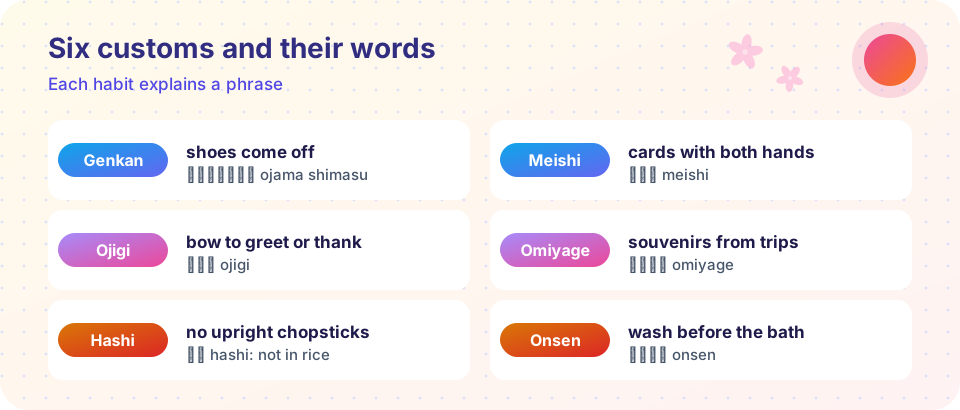
In a Japanese home, outdoor shoes stay at the genkan, a small lowered entrance floor. You step out of your shoes and up into the house, point the shoes toward the door so that you can step back into them easily, and put on slippers if they are offered. Slippers do not go onto tatami (woven straw mats), and many homes have separate slippers for the toilet. The same habit applies to some restaurants, schools and traditional inns.
The phrases attached to this ritual are some of the first ones you should learn:
- ごめんください。 (Gomen kudasai.) Used when calling at someone's door: "Is anyone home?"
- おじゃまします。 (Ojama shimasu.) Said when you enter: "Excuse me for intruding."
- ただいま。 (Tadaima.) "I am home," said by the resident on returning.
- おかえりなさい。 (Okaeri nasai.) "Welcome back," the reply.
When you bring a gift, a common humble phrase is これは つまらない ものですが (Kore wa tsumaranai mono desu ga), literally "This is a trifling thing, but...". It is not a real insult to the gift; it is modesty and a polite way to hand it over. Hand over the gift with both hands.
Greetings, bows and business cards
The bow (おじぎ) is used for hello, goodbye, thanks and apology. A small nod is typical for casual situations and a deeper bow for formal ones and apologies. Visitors are not expected to bow perfectly, and a handshake with a foreigner is common, but a small nod while saying こんにちは is a welcome gesture.
In business, business cards (名刺, めいし, meishi) are exchanged at the first meeting. The usual manner is to give and receive cards with both hands, to read the card for a moment, to place it carefully on the table during the meeting, and not to write on it. When you give yours, say はじめまして and your name, and the usual closing is よろしく おねがいします.
At the table
Meals begin with いただきます (itadakimasu) and end with ごちそうさまでした (gochisousama deshita). Both are said by everyone at the table, including children, and they express thanks to the cook and for the food. A few other table habits:
- Chopsticks (はし, hashi). Do not stand chopsticks upright in a bowl of rice (it resembles an offering at a funeral), and do not pass food directly from chopsticks to chopsticks (it resembles a funeral custom). Do not point with them. Rest them on a holder or across the bowl when you pause.
- Noodles. Slurping noodles is accepted and even considered a sign of enjoyment, because it also cools the noodles and aerates the broth.
- Soup. Lift small bowls of soup and rice to your mouth; you do not need a spoon for miso soup.
- Drinks. At a group dinner, people usually wait until everyone has a glass and say かんぱい (kanpai, "cheers"). It is polite to pour for others, and for others to pour for you.
- Tipping. There is no tipping, as you learned in the previous lesson.
Public places
Public behavior values quiet and consideration, and people expect a calm environment on trains and buses:
- Phones are set to silent ("manner mode", マナーモード) and phone calls are avoided on trains.
- People form orderly lines at platform markings and enter once passengers have exited.
- Litter bins are fewer than in many countries, so people often carry their trash with them. Recycling is sorted into several categories, with local rules.
- On escalators, people stand on one side to let others walk past. In the Tokyo area it is usually the left, and in the Osaka area the right. This is a small example of regional variation.
- Cash is still widely used, although cards and transit cards are common in cities; carrying some cash is wise.
A bath in a hot spring (温泉, onsen) or public bath (銭湯, sentou) has its own rules: you wash and rinse your body thoroughly at the washing station before entering the shared bath, you do not wear a swimsuit in the bath, and you keep the small towel out of the water. Policies about tattoos vary by facility, so check before you go.
Gifts and souvenirs
When people travel, they usually bring back omiyage, small packaged local specialties, for colleagues, family and friends. The custom is called おみやげ (omiyage), and is a normal part of work culture. Gifts are given with two hands and received with thanks, and the receiver often says ありがとうございます, いただきます (Arigatou gozaimasu, itadakimasu) or すみません (Sumimasen), a good example of how すみません also means "thank you."
Seasons and holidays
The calendar organizes many activities, and people comment on the season often in greetings. A few of the main events:
| Event | Japanese | When (approximately) |
|---|---|---|
| New Year | お正月 (おしょうがつ, oshougatsu) | January 1 to 3 |
| Cherry blossom viewing | 花見 (はなみ, hanami) | late March to April, depending on region |
| Golden Week | ゴールデンウィーク | late April to early May |
| Star Festival | 七夕 (たなばた, tanabata) | July 7 |
| Obon, ancestors' return | お盆 (おぼん, obon) | around mid-August |
| Autumn leaves | 紅葉 (こうよう, kouyou) | autumn |
Japan also has a number of fixed-date national holidays, some of which cluster into Golden Week at the end of April and the beginning of May. When a holiday falls on a Sunday, the following Monday is typically a day off. Use the tool below to see on which weekdays the fixed-date holidays fall in 2026.
Regional speech
What you hear in a language classroom is standard Japanese (標準語, hyoujungo, or 共通語, kyoutsuugo), based mainly on the speech of Tokyo. Across Japan, however, people also speak regional dialects (方言, hougen), and the differences can be large. The best-known is Kansai-ben, spoken around Osaka and Kyoto. Common examples: ありがとう can become おおきに (ookini), ほんとう (really) becomes ほんま (honma), and だめ (no good) becomes あかん (akan). The accent, called pitch accent, differs between regions too. Do not worry about dialects as a beginner: standard Japanese is understood everywhere, and dialect speakers easily switch to it with strangers. It does help to know that if somebody says something surprising, it may be a dialect word.
A final note on writing: the text you meet in books and newspapers may run vertically, top to bottom with columns moving from right to left, while most modern text on screens and in textbooks runs horizontally from left to right. Addresses in Japan go from large to small, starting with the prefecture, then the city and the district.
A visit to a friend's home
You (at the door): ごめんください。 (Gomen kudasai.) Hello, is anyone home? Host: はーい、いらっしゃい。 どうぞ あがって ください。 (Haai, irasshai. Douzo agatte kudasai.) Yes, welcome. Please come in. You: おじゃまします。 これは つまらない ものですが。 (Ojama shimasu. Kore wa tsumaranai mono desu ga.) Excuse me for intruding. This is just a small thing. Host: ありがとうございます。 スリッパを どうぞ。 (Arigatou gozaimasu. Surippa o douzo.) Thank you. Here are slippers.
Common misconceptions
"Everyone in Japan behaves exactly the same." Customs vary by region, age, family and workplace. Treat this lesson as the common default and watch what people around you do.
"Foreigners are expected to follow every rule perfectly." Effort matters more than perfection. People are usually helpful and forgiving.
"Slurping is rude everywhere." It is accepted for noodles, though not for everything.
"Honne and tatemae mean Japanese people are insincere." It is a way of describing tact and group harmony; every culture has its own version.
Try it
The first tool shows the weekday of each fixed-date holiday in 2026 and plots how many fall in each month. It is only for the fixed-date holidays (others, such as Coming of Age Day, move with the calendar).
Press Run (or Ctrl + Enter) to see the result here.
Program input · what you'd type while the program runs
Type the answers before you press Run, one per line. Each time the program reads a line (with input()), it gets the next line from this box.
The second tool is a quick "Do or don't?" game on the customs in this lesson.
Check your understanding
Quick check · 5 questions
of 5 answered You scored / 5 · perfect!
-
1. What do you do with your shoes at the genkan?
Outdoor shoes come off at the genkan and slippers may be provided. -
2. When do you say おじゃまします?
It means 'excuse me for intruding' and is said when entering a home. -
3. Which is NOT customary at the table?
Upright chopsticks in rice resemble a funeral offering. -
4. What is Kansai-ben?
Kansai-ben is the dialect of the Kansai region; standard Japanese is understood everywhere. -
5. What is omiyage?
Omiyage are local specialties that travelers bring back for colleagues, family and friends.
Summary
- Shoes come off at the genkan; use ごめんください and おじゃまします when visiting.
- Bow, exchange business cards with both hands, and say いただきます and ごちそうさまでした at meals; there is no tipping.
- Public places are quiet; carry your trash, set phones to silent, and expect orderly lines.
- Bring omiyage from trips; major seasonal events include お正月, 花見, Golden Week and お盆.
- Standard Japanese is understood everywhere; regional dialects like Kansai-ben add variety.
Next: Chapter 8 review
Track your progress
Create a free account to tick off lessons and pick up where you left off on any device.
of Japanese for Beginners lessons completed