


















Lesson 4 of 50 · Getting Started
Chapter 1 review: Getting Started
Review chapter 1 of Japanese for Beginners: the three scripts, verb-last word order, particles, politeness and everyday greetings, with a ten-question quiz.
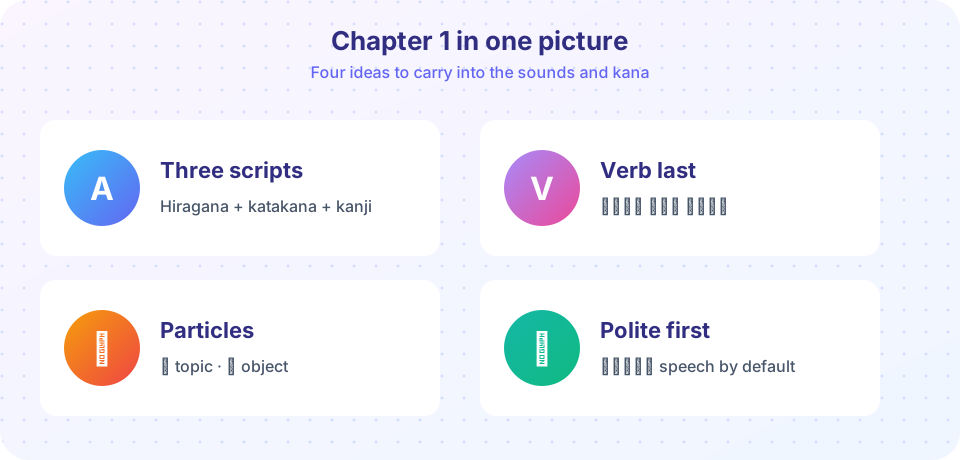
Chapter 1 gave you the big picture of Japanese. You met the course map, learned how the language is built and practiced your first greetings. This review pulls the key ideas into one page, so you can check that nothing is fuzzy before the sounds and kana of chapter 2. If any row of the recap table feels uncertain, follow the link back to that lesson and reread it.
What you will learn
- how to check your understanding of the three scripts and sentence order
- which greetings to use in which situation
- where your gaps are, so you can review them efficiently
Key terms
Script: a writing system. Japanese uses three together.
SOV: subject, object, verb: the verb is last.
Particle: a small word that tags the job of the word before it, such as は (topic) and を (object).
Polite form: the です / ます style, safe with everyone.
さん: a respectful title after another person's name.
The recap table
| Idea | What to remember | Lesson |
|---|---|---|
| Course path | Nine chapters; 20 focused minutes a day; say everything aloud | Course map |
| Scripts | Kanji for meaning, hiragana for grammar, katakana for loanwords | How Japanese works |
| Word order | Subject, object, verb: わたしは パンを たべます | How Japanese works |
| Particles | は marks the topic, を marks the object | How Japanese works |
| Politeness | Use ます and です first; add さん to other people's names | How Japanese works |
| Greetings | Match the time of day; say いただきます before a meal | Greetings and first phrases |
| Pronunciation | Read romaji with Japanese sounds, not English ones | Course map |
Three habits to carry forward
Say it aloud. Every phrase in this course is meant for your mouth as well as your eyes. A phrase you have said ten times out loud will come back to you in a real conversation; a phrase you have only read often will not.
Watch the end of the sentence. Because Japanese puts the verb last, the most important word arrives at the end. When you read or listen, hold the sentence in your head until the verb arrives. This habit will make you a better listener than any trick.
Build on polite speech. Chapter 1 introduced three levels of politeness. Everything in the next three chapters uses the middle one. Learning one level well is better than half-learning three.
Self-check: I can ...
Read each statement and tick it only if you can do it without looking at the lessons. Untick any that are shaky and reread the lesson in the right-hand column of the recap table.
- I can name the three scripts and say what each is used for.
- I can explain why the verb comes last and what particles do.
- I can say "good morning", "hello" and "good evening" at the right time.
- I can thank someone, apologise and get a waiter's attention politely.
- I can introduce myself with はじめまして, my name and どうぞ よろしく おねがいします.
- I can say いただきます and ごちそうさまでした at the right moments.
- I can add さん to someone else's name and know not to add it to my own.
If you ticked six or more, you are ready for chapter 2. If you ticked fewer, spend one more session on the greetings lesson, speaking each phrase aloud, because the next chapters assume that you are comfortable saying short phrases.
Questions beginners often ask
Do I need to learn kanji right now? No. Chapters 2 to 6 use almost no kanji, and chapter 7 introduces them gradually. Many learners add a few kanji at a time once they can read kana comfortably.
Can I keep using romaji? For a few days, yes. After that, switch to kana as quickly as you can, because romaji hides the real sounds and blocks reading practice.
How polite do I need to be? Polite speech (です / ます) is safe with everyone. Casual speech is for close friends and family, and honorific speech for customers and senior people. Learning one level well comes first.
Is Japanese pronounced as it is written? In kana, almost yes: each character is one beat. The few exceptions (は and へ as particles, long vowels, the small っ) are rules you will learn in chapter 2.
Common misconceptions
"I know Japanese greetings, so I can start speaking in sentences." Greetings are memorized units. Sentences need grammar, and the next chapters build exactly that. The good news: you already know the frame, X は Y です, from the introduction in lesson 3.
"Word order is free in Japanese." Only the middle parts move. The verb is fixed at the end.
Try it
The first exercise is a matching game for your three scripts. Tap a character group, then its script. Wrong answers just reset your pick, so you can try as often as you like.
The second exercise reviews the particle idea. The console labels each word of a spaced sentence by its final particle.
Press Run (or Ctrl + Enter) to see the console output here.
No output.
Check your understanding
Quick check · 10 questions
of 10 answered You scored / 10 · perfect!
-
1. Which script usually writes the word コーヒー (coffee)?
Loanwords are normally written in katakana. -
2. Which script carries the core meaning of nouns and verb stems?
Kanji carry meaning. Hiragana mostly writes grammar and endings. -
3. What is the correct order for "I eat bread" in Japanese?
The verb must come last: わたしは パンを たべます. -
4. In わたしは パンを たべます, what does を mark?
を marks the thing being acted on, here パン (bread). は marks the topic, わたし. -
5. Which sentence is safest to say to a stranger?
The polite ます style is safe with everyone. The plain form is casual, and めしあがれ is an honorific used for guests. -
6. How do you politely add a title to Ms. Tanaka's name?
さん follows the name, and it is never used about yourself. -
7. When do you say いただきます?
いただきます is said before eating; ごちそうさまでした after. -
8. Which is true of the last character of こんにちは?
In こんにちは and こんばんは the character は is pronounced wa. -
9. Why can Japanese leave out the subject so often?
Verbs are the same for I, you, he and they, so the listener relies on context, and speakers omit what is obvious. -
10. Which of these is the safest all-purpose apology to a stranger?
すみません is polite and works for strangers; ごめん is casual and おやすみなさい means good night.
Summary
- Three scripts share the work: kanji for meaning, hiragana for grammar, katakana for loanwords.
- The verb closes the sentence and particles tag the other parts.
- Polite ます / です speech and さん after others' names keep you safe.
- Greetings follow the time of day; meal and home phrases are fixed expressions.
- Next, you will learn the sounds and the 46 basic hiragana.
Track your progress
Create a free account to tick off lessons and pick up where you left off on any device.
of Japanese for Beginners lessons completed