


















Lesson 33 of 50 · Past and Te-form
Using the te-form
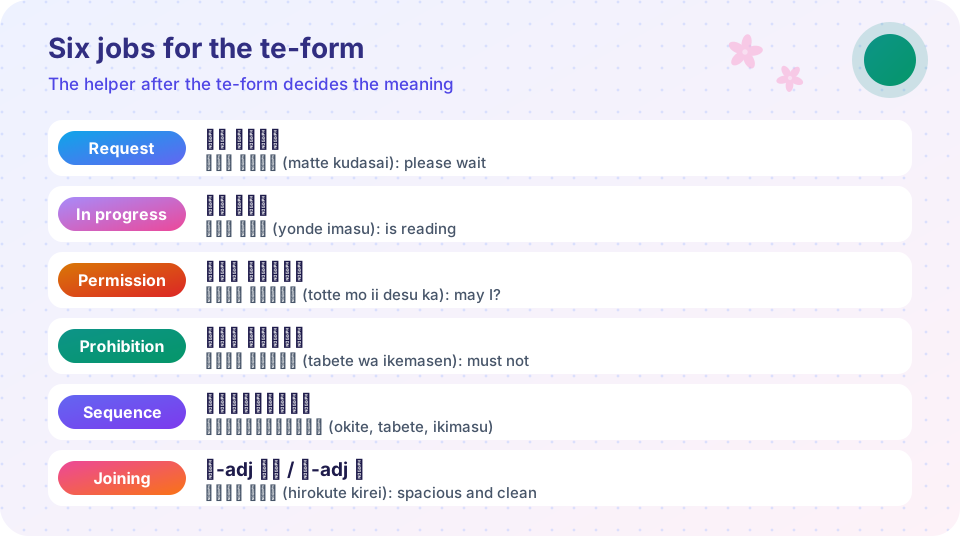
Use the te-form for requests (てください), ongoing actions (ています), permission (てもいいですか), prohibition (てはいけません), sequences and joining adjectives.
In the last lesson you learned to build the te-form. This lesson shows you what to do with it. The te-form is a small piece of grammar with a very wide reach: add ください and you have a polite request, add います and you describe something in progress, add もいいですか and you ask for permission. Chain two or three together and you can tell a story. Six patterns cover most of what a beginner needs.
What you will learn
- Make polite requests with 〜てください.
- Describe actions in progress and resulting states with 〜ています.
- Ask for permission with 〜てもいいですか and prohibit with 〜てはいけません.
- Chain actions with 〜て and 〜てから, and join adjectives and nouns.
Key terms
〜てください (te kudasai): "please do ...", the standard polite request.
〜ています (te imasu): is doing; also a state that resulted from an action.
〜てもいいです (te mo ii desu): "it is fine to ...", used to give or ask permission.
〜てはいけません (te wa ikemasen): "you must not ...".
〜てから (te kara): "after doing ..."
1. Requests: 〜てください
Put ください (kudasai, "please give") after the te-form for a polite request:
- ちょっと まって ください。 (Chotto matte kudasai.) Please wait a moment.
- ゆっくり はなして ください。 (Yukkuri hanashite kudasai.) Please speak slowly.
- ここに なまえを かいて ください。 (Koko ni namae o kaite kudasai.) Please write your name here.
- もういちど いって ください。 (Mou ichido itte kudasai.) Please say it once more.
Add すみません (sumimasen) in front to soften a request, and ちょっと (chotto, "a little") makes it gentler. Alone, the te-form is a casual request among friends: ちょっと まって (Chotto matte), "Wait a sec." If you ask a superior or ask for a service, ください is still fine, but おねがいします (onegai shimasu) with a noun (みずを おねがいします, "Water, please") sounds smoother. Negative requests (please do not) use a different form that you will learn later, but one set phrase is useful now: しんぱいしないで ください (shinpai shinaide kudasai), "Please don't worry."
2. Ongoing actions and states: 〜ています
The te-form plus います (imasu, "to be") tells you that an action is going on:
- いま ほんを よんで います。 (Ima hon o yonde imasu.) I am reading a book now.
- なにを して いますか。 (Nani o shite imasu ka.) What are you doing?
- あめが ふって います。 (Ame ga futte imasu.) It is raining.
The same pattern also expresses habits and, with some verbs, a state that results from an action:
- けっこんして います。 (Kekkon shite imasu.) I am married. (not "I am getting married")
- とうきょうに すんで います。 (Toukyou ni sunde imasu.) I live in Tokyo.
- かさを もって います。 (Kasa o motte imasu.) I have an umbrella (I am holding or carrying one).
- まいにち はしって います。 (Mainichi hashitte imasu.) I run every day.
The past of the pattern is ていました (te imashita): ゆうべ ほんを よんで いました (Yuube hon o yonde imashita), "I was reading a book last night." One verb is a famous exception: しる (to get to know) uses て います for "know" in the positive (しって います, "I know") but the negative is しりません (shirimasen), "I don't know," not しっていません.
3. Permission and prohibition
To ask "May I ...?" use the te-form with も (mo, "even") and いいですか (ii desu ka, "is it okay?"). To say "you must not", use は and いけません (ikemasen, "does not work"):
| Pattern | Example | Romaji | Meaning |
|---|---|---|---|
| 〜てもいいですか | ここで しゃしんを とっても いいですか。 | Koko de shashin o totte mo ii desu ka. | May I take photos here? |
| 〜てもいいです | はい、とっても いいですよ。 | Hai, totte mo ii desu yo. | Yes, you may. |
| 〜てはいけません | ここで たべては いけません。 | Koko de tabete wa ikemasen. | You must not eat here. |
If someone asks for permission and you want to refuse, a soft answer is すみません、ちょっと… (Sumimasen, chotto...), which trails off on purpose, because direct refusals are unusual in polite conversation.
4. Sequences: 〜て、〜て、〜ます
Link actions in order by putting each verb except the last in the te-form. Only the final verb carries the tense and politeness:
- あさ おきて、かおを あらって、あさごはんを たべます。 (Asa okite, kao o aratte, asagohan o tabemasu.) In the morning I get up, wash my face and eat breakfast.
- きのう えいがを みて、ラーメンを たべました。 (Kinou eiga o mite, raamen o tabemashita.) Yesterday I watched a movie and ate ramen.
〜てから (te kara) makes the order explicit, "after doing": ごはんを たべてから、はを みがきます (Gohan o tabete kara, ha o migakimasu), "After eating, I brush my teeth."
5. Joining adjectives and nouns
The te-form idea also works for descriptions. For い-adjectives, change い to くて. For な-adjectives and nouns, use で (de):
- この へやは ひろくて きれいです。 (Kono heya wa hirokute kirei desu.) This room is spacious and clean.
- おおきくて あたらしい へや (ookikute atarashii heya), a big, new room.
- あの みせは しずかで べんりです。 (Ano mise wa shizuka de benri desu.) That shop is quiet and convenient.
- わたしは がくせいで、ともだちは せんせいです。 (Watashi wa gakusei de, tomodachi wa sensei desu.) I am a student and my friend is a teacher.
6. A classroom dialogue
Teacher: ほんの ごページを ひらいて ください。 (Hon no go peeji o hiraite kudasai.) Please open your books to page five. Student: すみません、しゃしんを とっても いいですか。 (Sumimasen, shashin o totte mo ii desu ka.) Excuse me, may I take a photo? Teacher: はい、いいですよ。 でも、しけんの ときは とっては いけません。 (Hai, ii desu yo. Demo, shiken no toki wa totte wa ikemasen.) Yes, that is fine. But you must not take any during the exam.
Common misconceptions
"〜ています always means -ing." For verbs such as けっこんする, すむ and もつ it describes a state: けっこんして います means "I am married."
"The first verb in a chain also takes ました." Only the last verb carries tense. Write ...みて、たべました, never ...みました、たべました when you mean one flowing sentence.
"てください is rude." It is a standard polite request. It only sounds blunt if you drop the softening words and use it to someone much higher in status.
"いいですか means 'is it good?'" In the pattern ても いいですか it means "may I?"
Try it
The first program builds sentences from a list of te-forms and the six patterns, with romaji and English. Add a verb of your own with its te-form (use the previous lesson's conjugator to find it).
Press Run (or Ctrl + Enter) to see the result here.
Program input · what you'd type while the program runs
Type the answers before you press Run, one per line. Each time the program reads a line (with input()), it gets the next line from this box.
The second tool lets you chain three actions into one te-form sentence. Choose an action for each slot and read the result aloud.
Check your understanding
Quick check · 5 questions
of 5 answered You scored / 5 · perfect!
-
1. How do you say 'Please wait'?
te-form plus ください: まって ください (matte kudasai). -
2. What does 'けっこんして います' mean?
With some verbs, 〜ています describes a resulting state, so けっこんして います is 'I am married.' -
3. How do you ask 'May I take a photo here?'
〜ても いいですか asks for permission; 〜ては いけません forbids. -
4. In 'あさ おきて、かおを あらって、たべました', which verb carries the past tense?
Only the last verb in a te-form chain carries tense and politeness. -
5. How do you join 'big' (おおきい) and 'new' (あたらしい) for a room?
い-adjectives change い to くて when joining: おおきくて あたらしい へや.
Summary
- 〜てください asks politely; the bare te-form is casual.
- 〜ています means in progress, habit, or a resulting state (けっこんして います).
- 〜てもいいですか asks permission; 〜てはいけません forbids.
- Chain verbs with the te-form; only the last verb takes the tense. 〜てから means after.
- Join adjectives with くて (い-adjectives) and で (な-adjectives and nouns).
Next: Chapter 6 review
Track your progress
Create a free account to tick off lessons and pick up where you left off on any device.
of Japanese for Beginners lessons completed