


















Lesson 47 of 50 · Projects and Practice
Practice: mixed drills for chapters 5 to 8
Practice Japanese from chapters 5 to 8 with mixed drills on numbers, time, questions, the past tense, the te-form, kanji and conversation, plus answers and a grader.
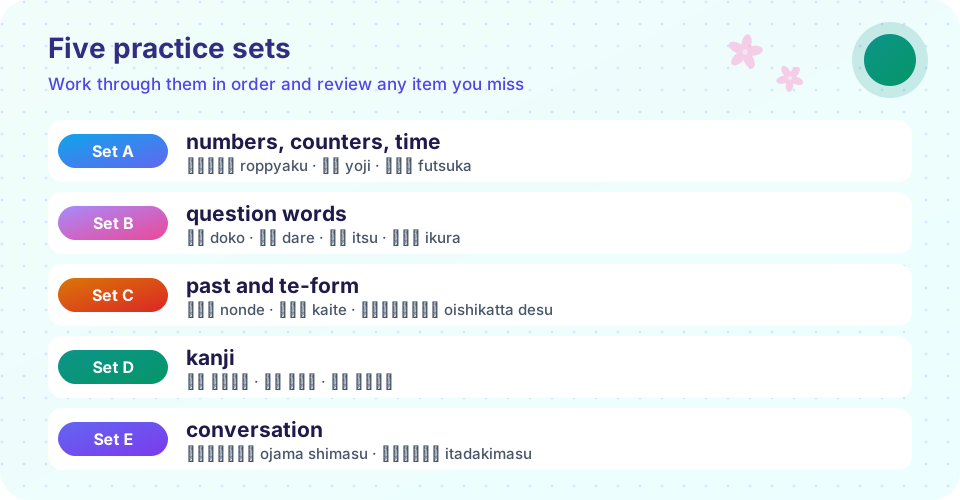
Knowing a rule and using it quickly under pressure are different skills, and practice is what connects them. This lesson gives you five sets of mixed drills drawn from chapters 5 to 8, with an answer key at the end and two interactive tools: a grader you can fill in and a number dictation game. Work through each set on paper first, say the answers aloud, and only then check. A mistake you make here costs nothing, and each one tells you exactly which page to review.
What you will learn
- Retrieve numbers, times and counters quickly.
- Choose question words, forms and tenses without a table.
- Read kanji words and match phrases to situations.
- Diagnose your own errors and decide what to review.
Key terms
Retrieval practice: trying to recall an answer before you look at it, which strengthens memory more than rereading.
Spaced review: coming back to old material at growing intervals.
Error log: a short list of your own mistakes, kept to review.
Dictation (ディクテーション): hearing or seeing something and writing it down.
Self-check: grading your own work against an answer key.
How to use this lesson
Do one set per day. Cover the answers, write your replies, and then check. Do not stop at "right" or "wrong": for each wrong answer write the correct form three times, and note the lesson where it was taught. Keep these notes in an error log. After a week, you will see that the same few items keep appearing, and those are the ones to put on flashcards.
Set A: numbers, counters and time (chapter 5)
Read each item in Japanese (hiragana is fine).
- 300 yen
- 650 yen
- 8,000 yen
- 25,000 yen
- Two people; five long bottles; three sheets of paper
- 4:00; 7:30; 9:10
- The 7th day of the month; the 20th day of the month
- Wednesday
Strategy: for numbers, say the units aloud in order (ten-thousands, thousands, hundreds, tens, ones), and apply the sound changes you memorized (さんびゃく, ろっぴゃく, はっぴゃく, さんぜん, はっせん). For time, apply the triple よじ, しちじ and くじ. For counters, identify the counter first (人, 本, 枚) and then check whether the number triggers a change (1, 3, 6, 8, 10).
Set B: questions (chapter 5)
Choose the right question word for each blank: なに/なん, だれ, どこ, いつ, どれ, いくら, どうして.
- えきは ___ですか。 (Where is the station?)
- あの ひとは ___ですか。 (Who is that person?)
- しけんは ___ですか。 (When is the exam?)
- この かばんは ___ですか。 (How much is this bag?)
- これは ___ですか。 (What is this?)
- ___にほんごを べんきょうしますか。 (Why do you study Japanese?)
- ___が あなたの かばんですか。 (Which one is your bag, of these three?)
Strategy: read the English first, name the slot (place, person, time, price, thing, reason, choice), and then pick the word. Remember なん before です and counters.
Set C: past tense and te-form (chapter 6)
- Put into the polite past: たべます, いきます, します, きます.
- Put into the negative past: のみます, みます.
- Past of い-adjectives: おいしいです, いいです, たのしいです.
- Past of nouns and な-adjectives: がくせいです, しずかです.
- Te-forms: のむ, あそぶ, かく, いく, およぐ, はなす, まつ, かえる, おきる, する, くる.
- Make a request, a permission question and a prohibition with たべて.
- Chain: あさ おきる / シャワーを あびる / がっこうへ いく (past).
Strategy: for te-forms, name the group first. Then apply the ending rule. Do not guess by sound; say the rule in your head ("む, ぶ, ぬ become んで").
Set D: kanji (chapter 7)
- Read: 日本語, 先生, 学校, 出口, 毎日, 電車, 水曜日, 友達, 今日, 大学.
- Write in kanji: やま, かわ, くち, ひと, みず, ほん.
- Read and translate: 駅で友達に会います。 and 毎日 本を読みます。
- Which reading type (on or kun) do you expect in 食べる and in 学生?
Strategy: split a sentence at the hiragana, read each chunk, and apply the rule of thumb (single kanji with okurigana: kun; compound: on).
Set E: conversation (chapter 8)
Say what you would say, in Japanese:
- You enter a friend's home.
- You sit down to eat.
- You finish eating and ask for the bill.
- You want to know where the toilet is.
- You want two tickets (adult, one way) to Tokyo.
- You decline an invitation politely.
Strategy: picture the scene and say the phrase aloud while you do the action, even if it feels silly.
Worked examples
It helps to see how an expert solves one item of each kind. Use the same thinking aloud when you work through the sets.
- A2, 650 yen. Split it into 600 and 50. Six hundred is ろっぴゃく (the ろく shortens and the h becomes p), and fifty is ごじゅう. Put them together, ろっぴゃくごじゅう, and add えん.
- A6, 7:30. Seven o'clock is しちじ (one of the three special hours), and half past is はん. So the answer is しちじはん.
- C5, the te-form of まつ. First the group: it does not end in る, so it is Group 1. The last kana is つ, and つ belongs with う and る, which become って. So the answer is まって.
- C3, the past of いいです. It is an い-adjective with an irregular stem, よ. Replace the stem and add かったです: よかったです.
- B6, "Why do you study Japanese?" The slot is a reason, so the question word is どうして (or なぜ).
- D3, 駅で友達に会います. Split at the hiragana: 駅 (えき), で, 友達 (ともだち), に, 会います (あいます). The meaning is "I meet a friend at the station."
Scoring yourself
When you have checked a set, note your score as a fraction, not just as "good" or "bad." Eighty or ninety percent correct means you can move on, but copy out the items you missed. Below sixty percent, return to the lesson for that chapter, re-read the key terms and redo the set after a day. Repeat the same set a week later; if your score rises, your memory is working. Mistakes in different places each time usually mean ordinary slips. Mistakes that repeat on the same item mean you should make that item a flashcard.
Answer key
| Set | Answers (hiragana with romaji) |
|---|---|
| A1 | さんびゃくえん (sanbyaku en) |
| A2 | ろっぴゃくごじゅうえん (roppyaku gojuu en) |
| A3 | はっせんえん (hassen en) |
| A4 | にまんごせんえん (niman gosen en) |
| A5 | ふたり (futari); ごほん (gohon); さんまい (sanmai) |
| A6 | よじ (yoji); しちじはん (shichiji han); くじ じゅっぷん (kuji juppun) |
| A7 | なのか (nanoka); はつか (hatsuka) |
| A8 | すいようび (suiyoubi) |
| B | どこ, だれ, いつ, いくら, なん, どうして, どれ |
| C1 | たべました, いきました, しました, きました |
| C2 | のみませんでした, みませんでした |
| C3 | おいしかったです, よかったです, たのしかったです |
| C4 | がくせいでした, しずかでした |
| C5 | のんで, あそんで, かいて, いって, およいで, はなして, まって, かえって, おきて, して, きて |
| C6 | たべて ください; たべても いいですか; たべては いけません |
| C7 | あさ おきて、シャワーを あびて、がっこうへ いきました。 (Asa okite, shawaa o abite, gakkou e ikimashita.) |
| D1 | にほんご, せんせい, がっこう, でぐち, まいにち, でんしゃ, すいようび, ともだち, きょう, だいがく |
| D2 | 山, 川, 口, 人, 水, 本 |
| D3 | "I meet a friend at the station." / "I read books every day." |
| D4 | kun (たべる); on (がくせい) |
| E1 | おじゃまします (ojama shimasu) |
| E2 | いただきます (itadakimasu) |
| E3 | ごちそうさまでした。 おかいけいを おねがいします。 |
| E4 | トイレは どこですか。 (Toire wa doko desu ka.) |
| E5 | とうきょうまで おとな ふたり、かたみちを おねがいします。 (Toukyou made otona futari, katamichi o onegai shimasu.) |
| E6 | すみません、ちょっと… (Sumimasen, chotto...) |
Try it
The first tool is a grader. Type your own answers in the my_answers list (they start with a few sample answers, two of them wrong) and run it to see the score and the corrections.
Press Run (or Ctrl + Enter) to see the result here.
Program input · what you'd type while the program runs
Type the answers before you press Run, one per line. Each time the program reads a line (with input()), it gets the next line from this box.
The second tool is a dictation game: it shows a random number from 1 to 99,999 and you type the reading in hiragana.
Check your understanding
Quick check · 5 questions
of 5 answered You scored / 5 · perfect!
-
1. What is the best response to a wrong answer in a drill?
An error log turns each mistake into a review item. -
2. How is 25,000 read?
2 man (にまん) plus 5 sen (ごせん). -
3. What is the te-form of およぐ?
ぐ becomes いで: およいで. -
4. Which question word fits 'これは ___ですか' (What is this?)
なん before です means what. -
5. What do you say when you enter a friend's home?
おじゃまします: excuse me for intruding.
Summary
- Practice with retrieval: answer first, then check.
- Keep an error log and review items that recur.
- Five sets cover numbers and time, questions, past tense and te-form, kanji and conversation.
- Use the grader and the dictation tool for repeat practice.
Next: Glossary
Track your progress
Create a free account to tick off lessons and pick up where you left off on any device.
of Japanese for Beginners lessons completed