


















Lesson 7 of 48 · Earth Materials
What is a mineral?
Learn the five requirements for a mineral, how crystal structure creates shape, what polymorphs and solid solutions are, and the main mineral classes.
In everyday speech "mineral" can mean a vitamin supplement, a drink, or any kind of stone. In geology it has a precise meaning, and that precision is useful. If you know exactly what a mineral is, you know what questions to ask about a sample: what is it made of, how are its atoms arranged, how did it form?
This lesson gives you the definition, shows why crystals have flat faces and fixed angles, and introduces the main families of minerals.
What you will learn
- The five-part definition of a mineral and how to apply it to examples
- How an ordered atomic structure leads to crystal shape and fixed angles
- What polymorphs and solid solutions are
- The seven main classes of minerals, by their chemistry
Key terms
Crystal structure: the repeating three-dimensional pattern of atoms in a mineral. Polymorph: one chemical compound with two or more crystal structures. Solid solution: a mineral whose chemistry varies smoothly between two end members. Mineraloid: a mineral-like substance without ordered atoms, such as opal or obsidian. Native element: a mineral that is a single element, such as gold, copper or sulfur.
The five requirements
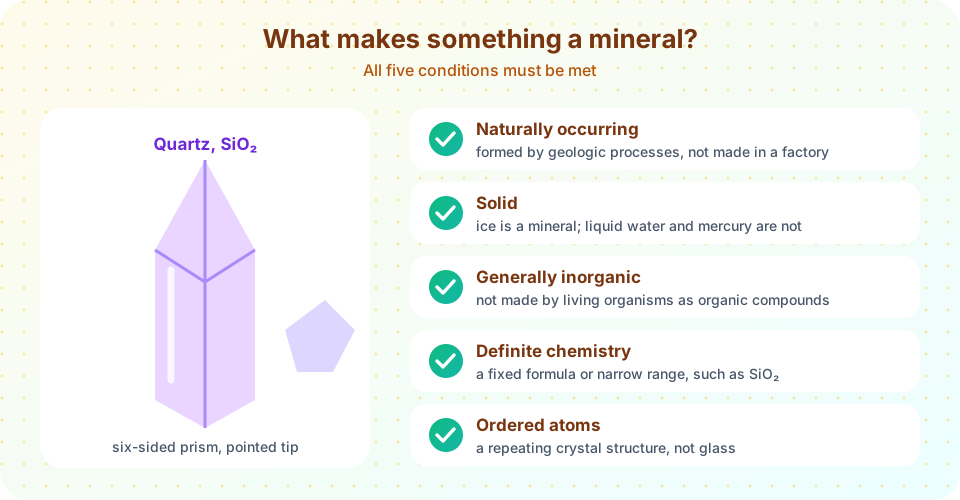
A substance is a mineral only if it meets all five of these criteria.
- Naturally occurring. It forms by geologic processes. Synthetic diamond and laboratory ruby are real crystals but not minerals.
- Solid. At normal Earth surface conditions it is a solid. Ice is a mineral; liquid water is not. (There are a few historical exceptions, such as native mercury, that were already named before the rules were written down.)
- Generally inorganic. It is not made by life as an organic compound. Coal and amber come from plant material and are not minerals. But some organisms build minerals as part of their bodies: the calcite or aragonite of a clam shell, or the apatite of your teeth, are minerals in the geological sense.
- Definite chemical composition. It has a specific formula, or a narrow, predictable range. Quartz is always SiO₂.
- Ordered internal structure. Its atoms form a repeating pattern, a crystal lattice.
The fifth criterion rules out glass. Obsidian is volcanic glass, and opal is a hydrated silica gel with only partial order. They are called mineraloids. They are real natural materials, just not minerals.
Why crystals have flat faces
Imagine stacking oranges in a crate. Because the oranges are all the same size, the stack automatically forms a regular pattern with flat sides. A crystal is like that, except the "oranges" are atoms and ions, and the bonds between them decide how they stack. In halite (table salt, NaCl) sodium and chlorine ions alternate in a cubic grid, so halite crystals are cubes. In quartz, linked SiO₄ units form a spiral that gives six-sided prisms.
The Danish scientist Nicolas Steno noticed in 1669 something remarkable: no matter how big or distorted a quartz crystal is, the angles between its corresponding faces are always the same. A large crystal and a small crystal, a fat one and a thin one, all have 120 degree angles between neighboring prism faces. This is Steno's law of constant interfacial angles. It is direct evidence of an atomic order that no one could see until X-ray diffraction was developed in 1912.
Crystals grow with perfect shapes only when they have room. In a crowded magma the growing grains bump into each other, so most minerals in rocks are irregular grains. The crystal faces are still hidden in the structure, and show up again when you break the mineral along its cleavage planes (next lesson).
Polymorphs and solid solutions
The same chemistry does not guarantee the same mineral. Diamond and graphite are both pure carbon. In diamond each carbon bonds strongly to four others in a three-dimensional network, so diamond is the hardest natural material. In graphite the carbon atoms form flat sheets held together weakly, so graphite is soft and slippery (and is used in pencils). They are polymorphs. Calcite and aragonite are two polymorphs of calcium carbonate, CaCO₃. Calcite is stable at the surface, while aragonite is made by many shell-building animals and by high-pressure rocks.
Going the other way, a mineral's chemistry can vary. In the mineral olivine magnesium and iron ions can substitute for each other, from pure Mg₂SiO₄ to pure Fe₂SiO₄. This smooth range is a solid solution, written (Mg,Fe)₂SiO₄. Plagioclase feldspar varies between calcium and sodium end members in the same way. That is why a mineral has a "narrow range" of composition rather than a single fixed recipe: it still counts as one mineral species.
The main mineral classes
Scientists group minerals by the negatively charged unit, or anion, in the formula. There are more than 6,000 known mineral species, but only a few dozen are common.
| Class | Key anion | Examples |
|---|---|---|
| Silicates | SiO₄ | quartz, feldspar, mica, olivine |
| Carbonates | CO₃ | calcite, dolomite |
| Oxides | O | hematite, magnetite, corundum |
| Sulfides | S | pyrite, galena, sphalerite |
| Sulfates | SO₄ | gypsum, barite |
| Halides | Cl, F | halite, fluorite |
| Native elements | none | gold, copper, sulfur, diamond |
Minerals form in four main ways: crystallizing from magma or lava as it cools, precipitating from water (salt left when seawater evaporates), growing in the solid state during metamorphism, and being built by organisms.
Common misconception: "Anything shiny and pretty is a mineral." A polished plastic bead is not. A mineral must be natural, solid, and have an ordered structure.
Common misconception: "Different color means a different mineral." Quartz comes as clear, purple (amethyst), pink, smoky gray and milky white. Color is often caused by tiny impurities. Chemistry and structure decide the species.
Common misconception: "A big crystal is a different mineral from a small one." Size does not matter. Steno's law holds at every size.
Try it
The first example is a checklist function that applies the five criteria to some candidates. Edit the entries and see how the answer changes.
Press Run (or Ctrl + Enter) to see the result here.
Program input · what you'd type while the program runs
Type the answers before you press Run, one per line. Each time the program reads a line (with input()), it gets the next line from this box.
The second example grows a crystal at random. Each press changes how far each face is from the center, so the crystal changes size and shape, but the angle between neighboring faces never changes. That is Steno's law.
Check your understanding
Quick check · 5 questions
of 5 answered You scored / 5 · perfect!
-
1. Which of these is a mineral?
Natural ice is a solid with a definite composition and ordered atoms. Coal is organic, and obsidian and glass lack ordered atoms. -
2. Diamond and graphite are both pure carbon. They are called
Polymorphs share a chemical formula but have different crystal structures. -
3. What does Steno's law say?
Whatever the size or shape of a crystal, corresponding face angles are constant, because they reflect the atomic structure. -
4. Olivine is (Mg,Fe)2SiO4. Why does it count as a single mineral?
A solid solution is a smooth range of composition within one crystal structure, which is allowed by the definition. -
5. Which mineral class has SiO4 as its key unit?
Silicates are built from silicon-oxygen tetrahedra and are the most abundant class in the crust.
Summary
- A mineral is natural, solid, generally inorganic, with definite chemistry and an ordered atomic structure.
- Steno's law: angles between crystal faces are constant, a clue to atomic order.
- Polymorphs share chemistry but differ in structure (diamond, graphite); solid solutions vary smoothly (olivine).
- Minerals are grouped by anion: silicates, carbonates, oxides, sulfides, sulfates, halides, native elements.
- Mineraloids such as obsidian and opal lack ordered atoms.
Next: Identifying minerals
Track your progress
Create a free account to tick off lessons and pick up where you left off on any device.
of Geology lessons completed