


















Lesson 13 of 48 · Igneous and Metamorphic Processes
Magma and igneous rocks
Learn how magma composition and cooling rate decide igneous rocks: felsic to mafic, textures, Bowen's reaction series, intrusive bodies and a classification chart.
Take a piece of granite and a piece of basalt. Granite is light, speckled and coarsely crystalline. Basalt is dark and so fine-grained that you cannot see individual crystals. Both crystallized from molten rock, so why are they so different? The answer has two parts: what the magma was made of, and how fast it cooled. Those two questions are the whole of igneous petrology, and once you can answer them you can name almost any igneous rock.
What you will learn
- How silica content defines felsic, intermediate and mafic magma
- How cooling rate controls texture (grain size)
- Bowen's reaction series and why minerals crystallize in order
- The shapes of intrusive bodies and how to use the classification chart
Key terms
Felsic: rich in silica, feldspar and quartz; light-colored (granite, rhyolite). Mafic: rich in magnesium and iron; dark (basalt, gabbro). Aphanitic: a fine-grained texture, too small to see, typical of lava. Phaneritic: a coarse-grained texture with visible crystals, typical of plutons. Porphyry: a rock with large crystals set in a fine groundmass.
Composition: how much silica?
Magma is mostly molten silicate, with dissolved gases such as water vapor and carbon dioxide. The single most useful number is the percentage of silica (SiO₂) by mass:
| Type | SiO₂ | Dominant minerals | Rock examples | Typical eruption temperature |
|---|---|---|---|---|
| Ultramafic | below 45% | olivine, pyroxene | peridotite, komatiite | rare today |
| Mafic | 45 to 52% | plagioclase, pyroxene (olivine) | basalt, gabbro | about 1,000 to 1,200 °C |
| Intermediate | 52 to 66% | plagioclase, amphibole | andesite, diorite | about 800 to 1,000 °C |
| Felsic | above 66% | quartz, K-feldspar, mica | rhyolite, granite | about 650 to 800 °C |
The word felsic comes from feldspar and silica, and mafic from magnesium and ferric (iron). Silica matters for a second reason: it controls viscosity, the stickiness of the melt. Silica forms long chains in the liquid, so felsic magma is thick and sticky (like cold honey), while mafic magma is runny. Viscosity decides whether trapped gas can escape quietly or builds up to an explosion, a point we return to in the next lesson.
Mafic magma comes mostly from partial melting of the mantle. Felsic magma mostly comes from melting of continental crust or from the long evolution of a mafic magma, as the next section explains.
Texture: how fast did it cool?
Texture is the size and arrangement of crystals, and it records the cooling history.
- Phaneritic (coarse). Slow cooling deep underground, over thousands to millions of years, gives crystals time to grow to millimeters or centimeters. Examples: granite, diorite, gabbro.
- Aphanitic (fine). Fast cooling at the surface leaves crystals too small to see without a hand lens. Examples: rhyolite, andesite, basalt.
- Porphyritic. A mix: large crystals (phenocrysts) that grew slowly at depth, set in a fine groundmass that cooled quickly after eruption. It records two stages of cooling.
- Glassy. Extremely fast cooling gives no time for atoms to organize, so the result is volcanic glass: obsidian.
- Vesicular. Gas bubbles trapped in the cooling lava leave holes. Scoria (dark, mafic) and pumice (light, felsic, so frothy that it can float) are vesicular.
- Pyroclastic. Fragments blown out in explosive eruptions, such as ash, welded into rock: tuff.
Bowen's reaction series
In the early 1900s the Canadian geologist Norman L. Bowen melted rock mixtures in laboratory furnaces and cooled them slowly. He found that minerals crystallize in a predictable order as a magma cools. The result is Bowen's reaction series:
- The discontinuous branch (different minerals appear in turn): olivine, then pyroxene, then amphibole, then biotite mica. Each earlier mineral reacts with the melt to form the next.
- The continuous branch (one mineral changing smoothly): plagioclase feldspar starts calcium-rich and becomes more sodium-rich as the melt cools.
- At the low-temperature end the two branches merge: potassium feldspar, then muscovite, then quartz last.
Minerals that crystallize first at high temperatures (olivine, calcium-rich plagioclase) are the same minerals that melt first when rock is heated, and they are the least stable at the Earth's surface. Quartz crystallizes last and is the most stable.
The series explains how one magma can produce many rocks, a process called magmatic differentiation. As early dense crystals such as olivine form, they can settle to the bottom of the magma chamber. The remaining liquid becomes richer in silica. Repeat this and a mafic magma slowly evolves toward intermediate and felsic compositions. (Real magmas also mix and assimilate surrounding rock, so the picture is more complicated than the diagram, but the principle holds.)
Intrusive bodies
Magma that cools underground makes intrusive or plutonic bodies, collectively called plutons. Their shapes are described by how they relate to the surrounding rock layers.
- A batholith is a huge body, more than 100 square kilometers at the surface, often made of many pieces of granite. The Sierra Nevada of California is a famous example.
- A stock is a smaller version.
- A dike is a sheet-like body that cuts across the layers.
- A sill is a sheet-like body that squeezes between layers.
Intrusions are younger than the rocks they cut. That simple rule, used in Chapter 6 for relative dating, is among the most powerful in geology.
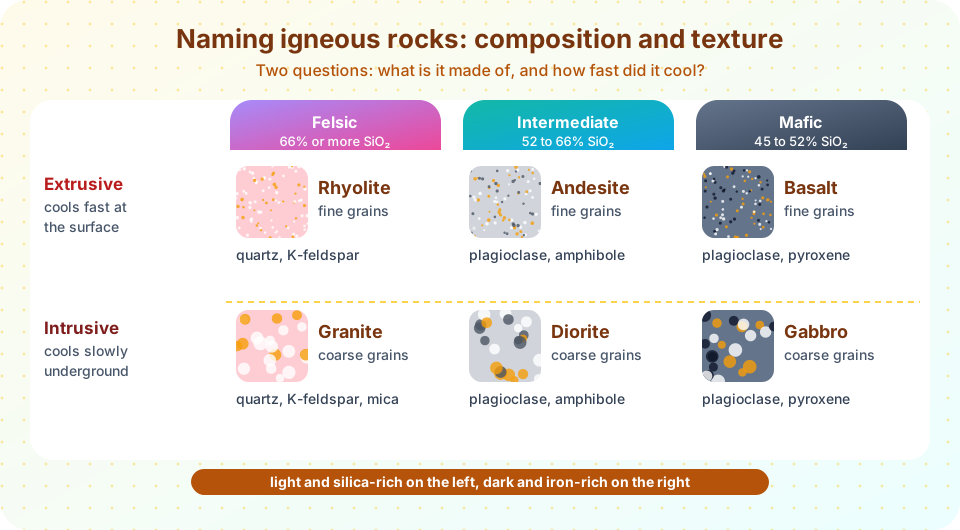
Using the chart
To name an igneous rock, ask two questions:
- Texture? Visible crystals (coarse, intrusive) or not (fine, extrusive)?
- Color or minerals? Light with quartz (felsic), intermediate gray, or dark (mafic)?
A coarse, pink-and-white rock with gray glassy quartz is granite. A fine-grained black rock with tiny holes is basalt (or scoria if very bubbly). A light, frothy, glassy rock that floats is pumice.
Common misconception: "Dark-colored rock means the rock is older or heavier." Color mostly reflects iron and magnesium content (mafic) versus silica and feldspar (felsic). Dark basalt is also denser than light granite, which is partly why oceanic crust sits lower than continental crust.
Common misconception: "Obsidian is a mineral." It is a rock made of glass, with no ordered crystal structure.
Common misconception: "Magma has been molten since Earth formed." Magma forms and solidifies continually; most of it forms from solid rock that partly melted recently.
Try it
The first example is a classifier. It takes a silica percentage and a grain size and returns a rock name from the chart. Add your own samples.
Press Run (or Ctrl + Enter) to see the result here.
Program input · what you'd type while the program runs
Type the answers before you press Run, one per line. Each time the program reads a line (with input()), it gets the next line from this box.
The second example is a demonstration of cooling rate and texture. Drag the slider from "fast" to "slow" and watch the crystals grow larger and fewer. It is an illustration of the idea, not a measured relationship.
Check your understanding
Quick check · 5 questions
of 5 answered You scored / 5 · perfect!
-
1. A rock has large visible crystals of quartz and pink feldspar. It is most likely
Coarse, light-colored crystals of quartz and feldspar point to felsic, slowly cooled granite. -
2. Which property of felsic magma makes it thicker than mafic magma?
Silica forms long chains in the melt, raising viscosity. -
3. In Bowen's reaction series, which mineral crystallizes last?
Quartz crystallizes at the lowest temperature, along with potassium feldspar and muscovite. -
4. A sheet of igneous rock cutting across layers of older rock is a
A dike cuts across layers; a sill lies between them. -
5. A porphyritic texture records
Large crystals grew slowly at depth; the fine groundmass cooled quickly after eruption.
Summary
- Igneous rocks are named by composition (felsic, intermediate, mafic) and texture (coarse or fine).
- Slow cooling gives coarse grains, fast cooling fine grains, very fast cooling glass.
- Bowen's reaction series gives the order of crystallization and explains differentiation.
- Plutons include batholiths, stocks, dikes and sills.
- Granite is felsic and coarse; basalt is mafic and fine.
Next: Volcanoes and eruptions
Track your progress
Create a free account to tick off lessons and pick up where you left off on any device.
of Geology lessons completed