


















Lesson 9 of 48 · Earth Materials
Silicate minerals
Meet the silica tetrahedron and the five ways it links into olivine, pyroxene, amphibole, mica, quartz and feldspar, and why structure controls properties.
If you could only learn one mineral family, it should be the silicates. They make up more than 90% of the crust by volume and nearly all of the mantle. Granite, basalt, sand, clay and most gemstones are silicates. The remarkable thing is how much variety comes from a single building block: a silicon atom surrounded by four oxygen atoms.
Once you understand how those blocks link together, you can predict why mica peels into sheets, why quartz has no cleavage, and why olivine dominates the upper mantle.
What you will learn
- What the silica tetrahedron is and why it carries a charge
- The five structural types, from isolated tetrahedra to frameworks
- How structure explains cleavage and common mineral properties
- The difference between dark (ferromagnesian) and light silicates
Key terms
Silica tetrahedron: a silicon ion bonded to four oxygen ions, the unit SiO₄. Ferromagnesian: a silicate rich in iron and magnesium, usually dark. Feldspar: the most abundant mineral group in the crust, a framework silicate with aluminum, sodium, potassium or calcium. Polymerization: the linking of tetrahedra by shared oxygen.
The silica tetrahedron
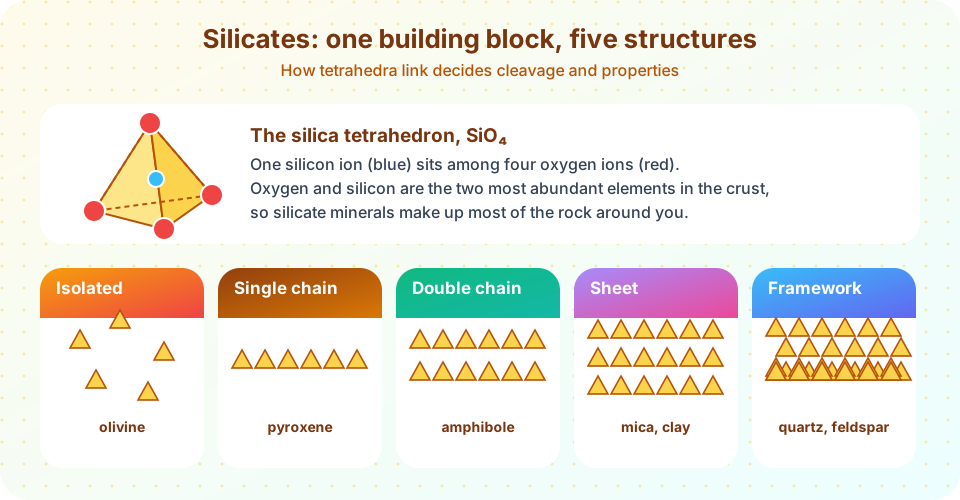
A silicon ion (Si⁴⁺) is small, and four larger oxygen ions (O²⁻) fit snugly around it at the corners of a four-sided pyramid called a tetrahedron. The silicon has a charge of +4, but four oxygens add up to −8, so the isolated unit has a net charge of −4 and is written SiO₄⁴⁻. This leftover charge is the key to everything. The unit needs either positive ions such as Mg²⁺, Fe²⁺, Ca²⁺ or K⁺ to balance it, or it can share oxygen atoms with neighboring tetrahedra. Each shared oxygen lowers the unit's remaining negative charge.
Sharing is the dial that creates the five structures. The more corners are shared, the more oxygen is "used up", and the closer the ratio of oxygen to silicon gets to its minimum of 2:1 (as in quartz).
The five structures
| Structure | Corners shared | O : Si ratio | Examples | Cleavage |
|---|---|---|---|---|
| Isolated | 0 | 4 : 1 | olivine, garnet | none, conchoidal fracture |
| Single chain | 2 | 3 : 1 | pyroxene (augite) | two directions near 90° |
| Double chain | 2 or 3 | 2.75 : 1 | amphibole (hornblende) | two directions near 56° and 124° |
| Sheet | 3 | 2.5 : 1 | micas, clays, chlorite | one perfect direction |
| Framework | 4 | 2 : 1 | quartz, feldspars | none (quartz) or two (feldspar) |
Isolated tetrahedra (olivine) are held together by Mg²⁺ and Fe²⁺ ions rather than by shared oxygen. Olivine is a glassy olive-green mineral and a main component of the upper mantle. Garnet, also with isolated tetrahedra, forms in metamorphic rocks and has dense, many-sided crystals.
Single chains (pyroxenes) share two corners with neighbors to form a long strand. The bonds within the chain are strong and the bonds between chains are weak, so pyroxene cleaves between the chains, giving two cleavages at nearly right angles. Double chains (amphiboles) join two strands side by side, producing a bar shape with cleavage angles of about 56° and 124°. This angle difference (near 90° for pyroxene, 56°/124° for amphibole) is the classic way to tell them apart.
Sheet silicates link three corners to form flat layers. Strong bonds inside the sheet and weak bonds between sheets explain why mica peels into thin, flexible flakes: biotite (black) and muscovite (colorless to silvery). The clay minerals, formed when other silicates weather, are also sheet silicates, which is why clay feels slippery and holds water between its layers.
Frameworks share all four corners in a three-dimensional network. Quartz (SiO₂) is the purest framework: every oxygen is shared by exactly two silicons, so the charges balance with no other ions. Because the bonds are strong and equal in all directions, quartz is hard (7), lacks cleavage and resists weathering. That is why beach sand is mostly quartz: nearly everything else has dissolved away. In the feldspars, some Si⁴⁺ is replaced by Al³⁺ and the leftover charge is balanced by K⁺, Na⁺ or Ca²⁺. Feldspars come in two families: potassium feldspar (orthoclase, microcline) and plagioclase (sodium to calcium). Together feldspars make up roughly half of the crust.
Dark and light silicates
Geologists also sort silicates by chemistry.
- Ferromagnesian minerals contain iron and magnesium: olivine, pyroxene, amphibole and biotite. They are dark (green, brown or black) and relatively dense (3.2 to 3.6 g/cm³).
- Nonferromagnesian minerals lack significant Fe and Mg: quartz, feldspars and muscovite. They are light in color (white, pink, gray, clear) and less dense (2.6 to 2.8 g/cm³).
This simple split gets you a long way when naming igneous rocks in Chapter 3. Granite is rich in the light minerals quartz and feldspar. Basalt and gabbro are rich in dark minerals such as pyroxene and olivine. The mantle, richer in iron and magnesium than the crust, is dominated by dark silicates.
Common misconception: "Silicate means silicone." Silicones are synthetic polymers used in sealants. Silicate minerals are natural crystals of silicon and oxygen.
Common misconception: "Mica and clay are unrelated." Both are sheet silicates. Clays form when feldspars and micas react with water at the surface.
Common misconception: "Quartz and feldspar are just 'white minerals'." Feldspar has two cleavages near 90°, a hardness of 6 and often a pink or salmon tint; quartz has no cleavage, a hardness of 7 and a glassy luster.
Try it
The first example calculates how the oxygen to silicon ratio changes with the number of shared corners. Each shared oxygen counts half for each tetrahedron that shares it.
Press Run (or Ctrl + Enter) to see the result here.
Program input · what you'd type while the program runs
Type the answers before you press Run, one per line. Each time the program reads a line (with input()), it gets the next line from this box.
The second example draws each structure as a pattern of tetrahedra (triangles) and shows its cleavage and examples.
Check your understanding
Quick check · 5 questions
of 5 answered You scored / 5 · perfect!
-
1. What is the net charge of an isolated silica tetrahedron (SiO4)?
Si has +4 and four O have -8 in total, so the unit has a net charge of -4 and must be balanced or share oxygen. -
2. A black mineral has two cleavage directions at about 56 and 124 degrees. It is most likely
Cleavage angles of about 56 and 124 degrees are characteristic of amphibole, which has double chains. -
3. Why does mica split into thin sheets?
Sheet silicates have strongly bonded layers held together weakly, so they cleave in one direction. -
4. Which pair are both framework silicates?
Quartz and feldspars share all four oxygen corners in a three-dimensional framework. -
5. Which group is ferromagnesian (rich in Fe and Mg)?
Olivine, pyroxene, amphibole and biotite contain iron and magnesium and are dark and dense.
Summary
- The silica tetrahedron SiO₄⁴⁻ is the building block of silicates.
- Sharing more corners gives isolated, single-chain, double-chain, sheet and framework structures.
- Structure explains cleavage: none in olivine and quartz, two in pyroxene and amphibole, one in mica.
- Ferromagnesian silicates are dark and dense; quartz, feldspar and muscovite are light.
- Feldspars are about half of the crust; quartz resists weathering.
Next: The rock cycle
Track your progress
Create a free account to tick off lessons and pick up where you left off on any device.
of Geology lessons completed