


















Lesson 10 of 48 · Earth Materials
The rock cycle
Understand the rock cycle: the three rock families, the processes that connect them, the shortcuts, and what drives the cycle over millions of years.
A mountain looks permanent, but its rock is on a long journey. It may have begun as molten rock deep underground, been carried to the surface, worn into sand by rain, buried at the bottom of a sea, cooked and squeezed into a new rock, and eventually melted again. Geologists call this endless recycling the rock cycle.
The rock cycle is not a conveyor belt with a fixed route. It is a map of possibilities. Any rock can become any other, depending on what happens to it. Understanding the map lets you read a rock as a chapter in a longer story.
What you will learn
- The three rock families and how each forms
- The processes that connect them
- Common shortcuts through the cycle
- What powers the cycle
Key terms
Igneous rock: formed by cooling and crystallization of magma or lava. Sedimentary rock: formed from sediment that is compacted and cemented. Metamorphic rock: an existing rock changed by heat, pressure or fluids without melting. Lithification: the conversion of loose sediment into solid rock. Magma: molten rock beneath the surface (lava once it erupts).
The three rock families
Igneous rocks (from the Latin for "fire") form when molten rock cools and crystallizes. If the magma cools slowly deep underground, the crystals have time to grow large: this makes intrusive rocks like granite. If lava erupts and cools quickly at the surface, the crystals stay tiny or do not form at all: this makes extrusive rocks like basalt and obsidian.
Sedimentary rocks form at or near the surface from sediment: fragments of older rocks (sand, mud, gravel), dissolved minerals, or the remains of organisms. Water, wind and ice carry sediment and deposit it in layers. Burial then compacts the layers and minerals precipitating between the grains cement them into solid rock. Sandstone, shale and limestone are common examples. These rocks often preserve fossils and layering, so they hold much of the record of Earth history.
Metamorphic rocks are old rocks changed by heat, pressure or hot fluids, but they never completely melt. Minerals recrystallize and often realign in layers. Shale can turn into slate, then schist; limestone becomes marble; sandstone becomes quartzite. If the temperature rises so far that the rock melts, it leaves the metamorphic realm and becomes magma.
| Family | How it forms | Key textures | Examples |
|---|---|---|---|
| Igneous | Cooling of magma or lava | interlocking crystals or glass | granite, basalt, obsidian |
| Sedimentary | Deposition, compaction, cementation | grains, layers, fossils | sandstone, shale, limestone |
| Metamorphic | Heat and pressure, solid state | banding, foliation, recrystallized grains | slate, schist, gneiss, marble |
The processes that link them
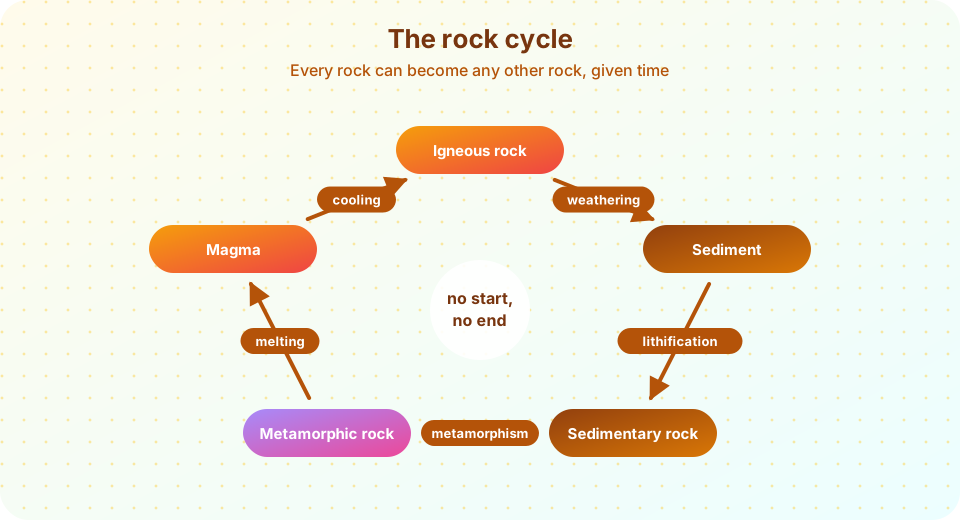
Follow the loop in the picture.
- Cooling and crystallization turns magma into igneous rock.
- Weathering and erosion break any exposed rock into sediment, and transportation and deposition move it and lay it down.
- Burial and lithification (compaction and cementation) turn sediment into sedimentary rock.
- Metamorphism, caused by deep burial, mountain building or nearby magma, changes any rock into metamorphic rock.
- Melting of deeply buried or subducted rock produces magma, closing the loop.
The real cycle has many shortcuts, shown by arrows that skip steps. An igneous rock can be uplifted, eroded and become sediment without metamorphism. A metamorphic rock can be exposed and weathered into sediment. A sedimentary rock can be metamorphosed or be eroded again into new sediment, a process called recycling. An igneous rock can even be metamorphosed into a new rock without ever visiting the surface. Granite might be turned into gneiss, then weathered into sediment, then buried as sandstone, then heated into quartzite.
What powers the cycle?
Two energy sources run the two halves of the cycle. The Sun, through the water cycle, drives weathering, erosion and deposition at the surface. Earth's internal heat, through plate tectonics, drives melting, uplift, burial and metamorphism. Plate tectonics is the link: it creates mountains that expose rocks to weathering, buries sediments in basins, and drags rocks down to melting at subduction zones.
The cycle runs on many time scales. A volcanic eruption can make igneous rock in days. Sand can be cemented into sandstone over millions of years. A complete circuit of one rock might take hundreds of millions of years. Many individual atoms have been through the loop several times in the 4.5 billion year history of Earth.
A note on proportions
By surface area, sedimentary rocks cover roughly three quarters of the continents, because the surface is where sediment accumulates. By volume, however, they form only a thin veneer: the bulk of the crust is igneous and metamorphic rock. The most widespread rock under your feet might be shale or sandstone, but the vast majority of the crust below is granite-like or basalt-like crystalline rock.
James Hutton, whom you met in lesson 2, saw in the 1780s that rocks at Siccar Point in Scotland tell a story of one cycle of deposition, tilting and erosion, and then another: layers of tilted older sediment overlaid by flat younger layers. He concluded the Earth works in cycles, without "vestige of a beginning". The rock cycle is the same idea as a diagram.
Common misconception: "The rock cycle goes in one fixed order." Rocks can take many routes and skip steps. Not every rock goes through every stage.
Common misconception: "Metamorphic rocks are melted rocks." They are changed in the solid state. When rock melts, it becomes magma and a new igneous rock when it cools.
Common misconception: "Rocks are permanent." Rocks last long on a human scale but are all transient on a geologic one.
Try it
The first example is a toy model: a random walk through the rock cycle. The probabilities are invented for illustration, not measured. Run it a few times with different seeds to see how a rock spends its time.
Press Run (or Ctrl + Enter) to see the result here.
Program input · what you'd type while the program runs
Type the answers before you press Run, one per line. Each time the program reads a line (with input()), it gets the next line from this box.
The second example lets you steer a rock yourself. At each step choose a process that is possible for the current rock type and watch its journey.
Check your understanding
Quick check · 4 questions
of 4 answered You scored / 4 · perfect!
-
1. Which process turns loose sediment into solid sedimentary rock?
Lithification is compaction and cementation of sediment into rock. -
2. Which is true of metamorphic rocks?
Metamorphism changes rocks without melting. If melting occurs, the result is magma and then igneous rock. -
3. A granite is uplifted, weathered to sand, buried and cemented. The final rock is
Granite turned into sediment and then lithified is a sedimentary rock such as sandstone. -
4. What drives the surface half of the rock cycle?
Solar energy drives weathering, erosion and deposition. Internal heat drives melting, uplift and metamorphism.
Summary
- Igneous, sedimentary and metamorphic rocks are linked by processes: cooling, weathering and erosion, lithification, metamorphism and melting.
- There is no fixed order: many shortcuts exist, and any rock can become any other.
- The Sun powers surface processes; internal heat and plate tectonics power the deep ones.
- Sedimentary rocks cover most land surface but are a thin layer by volume.
Next: Chapter 2 review
Track your progress
Create a free account to tick off lessons and pick up where you left off on any device.
of Geology lessons completed