


















Lesson 21 of 48 · Sedimentary Environments
Chapter 4 review: Sedimentary environments
Review weathering, erosion, clastic and chemical sedimentary rocks, lithification and depositional environments with a recap table and a ten-question quiz.
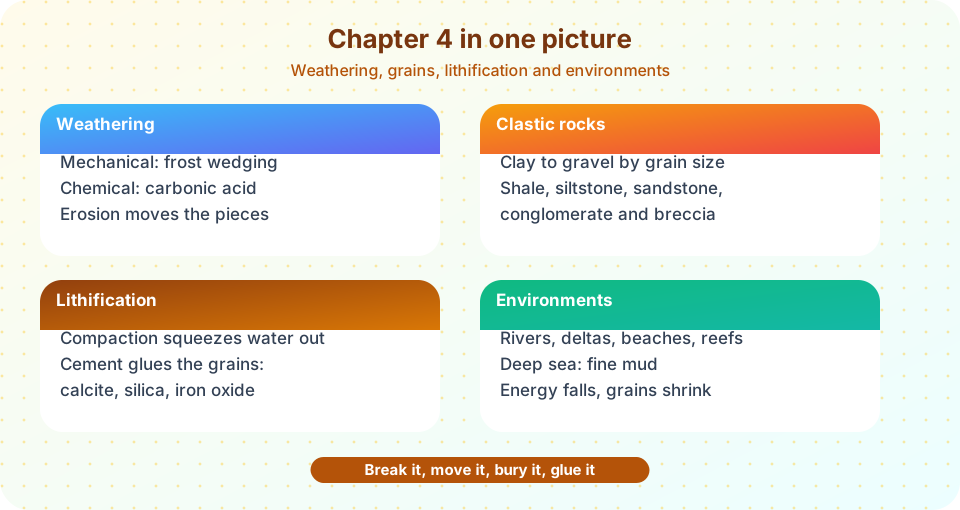
Chapter 4 followed sediment from the mountain to the sea: how rock breaks down, how pieces are carried and sorted, how loose sand and mud become rock, and how each place where sediment settles leaves its own signature. This lesson collects the key ideas and tests them.
What you will learn
- The main facts and numbers from the chapter
- How to connect weathering, grain size and environment
- Where to focus your revision
The chapter at a glance
| Topic | Main idea | Facts to know |
|---|---|---|
| Weathering | Mechanical breaks; chemical changes minerals | Frost wedging (ice expands about 9%); carbonic acid dissolves calcite; feldspar to clay |
| Rates | Surface area, climate, mineral stability | Quartz is the most resistant; olivine weathers fastest |
| Soil | Climate, organisms, relief, parent material, time | Horizons O, A, B, C, bedrock |
| Clastic rocks | Named by grain size | Shale, siltstone, sandstone, conglomerate or breccia |
| Other groups | Chemical and biochemical | Evaporites, limestone, chert, coal |
| Lithification | Compaction then cementation | Cements: calcite, silica, iron oxide |
| Environments | Energy falls from land to sea | Fining up (river), coarsening up (delta), graded (turbidite) |
| Walther's law | Vertical facies mirror lateral environments | Transgression and regression |
How the lessons connect
Each stage leaves information in the next. Chemical weathering decides which minerals survive: durable quartz becomes sand, feldspar becomes clay. Transport sorts and rounds grains, so a well-sorted, rounded, quartz-rich sandstone points to a long journey. Deposition in a particular environment adds structures: cross-bedding for dunes and rivers, ripple marks for waves, graded beds for deep-sea avalanches. Burial and cementation lock it all in place. Walther's law turns a column of rock into a record of how the shoreline moved.
To revise, take any sedimentary rock and tell its story in reverse. "This is a cross-bedded, well-sorted quartz sandstone. The quartz means a mature sediment, the sorting and cross-bedding mean a steady current, so it may be an ancient dune field or beach." Practicing this reasoning is more valuable than memorizing a list.
Exam tip. Describe in three steps: grains (size, sorting, rounding), composition (quartz, feldspar, calcite), and structures (bedding, cross-bedding, fossils). Then name the rock, then the environment.
Common misconceptions
Weathering and erosion are the same (they are not). Sandstone is melted sand (it is cemented, not melted). Limestone and marble are identical (marble is metamorphosed limestone). A rock type belongs to just one environment (use several clues). All sedimentary rocks have fossils (many do not).
Try it
The first example is a practice tool: it names a clastic rock from the dominant grain size and rounding, and it computes porosity at a burial depth. Edit the inputs.
Press Run (or Ctrl + Enter) to see the result here.
Program input · what you'd type while the program runs
Type the answers before you press Run, one per line. Each time the program reads a line (with input()), it gets the next line from this box.
The second example is a flash-card deck for the chapter.
Check your understanding
Quick check · 10 questions
of 10 answered You scored / 10 · perfect!
-
1. Which is an example of mechanical weathering?
Frost wedging physically splits rock; the others are chemical reactions. -
2. Which mineral is the most resistant to chemical weathering?
Quartz is stable at the surface, which is why it dominates sand. -
3. Mud, sand and boulders mixed together without sorting suggest
Ice deposits poorly sorted material. -
4. Which rock forms from rounded gravel cemented together?
Conglomerate has rounded clasts; breccia has angular ones. -
5. Compaction mostly affects
Fresh mud is very watery, and flat clay flakes rotate into parallel layers as water is squeezed out. -
6. A coarsening-upward sequence is characteristic of
As a delta builds seaward, coarse sand overlies finer mud. -
7. A graded bed is coarse at the bottom and fine at the top. It is typical of
The turbidity current drops its coarse load first as it slows. -
8. Which soil horizon is the topsoil rich in humus?
The A horizon is the dark, organic-rich topsoil. -
9. Chemical sedimentary rocks such as rock salt form by
Dissolved minerals precipitate when water evaporates or becomes supersaturated. -
10. In a vertical section, beach sand overlain by shallow shelf sand and then deep marine mud records
Deeper-water facies stacked above shallower ones show that the sea level rose.
Summary
- Weathering (mechanical and chemical) makes sediment; erosion moves it; deposition happens when energy falls.
- Clastic rocks are named by grain size; sorting and rounding record transport history.
- Compaction and cementation lithify sediment.
- Environments leave signatures; Walther's law turns vertical sequences into lateral maps.
- Chapter 5 turns to what happens when these layers are bent and broken.
Track your progress
Create a free account to tick off lessons and pick up where you left off on any device.
of Geology lessons completed