


















Lesson 47 of 48 · Projects and Practice
Cheat sheet: the one-page geology recap
A one-page geology recap for structures, time, resources, hazards and maps: formulas with units, key numbers to remember and quick sanity checks.
A cheat sheet is not a substitute for understanding; it is a tool for recalling what you already understand. This page collects the formulas, key numbers and rules from the second half of the course in one place, together with the units and the most common traps. Print the picture, keep it beside your notes, and use the tables to decide which tool to reach for.
Beside each formula you will find when to use it and what to check. The aim is that, faced with a new problem, you can quickly say what kind of problem it is.
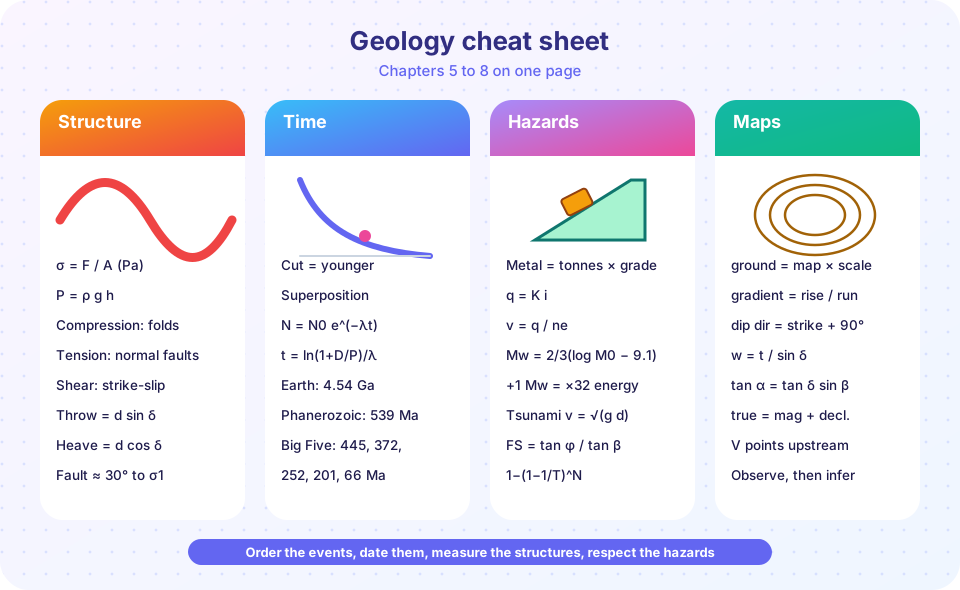
What you will learn
- A single reference for the formulas of Chapters 5 to 8.
- The key numbers worth memorizing.
- How to recognize which formula fits which problem.
- Quick sanity checks that catch most mistakes.
Structure
| Idea | Formula or rule | Units and notes |
|---|---|---|
| Stress | σ = F / A |
Pa (N/m²); rocks use MPa |
| Pressure at depth | P = ρ g h |
About 26 MPa per km; depth in meters |
| Strain | ε = ΔL / L0 |
No units; negative for shortening |
| Stress on a plane | σn = (σ1+σ3)/2 + (σ1−σ3)/2 cos 2θ, τ = (σ1−σ3)/2 sin 2θ |
θ is from σ1 to the plane's normal |
| Fault angle | Fault forms 45° − φ/2 from σ1 |
φ = arctan μ; μ about 0.6 to 0.85 |
| Shortening | (L0 − L) / L0 |
Percent if multiplied by 100 |
| Throw and heave | d sin δ, d cos δ |
d is net slip; δ is fault dip |
| Fault types | Normal: hanging wall down; reverse: up; strike-slip: sideways | Tension, compression, shear |
| Fold rule | Anticline: oldest in core; syncline: youngest in core | Only if layers are the right way up |
The picture to hold in mind is stress in, structure out. Compression shortens and builds folds and reverse faults. Tension lengthens and builds normal faults. Shear skews and builds strike-slip faults. Heat and slow loading make rock flow; cold and fast loading make it break.
Time
| Idea | Formula or rule | Units and notes |
|---|---|---|
| Relative dating | Superposition, cross-cutting, inclusions, faunal succession | The cut or the included fragment gives the order |
| Unconformities | Angular, disconformity, nonconformity | Each marks missing time; gap = lower age − upper age |
| Decay law | N = N0 e^(−λt) |
λ = ln 2 / T½; after n half-lives 1/2ⁿ left |
| Age equation | t = (1/λ) ln(1 + D/P) |
Same unit for t and 1/λ |
| Isochron | Slope = e^(λt) − 1 |
Intercept is the initial ratio |
| Radiocarbon | t = (T½ / ln 2) ln(N0/N) |
Up to about 50,000 years |
| Time scale | Four eons; Phanerozoic = Paleozoic, Mesozoic, Cenozoic | Earth: 4.54 Ga; Phanerozoic began 539 Ma |
| Big Five | 445, 372, 252, 201, 66 Ma | End-Permian is the worst |
Pick the clock to fit the rock and the age. Uranium-lead in zircon suits igneous rocks from millions to billions of years. Carbon-14 suits organic material under about 50,000 years. Sedimentary rocks are dated by bracketing between ash beds, not directly.
Resources and hazards
| Idea | Formula or rule | Units and notes |
|---|---|---|
| Contained metal | tonnage × grade |
Convert percent to a fraction first |
| Cut-off grade | cost / (recovery × price) |
Rises with costs, falls with price |
| Darcy's law | q = K i, i = Δh / L |
K in m/s; seepage v = q / n_e |
| Petroleum system | Source, maturation, migration, reservoir, seal; timing | Oil window about 60 to 120 °C |
| S-P distance | d = Δt vP vS / (vP − vS) |
About 8.4 km per second of delay in crust |
| Moment magnitude | M0 = μ A D; Mw = (2/3)(log M0 − 9.1) |
M0 in N·m; log base 10 |
| Energy and magnitude | One unit is about 32 times energy | 10 times amplitude |
| Tsunami speed | v = √(g d) |
About 198 m/s at 4,000 m |
| Slope stability | FS = tan φ / tan β (dry cohesionless) |
Saturation roughly halves it |
| Flood probability | P = 1/T; 1 − (1 − 1/T)^N |
100-year flood in 30 years: about 26 percent |
| Risk | hazard × exposure × vulnerability | Same hazard, different risk |
Maps and field methods
| Idea | Formula or rule | Units and notes |
|---|---|---|
| Scale | ground = map distance × denominator | 1:24,000 means 1 cm = 240 m |
| Contours | Close = steep; V's point upstream; never cross | Interval constant on a map |
| Slope from contours | tan θ = interval / (spacing × denominator) |
Convert mm to m |
| Gradient | rise / run | 100 percent = 45° |
| Vertical exaggeration | VE = H denominator / V denominator |
Label it on every profile |
| Strike and dip | Dip direction = strike + 90° (right-hand rule) | Write 045/30 SE |
| Outcrop width | w = t / sin δ, t = w sin δ |
Flat ground, measured across strike |
| Apparent dip | tan α = tan δ sin β |
Never exceeds the true dip |
| Declination | true = magnetic + declination (east positive) | Check the date and place |
Numbers worth remembering
| Quantity | Value |
|---|---|
| Rock density (crust) | about 2,700 kg/m³ |
| Pressure gradient | about 26 MPa per km |
| Geothermal gradient | about 25 to 30 °C per km |
| P and S wave speeds in crust | about 6 and 3.5 km/s |
| Shear modulus of crust | about 3 × 10¹⁰ Pa |
| Friction coefficient | about 0.6 to 0.85 |
| Angle of repose of sand | about 30° to 35° |
| Hydraulic conductivity | gravel 10⁻², sand 10⁻⁴, silt 10⁻⁷, clay 10⁻¹⁰ m/s |
| Half-lives | U-238 4.47 Ga, K-40 1.25 Ga, C-14 5,730 yr |
Sanity checks
- Dips are between 0° and 90°; magnitudes of earthquakes rarely exceed 9.5.
- Units: convert to SI before you multiply; check that the answer has the unit you expect.
- Directions: strike and dip direction differ by 90°; the apparent dip is at most the true dip.
- Orders of magnitude: groundwater moves meters per day at most in sand, not meters per second.
- Relative before absolute: make sure your numeric ages respect the order of the layers.
- Observation before interpretation: if you cannot point to the evidence, it is an interpretation.
Try it
Press Run (or Ctrl + Enter) to see the result here.
Program input · what you'd type while the program runs
Type the answers before you press Run, one per line. Each time the program reads a line (with input()), it gets the next line from this box.
Press Run (or Ctrl + Enter) to see the console output here.
No output.
Check your understanding
Quick check · 5 questions
of 5 answered You scored / 5 · perfect!
-
1. Which formula gives the horizontal extension of a normal fault?
Heave is the horizontal component of net slip. -
2. Which clock would you choose for a 4,000-year-old wooden object?
Carbon-14 suits organic material younger than about 50,000 years. -
3. A 100-year flood has a chance of about what over 30 years?
1 − 0.99³⁰ ≈ 0.26. -
4. Which statement about apparent dip is correct?
tan α = tan δ sin β, and sin β is at most 1. -
5. True azimuth with a magnetic reading of 100° and a 7° east declination is:
True = magnetic + east declination = 107°.
Summary
- The tables list every formula of Chapters 5 to 8 with units and notes.
- Stress in, structure out; order first, numbers second; concentration makes resources, release makes hazards; maps are models and outcrops are evidence.
- Key numbers: 26 MPa per km, 6 and 3.5 km/s, 4.54 Ga, 539 Ma, 32 times energy per magnitude.
- Use sanity checks on units, ranges and orders of magnitude.
Next: Further study
Track your progress
Create a free account to tick off lessons and pick up where you left off on any device.
of Geology lessons completed