


















Lesson 6 of 48 · Earth Materials
Chapter 2 overview: Earth materials
Chapter 2 overview: how atoms form minerals, how minerals form rocks, and what you will learn about identifying minerals and the rock cycle.
Everything a geologist studies is made of something. Mountains, beaches, volcanoes and the ocean floor are all built from a surprisingly small set of ingredients: a few dozen common minerals, combined into a few families of rocks. Learn the ingredients and the way they combine, and the rest of the subject becomes much easier.
This chapter is about those ingredients. It starts with atoms and ends with the rock cycle, the idea that every rock is a temporary form of Earth's material.
What you will learn
- The big picture of Chapter 2 and how its five lessons connect
- Which elements make up Earth's crust, and why that matters
- The difference between a mineral and a rock
Atoms become minerals
Minerals become rocks
Rocks never stay rocks
Key terms
Element: a substance made of one kind of atom (oxygen, silicon). Mineral: a natural, solid, inorganic crystal with a definite chemistry. Rock: a natural solid made of mineral grains or other solid material. Rock cycle: the set of processes that turn each rock type into others.
The big picture
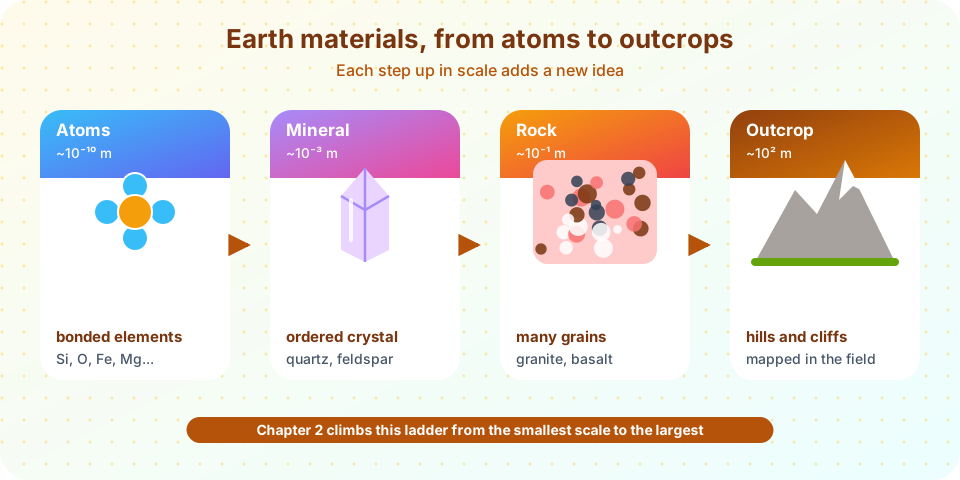
Imagine zooming in on a granite countertop. At arm's length it is a speckled stone. With a hand lens you see separate grains: glassy gray quartz, pink or white feldspar, and flakes of black mica. Each grain is a mineral, and each mineral is an ordered arrangement of atoms. The whole slab is a rock, a collection of those grains locked together.
That progression from atoms to minerals to rocks to landscapes is the spine of this chapter. At each level new questions arise. At the atomic level: which elements are common and how do they bond? At the mineral level: how can you tell quartz from calcite on a hillside with no laboratory? At the rock level: how did these grains come together, and what will happen to them next?
Which elements make up the crust?
Only eight elements make up about 98% of the crust by mass: oxygen, silicon, aluminum, iron, calcium, sodium, potassium and magnesium. Oxygen alone is almost half of the crust by mass, and by volume it is even more dominant because oxygen ions are large. Silicon is the next most common. Since silicon and oxygen bond together strongly, the silicate minerals (those built around silicon and oxygen) make up more than 90% of the crust by volume. That is why Lesson 4 of this chapter focuses on them.
Lessons in this chapter
- What is a mineral?: the five requirements, crystal structure, and why ice counts but a liquid does not.
- Identifying minerals: luster, color, streak, hardness, cleavage and the Mohs scale, as a field kit.
- Silicate minerals: the silica tetrahedron, the major mineral groups and how structure controls properties.
- The rock cycle: the three rock families and how each can become another.
- Chapter 2 review: a recap and a ten-question quiz.
Common misconceptions
"Rock" and "mineral" mean the same thing. They do not. Quartz is a mineral; sandstone is a rock made mostly of quartz grains. A rock can contain one mineral (limestone is mostly calcite) or many (granite).
"Gems and crystals are rare special things." Every mineral is a crystal structure. A gem is just a mineral of unusual beauty and rarity, such as ruby, which is the mineral corundum with a trace of chromium.
Try it
The first example charts the elements in the crust. It uses approximate percentages by mass.
Press Run (or Ctrl + Enter) to see the result here.
Program input · what you'd type while the program runs
Type the answers before you press Run, one per line. Each time the program reads a line (with input()), it gets the next line from this box.
The second example is a quick sorting game. Decide whether each item is a mineral, a rock, or neither, then check.
Check your understanding
Quick check · 4 questions
of 4 answered You scored / 4 · perfect!
-
1. Which two elements together make up about three quarters of the crust by mass?
Oxygen (about 46.6%) and silicon (about 27.7%) add up to roughly 74%. -
2. Which is a rock rather than a single mineral?
Granite is a mixture of grains of several minerals. The other three are minerals. -
3. Why do silicate minerals dominate the crust?
Abundant oxygen and silicon form very stable SiO4 units that build most minerals. -
4. Ruby is best described as
Ruby is a variety of corundum, an aluminum oxide mineral, colored red by chromium.
Summary
- Crust: oxygen, silicon, aluminum, iron, calcium, sodium, potassium and magnesium dominate.
- Atoms make minerals; minerals make rocks; rocks form landscapes.
- Silicate minerals are over 90% of the crust by volume.
- This chapter covers minerals, identification, silicates and the rock cycle.
Next: What is a mineral?
Track your progress
Create a free account to tick off lessons and pick up where you left off on any device.
of Geology lessons completed