


















Lesson 29 of 48 · Geologic Time and Fossils
Radiometric dating: clocks in rock
Learn how radioactive decay becomes a clock, how to calculate an age from a parent-daughter ratio, and how scientists found Earth is 4.54 billion years old.
Some atoms are unstable. Over time they change into other atoms at a rate that does not depend on temperature, pressure or chemistry. That steady rate is what makes them a clock. If a mineral crystallized with a known amount of an unstable parent isotope and none of its stable daughter, then the ratio of daughter to parent tells you how long the clock has been running.
Radiometric dating is how we know that the oldest rocks are billions of years old, that the Cambrian began about 539 million years ago and that the dinosaurs died out 66 million years ago. It is also a good example of a measurement built on a simple equation and careful reasoning about what can go wrong.
What you will learn
- The decay law and the meaning of half-life and decay constant.
- How to compute an age from a daughter-to-parent ratio.
- Which isotope systems date which rocks, and why closure matters.
- How the age of Earth was established.
Key terms
Isotopes are atoms of the same element with different numbers of neutrons, such as carbon-12 and carbon-14.
Half-life (T½) is the time for half of a sample of a radioactive isotope to decay.
Decay constant (λ) is the probability per unit time that a given atom decays. λ = ln 2 / T½.
Parent and daughter are the original isotope and the isotope it turns into.
Closure temperature is the temperature below which a mineral keeps its daughter atoms, so the clock starts.
The decay law
Individual atoms decay at random, but large numbers of them follow a smooth curve. If N0 parent atoms exist at the start, the number left after time t is
N = N0 · e^(−λ t) with λ = ln 2 / T½
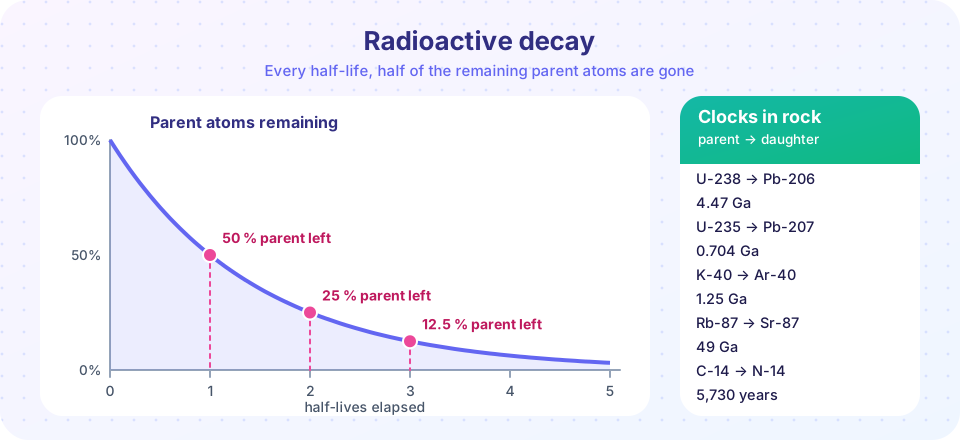
After one half-life, N = N0/2; after two, N0/4; after three, N0/8. Every parent atom that disappears becomes a daughter atom, so the daughter count is D = N0 − N. In a mineral that began with no daughter, D = N0 − N and P = N (the parent still left), so
D / P = e^(λ t) − 1 which gives t = (1/λ) · ln(1 + D/P)
That is the age equation. Measure D and P with a mass spectrometer, look up the half-life, and you can find t.
A worked example
A zircon crystal contains uranium-238 and its decay product lead-206 in a ratio D/P = 0.25. The half-life of uranium-238 is 4.468 billion years. Then
λ = ln 2 / 4.468 Ga = 0.1551 per Ga
t = ln(1.25) / 0.1551 = 0.2231 / 0.1551 ≈ 1.44 Ga
The crystal is about 1.44 billion years old. Check it against the half-life: if the ratio were 1.0, exactly one half-life would have passed (4.468 Ga). A ratio of 0.25 is much smaller, so the age is much less. The answer is sensible.
Choosing a clock
Different isotope systems suit different ages and rocks:
| System | Half-life | Useful for |
|---|---|---|
| Uranium-238 to lead-206 | 4.468 billion years | Zircon and other minerals in igneous and metamorphic rocks, from millions to billions of years |
| Uranium-235 to lead-207 | 0.704 billion years | Used with U-238 to cross-check ages ("concordia") |
| Potassium-40 to argon-40 | 1.25 billion years | Volcanic rocks and minerals such as mica and feldspar, young to very old |
| Rubidium-87 to strontium-87 | about 49 billion years | Very old rocks and meteorites, usually with isochrons |
| Carbon-14 to nitrogen-14 | 5,730 years | Once-living material, back to about 50,000 years |
Why zircon is a favorite
When zircon crystallizes it welcomes uranium into its lattice but rejects lead. That means a newly formed zircon starts with almost no lead, and any lead found later came from uranium decay. Zircon is also hard and chemically tough, so it survives erosion and metamorphism. Two uranium systems, U-238 and U-235, produce two independent ages. If they agree, the age is called concordant and is very reliable.
Isochrons: no need to know the starting daughter
What if a rock began with some daughter atoms already present? An isochron plot handles this. Several minerals from the same rock are measured. In rubidium-strontium dating, you plot 87Sr/86Sr against 87Rb/86Sr for each mineral. Because they formed together, they started with the same initial 87Sr/86Sr but different amounts of rubidium, so over time they spread along a line. The slope of the line equals e^(λ t) − 1, which gives the age, and the intercept gives the initial ratio.
What gets dated
Igneous rocks are easiest, because crystallization sets the clock. Sedimentary rocks contain grains from older sources, so a date on a grain gives the age of the source, not the deposit. Geologists therefore date volcanic ash layers interleaved with sediments, or find the youngest zircon grains, which set a maximum age for the deposit. Fossils are placed in the time scale by bracketing their layers between dated ash beds.
Closure
A clock only starts when the daughter is trapped. Argon, being a gas, escapes from a hot mineral, so the K-Ar clock starts when the mineral cools below its closure temperature, a few hundred degrees Celsius. That means K-Ar gives a cooling age, which can be younger than the crystallization age. Metamorphism can partly or fully reset a clock, which is why geologists often use several methods on the same rock.
Radiocarbon dating
Cosmic rays make carbon-14 in the upper atmosphere. It mixes into carbon dioxide and enters plants and animals while they live, keeping the ratio of C-14 to C-12 roughly constant. At death the intake stops, and the C-14 decays with a half-life of 5,730 years. After about 50,000 years too little remains to measure. Because atmospheric C-14 has varied, raw radiocarbon years are calibrated against tree rings, corals and layered lake sediments. Radiocarbon dating helps archaeology, but it is too short to date most rocks.
The age of Earth
In the 19th century Lord Kelvin calculated that Earth had cooled from molten rock in only tens of millions of years (his estimates varied). He did not know that radioactive decay adds heat. Radioactivity was discovered in 1896, and by 1907 Bertram Boltwood had produced the first radiometric ages of minerals in the hundreds of millions to billions of years range. In the 1950s Clair Patterson measured lead isotopes in the Canyon Diablo meteorite and in seafloor sediment and found an age of about 4.55 billion years for the solar system. Later work puts the oldest solar system solids at about 4.567 Ga, and Earth's age at about 4.54 ± 0.05 billion years.
Earth's oldest rocks have been eroded or recycled by plate tectonics. The oldest surviving rock bodies, such as the Acasta Gneiss in Canada, are around 4 billion years old, and individual zircon grains from Western Australia reach about 4.4 billion years.
Common misconceptions
"Radiometric dating assumes the decay rate was different in the past." Decay rates have been measured under extreme heat and pressure and found unchanged; they are set by the nucleus.
"Carbon-14 dates rocks." Its half-life is too short for rocks. It dates organic material younger than about 50,000 years.
"One method is enough." Reliable ages come from cross-checks between methods and with relative order.
"A dated mineral gives the age of the whole landscape." It gives the age of that mineral's closure, which must be interpreted in context.
Try it
Press Run (or Ctrl + Enter) to see the result here.
Program input · what you'd type while the program runs
Type the answers before you press Run, one per line. Each time the program reads a line (with input()), it gets the next line from this box.
Press Run (or Ctrl + Enter) to see the result here.
Program input · what you'd type while the program runs
Type the answers before you press Run, one per line. Each time the program reads a line (with input()), it gets the next line from this box.
Press Run (or Ctrl + Enter) to see the console output here.
No output.
Check your understanding
Quick check · 6 questions
of 6 answered You scored / 6 · perfect!
-
1. A sample has 1/8 of its original parent atoms left. How many half-lives have passed?
One half-life leaves 1/2, two leave 1/4, three leave 1/8. -
2. Why is zircon especially useful for U-Pb dating?
Newly formed zircon contains uranium but almost no lead, so the lead present is from decay. -
3. A sample has D/P = 1 for a system with a half-life of 2 billion years. Its age is:
D/P = 1 means half the parent has decayed, which is one half-life. -
4. Which method would you pick for a wooden tool about 8,000 years old?
Carbon-14 has a half-life of 5,730 years and works on organic material younger than about 50,000 years. -
5. What does an isochron slope give you?
The slope equals e^(λt) − 1, so it yields the age; the intercept gives the initial ratio. -
6. The age of Earth is currently put at about:
Meteorite lead isotopes and oldest solar-system solids give about 4.54 to 4.57 billion years.
Summary
- Parent isotopes decay to daughters at a fixed rate:
N = N0 e^(−λt),λ = ln 2 / T½. - Age equation:
t = (1/λ) ln(1 + D/P). - U-Pb, K-Ar, Rb-Sr and C-14 suit different ages and materials; isochrons remove the need to know the starting daughter.
- Closure temperature determines when the clock starts; igneous rocks and ash layers are the best targets.
- Earth is about 4.54 billion years old.
Track your progress
Create a free account to tick off lessons and pick up where you left off on any device.
of Geology lessons completed