


















Lesson 33 of 48 · Resources and Hazards
Ore and mineral resources
Learn what makes an ore deposit, the main ways metals are concentrated, how grade and cut-off grade work, and how to calculate whether a deposit pays.
Earth's crust contains every element, but almost none of them are easy to use. Copper makes up only about 60 parts per million of the average crust, and gold a few parts per billion. You cannot mine average rock; you would spend far more energy than the metal is worth. Mining works only where a geologic process has gathered a metal into a small volume at a concentration far above the average. That concentrated rock is ore.
This lesson explains how nature does the concentrating, how geologists describe a deposit with a few numbers, and how those numbers decide whether a mine is built. The geology and the economics are inseparable, and the best exploration geologists think in both.
What you will learn
- What ore, grade, gangue and a cut-off grade are.
- The main families of ore deposit and how each forms.
- How to compute contained metal, recovery and break-even grade.
- Why mining has environmental costs, and why recycling and critical minerals matter.
Key terms
Ore is rock that contains enough of a valuable material to be mined profitably.
Grade is the concentration of the valuable material, as a percent for most metals or grams per tonne (g/t) for gold.
Gangue is the worthless mineral material in ore.
Cut-off grade is the lowest grade that can be mined and processed at a profit.
Reserve is the part of a resource that is proven to be economic to mine now.
From occurrence to ore
A mineral occurrence is any place with an interesting amount of a metal. A resource is a body with enough size and grade to have some chance of being mined. A reserve is the portion that has been drilled in enough detail to show it can be mined at a profit with current technology, prices and laws. The same body can move between categories when prices change, which is why the world's "reserves" of a metal often grow even as we mine it.
The concentration factor is grade divided by average crustal abundance. Aluminum needs only about a threefold enrichment. Iron needs roughly a tenfold one. Copper needs about a hundredfold, and gold hundreds to thousands of times. The rarer the metal, the more spectacular the natural concentration has to be.
How nature concentrates metal
Magmatic deposits
As magma cools, heavy early-formed crystals sink and form layers. In giant layered intrusions such as the Bushveld Complex in South Africa, chromite and platinum-group metals build thin, continuous layers. Nickel and copper can also separate as dense sulfide liquid that sinks to the base of a magma body, forming nickel-sulfide ore.
Hydrothermal deposits
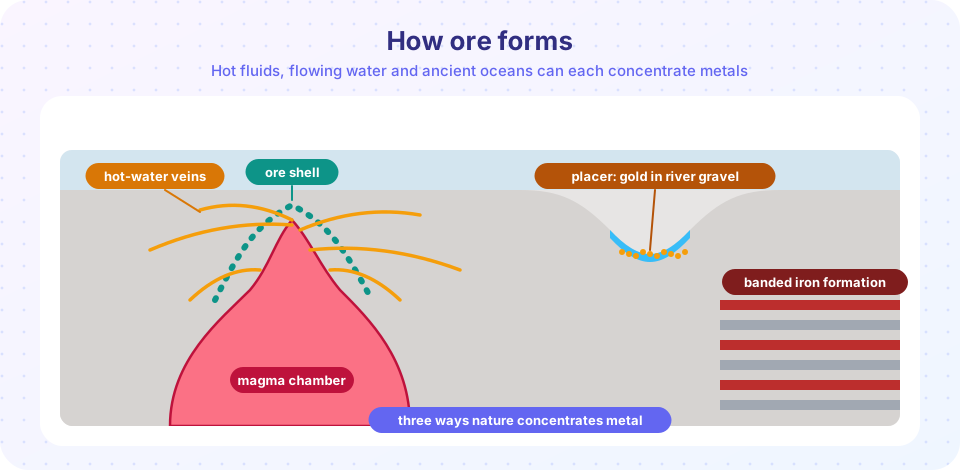
Hot water carries dissolved metals and drops them where it cools, boils or mixes with other water. Most of the world's copper comes from porphyry deposits, where an intrusion a few kilometers deep releases fluids that fracture the surrounding rock and fill it with a fine network of veins. Grades are low, often well under 1 percent copper, but the tonnage is vast and the ore sits close to the surface, so huge open pits can pay. Vein deposits concentrate gold and silver in narrow fractures. Volcanogenic massive sulfide deposits form where hot fluids vent on the seafloor.
Sedimentary deposits
Flowing water sorts grains by density. Heavy minerals such as gold, tin oxide and diamond settle in river gravels and beaches, forming placers. Chemical precipitation from seawater built banded iron formations, layered rocks of iron oxide and silica that supply most of the world's iron ore. Most formed in the Precambrian, when iron-rich oceans met the first free oxygen. Evaporation of shallow seas leaves evaporites such as salt, gypsum and potash.
Residual and supergene deposits
In hot, rainy climates, deep weathering leaches soluble elements from the soil and leaves behind the insoluble ones. Bauxite, the main aluminum ore, forms this way and is a residue of aluminum-rich rocks in the tropics. Supergene enrichment takes a low-grade copper deposit near the surface, dissolves the copper and redeposits it as a richer layer just below the water table.
Describing a deposit with numbers
Three numbers matter: tonnage, grade and depth. Contained metal is
contained metal = tonnage × grade
A deposit of 50 million tonnes at 0.8 percent copper contains 50,000,000 × 0.008 = 400,000 tonnes of copper. Not all of it is recovered: the recovery is the share captured by processing, often 80 to 90 percent for copper. So the saleable metal is 400,000 × 0.88 = 352,000 tonnes.
The cut-off grade
A tonne of ore costs money to mine, crush and process whether it contains a lot of metal or a little. If the metal in the tonne is worth less than that cost, the tonne is waste. The break-even grade is
cut-off grade = cost per tonne of ore / (recovery × price per tonne of metal)
With a cost of 40 dollars per tonne, recovery of 0.88 and a price of 9,000 dollars per tonne of copper, the cut-off is 40 / (0.88 × 9,000) = 0.0051, or about 0.5 percent. All prices in this lesson are illustrative, not market data. If the price doubles, the cut-off falls and more rock becomes ore. This is why mines open and close with commodity cycles.
Lower-grade rock is usually far more plentiful than high-grade rock, so a small drop in the cut-off adds a lot of tonnage. A grade-tonnage curve shows this: tonnage rises quickly and average grade falls as the cut-off is lowered.
Open pit or underground?
Shallow, wide deposits are mined by open pit, where the strip ratio (tonnes of waste removed for each tonne of ore) controls the economics. Deep, narrow, high-grade veins are mined underground, which costs more per tonne but moves less waste.
The costs of mining
Mining reshapes landscapes. Waste rock and tailings, the finely ground residue after processing, must be stored safely. Sulfide minerals exposed to air and water can produce acid mine drainage, which dissolves metals and pollutes streams for decades. Good practice includes lined tailings storage, treatment, and reclamation that restores the land after closure. Tailings dam failures are among the most serious industrial accidents, which is why dam design and monitoring involve geologists and engineers.
Recycling reduces the need for new mines. Steel, aluminum and copper are recycled at high rates because remelting costs far less energy than making new metal. But growing demand for batteries and electronics means new supply is also needed. Critical minerals, such as lithium, cobalt, nickel and rare earth elements, are those with high importance and supply risk. Geologists locate them, but society decides how to balance supply, cost and environmental impact.
Common misconceptions
"We are running out of metals." The crust contains vast amounts. What runs short is economic ore at a given price and technology, and that changes with exploration and cost.
"Higher grade always means a better mine." A large low-grade deposit near the surface can be more profitable than a small rich vein deep underground.
"Ore is a mineral." Ore is a rock body defined by economics. Gold ore is mostly worthless gangue.
"Gold is found as big nuggets." Most gold is microscopic or finely disseminated in rock; nuggets are rare.
Try it
Press Run (or Ctrl + Enter) to see the result here.
Program input · what you'd type while the program runs
Type the answers before you press Run, one per line. Each time the program reads a line (with input()), it gets the next line from this box.
Press Run (or Ctrl + Enter) to see the result here.
Program input · what you'd type while the program runs
Type the answers before you press Run, one per line. Each time the program reads a line (with input()), it gets the next line from this box.
Press Run (or Ctrl + Enter) to see the console output here.
No output.
Check your understanding
Quick check · 5 questions
of 5 answered You scored / 5 · perfect!
-
1. A deposit has 20 million tonnes at 2 percent zinc. How much zinc does it contain?
20,000,000 × 0.02 = 400,000 tonnes. -
2. Which deposit type forms when heavy minerals settle in river gravel?
Placers concentrate dense minerals such as gold by sorting in flowing water. -
3. If the price of a metal rises sharply, the cut-off grade will:
Each tonne of metal pays for more cost, so poorer rock becomes ore. -
4. Which is the main source of the world's iron ore?
Banded iron formations hold most of the world's iron ore. -
5. What is acid mine drainage?
Oxidation of sulfides makes acid that dissolves metals and pollutes streams.
Summary
- Ore is rock that can be mined at a profit; grade, tonnage and depth set the economics.
- Magmatic, hydrothermal, sedimentary and residual processes concentrate metals.
- Contained metal = tonnage × grade; cut-off grade = cost / (recovery × price).
- Mining has environmental costs; recycling and careful planning reduce them.
- Critical minerals show how geology, markets and policy interact.
Next: Energy and groundwater
Track your progress
Create a free account to tick off lessons and pick up where you left off on any device.
of Geology lessons completed