


















Lesson 8 of 48 · Earth Materials
Identifying minerals
Build a mineral identification kit: luster, color, streak, the Mohs hardness scale, cleavage, fracture and specific gravity, with worked examples.
You pick up a gray stone on a hillside. Is it quartz, calcite or feldspar? A geologist does not need a laboratory to find out. A few simple tests, applied in a sensible order, can narrow hundreds of possibilities to one or two. The skill is not memorizing a table: it is knowing which properties are reliable and which are traps.
This lesson teaches the standard physical tests and the logic of combining them. By the end you will be able to assemble a field kit from household items and identify common minerals.
What you will learn
- Which properties to test first, and which are unreliable
- How to use the Mohs scale and everyday tools to estimate hardness
- The difference between cleavage and fracture
- How to calculate specific gravity with a scale and a bucket of water
Key terms
Luster: how a mineral surface reflects light (metallic or nonmetallic). Streak: the color of a mineral's powder on a white porcelain plate. Hardness: resistance to scratching, measured on the Mohs scale. Cleavage: the tendency to break along flat planes of weak bonding. Specific gravity: density relative to water.
Start with luster, and be careful with color
Luster is the first thing you notice. It is either metallic (shiny like a polished metal, opaque: pyrite, galena) or nonmetallic. Nonmetallic luster has many flavors: vitreous (glassy: quartz), pearly (mica), silky (satin spar gypsum), resinous (like dried resin: sphalerite sometimes), greasy, dull or earthy (clay) and adamantine (brilliant, diamond-like).
Color feels like the obvious clue, but it is often the least reliable. Quartz can be clear, white, purple, pink, brown or black, because tiny impurities tint it. On the other hand, some minerals have a color so characteristic that it is diagnostic: malachite is always green, sulfur yellow, and azurite deep blue. Use color as a hint, never a verdict.
Streak is more reliable. Rub the mineral across an unglazed white porcelain tile and look at the color of the powder. Streak removes the surface and impurity effects. The classic example is hematite, which can look silver-gray and metallic or earthy red, but always leaves a red-brown streak. Pyrite ("fool's gold") has a brassy color but a greenish-black streak, while real gold leaves a golden streak. Streak only works for minerals softer than the porcelain, about 6.5; harder ones scratch the plate and leave no powder.
Hardness and the Mohs scale
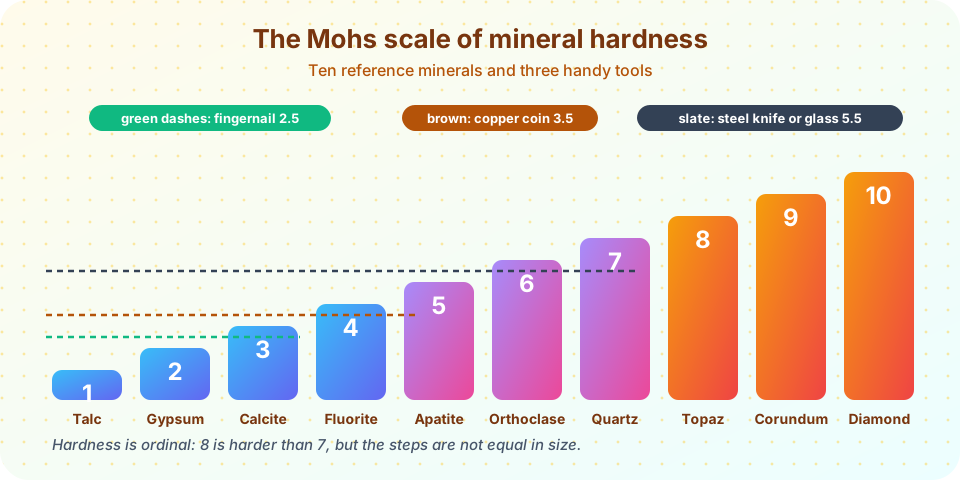
Hardness is a mineral's resistance to being scratched. In 1812 the German mineralogist Friedrich Mohs proposed a scale of ten reference minerals, from talc (1) to diamond (10). A mineral scratches any mineral softer than itself.
| Mohs | Mineral | Everyday benchmark |
|---|---|---|
| 1 | Talc | feels soapy |
| 2 | Gypsum | scratched by a fingernail (about 2.5) |
| 3 | Calcite | scratched by a copper coin (about 3.5) |
| 4 | Fluorite | scratched easily by a knife |
| 5 | Apatite | scratched by a knife; glass is about 5.5 |
| 6 | Orthoclase (feldspar) | scratches glass |
| 7 | Quartz | scratches steel and glass easily |
| 8 | Topaz | |
| 9 | Corundum | |
| 10 | Diamond | scratches everything |
The scale is ordinal: it ranks minerals, but the steps are not equal. Diamond is far harder than corundum, even though they are only one step apart. Test on a fresh, clean surface, and press firmly. Be careful with powdery crumbs that rub off, because they can look like a scratch.
A neat field strategy: try your fingernail first. If it scratches, the mineral is softer than 2.5 (gypsum, talc). If not, try a copper coin, then a steel knife, then glass. This quickly lands you in a range such as "between 3.5 and 5.5".
Cleavage and fracture
When you break a mineral, it may split along smooth, flat planes called cleavage. These planes follow rows of weaker chemical bonds in the crystal structure. Cleavage is described by the number of directions and the angles between them:
- One direction: mica splits into thin, flexible sheets.
- Two directions at about 90 degrees: feldspar, which gives the flat, shiny faces you see in granite.
- Three directions at 90 degrees: halite breaks into little cubes.
- Three directions not at 90 degrees: calcite breaks into slanted blocks called rhombohedra.
Don't confuse cleavage with crystal faces. Crystal faces form as the mineral grows; cleavage surfaces appear when it breaks, and they repeat in parallel as you look at the sample from different angles (you see many reflecting planes flashing at once).
Minerals without cleavage show fracture. Conchoidal fracture makes smooth, curved, shell-like surfaces, as in quartz and obsidian. Others fracture unevenly or splintery. A mineral without cleavage and with conchoidal fracture is a strong hint for quartz.
Specific gravity and other tests
Specific gravity (SG) is the density of a mineral divided by the density of water. Quartz has an SG of about 2.65, so a quartz sample is 2.65 times as heavy as the same volume of water. Galena (lead sulfide) is about 7.5, and gold is 19.3, which is why a gold nugget feels shockingly heavy in the hand. To measure it, weigh the sample in air, then weigh it suspended in water. Then:
SG = weight in air / (weight in air − weight in water)
(Archimedes' principle: the apparent loss of weight equals the weight of the water displaced.)
A few special tests help with specific minerals. Calcite fizzes when a drop of dilute hydrochloric acid touches it (vinegar works weakly). Magnetite is attracted to a magnet. Halite tastes salty (do not taste unknown samples). Calcite shows double refraction: a clear crystal placed over text shows two images.
A sensible order
- Luster: metallic or not?
- Hardness: fingernail, coin, knife, glass.
- Cleavage or fracture: how many flat surfaces, at what angle?
- Streak and color as supporting clues.
- Special tests (acid, magnet) and specific gravity if still unsure.
Common misconception: "Color identifies a mineral." Color is unreliable for many minerals. Quartz exists in many colors, and different minerals can share the same color.
Common misconception: "Harder means stronger or more durable." Hardness is only scratch resistance. A diamond is the hardest mineral, yet it can be cleaved with a sharp blow along its cleavage planes. Toughness is a different property.
Common misconception: "Shiny crystal faces are cleavage." Cleavage appears on broken surfaces and repeats in parallel planes.
Try it
The first example calculates specific gravity from two weighings and finds the closest mineral from a short reference table. Change the weights to test other samples.
Press Run (or Ctrl + Enter) to see the result here.
Program input · what you'd type while the program runs
Type the answers before you press Run, one per line. Each time the program reads a line (with input()), it gets the next line from this box.
The second example is a tiny identification key. Choose what you observe and see which minerals in its short list still fit. It covers only ten minerals, so treat it as a training aid, not a complete key.
Check your understanding
Quick check · 6 questions
of 6 answered You scored / 6 · perfect!
-
1. A mineral scratches glass but is scratched by quartz. Its Mohs hardness is roughly
Glass is about 5.5, so anything that scratches it is harder than 5.5. Quartz is 7, so the mineral is softer than 7. -
2. Why is streak more reliable than color?
The color of the powder is generally characteristic of the mineral. Hematite is silver or red but always streaks red-brown. -
3. A mineral breaks into small cubes. It most likely shows
Cubic cleavage with three directions at right angles is typical of halite. -
4. A sample weighs 40 g in air and 25 g in water. Its specific gravity is
SG = 40 / (40 - 25) = 2.67, about the value of quartz. -
5. Which mineral fizzes in dilute hydrochloric acid?
Calcite (CaCO3) reacts with acid and releases carbon dioxide bubbles. -
6. Diamond is the hardest mineral. Which statement is true?
Hardness is scratch resistance; diamond has cleavage and can split with a sharp blow.
Summary
- Test luster, hardness, cleavage or fracture first; use color and streak as supporting clues.
- The Mohs scale ranks hardness from talc (1) to diamond (10); a fingernail is about 2.5, a coin about 3.5, glass about 5.5.
- Cleavage gives flat planes in set directions; fracture is irregular or conchoidal.
- Specific gravity = weight in air / (weight in air minus weight in water).
- Calcite fizzes in acid; magnetite is magnetic; halite is salty.
Next: Silicate minerals
Track your progress
Create a free account to tick off lessons and pick up where you left off on any device.
of Geology lessons completed