


















Lesson 5 of 48 · Getting Started
Chapter 1 review: Getting started
Review Chapter 1 of the Geology course: Earth systems, deep time, the layers of the Earth and plate tectonics, with a recap table and a ten-question quiz.
You have now covered the foundations: how Earth works as a set of systems, how long it has taken, what lies inside it, and how the surface is organized into moving plates. Before you move on to minerals and rocks, this lesson pulls the pieces together, lets you practice the key calculations, and tests you with a longer quiz.
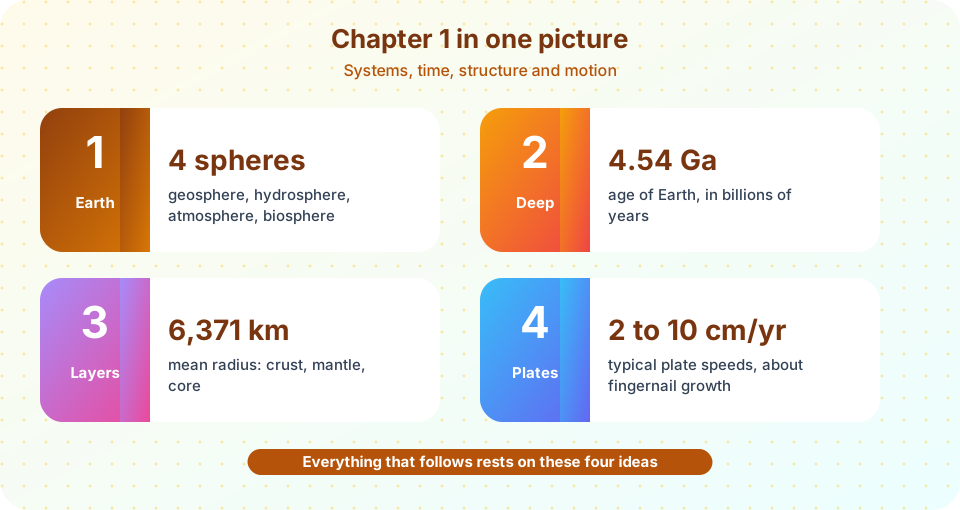
What you will learn
- How to connect the four big ideas of Chapter 1
- Which numbers to remember, and which to be able to calculate
- Where you are still unsure, using a ten-question quiz
The chapter in one table
| Idea | What to remember | Key numbers |
|---|---|---|
| Earth systems | Geosphere, hydrosphere, atmosphere and biosphere exchange matter and energy | Oceans hold about 97% of water |
| Deep time | Uniformitarianism: same laws, variable rates; time scale in eons and eras | Earth is 4.54 billion years old; Phanerozoic began 539 Ma |
| Rates | Distance = rate x time | 25 mm/yr for 100 Myr = 2,500 km |
| Layers | Crust, mantle, liquid outer core, solid inner core; lithosphere and asthenosphere by strength | Radius 6,371 km; mantle to about 2,890 km; inner core radius about 1,221 km |
| Seismic evidence | P waves pass through liquids, S waves do not | Core shadow zones, Lehmann 1936 |
| Plates | Divergent, convergent, transform; slab pull; seafloor spreading | Speeds of 1 to 10 cm/yr; oceanic crust under 180 Ma |
How the ideas connect
Notice the chain of reasoning. Earth's interior stays hot because it formed hot and because radioactive elements keep releasing heat (Earth systems). That heat, over deep time, drives slow convection in the mantle, which helps pull and push the rigid lithosphere into plates. Plates make mountains, volcanoes and oceans, which in turn change the atmosphere, hydrosphere and biosphere. The loop closes.
Most students lose marks in two places. The first is mixing up composition layers (crust, mantle, core) with strength layers (lithosphere, asthenosphere). Remember: the lithosphere is crust plus the top of the mantle. The second is confusing the rate of a process with the time it needs: slow rates are not a reason a process is unimportant, because time multiplies them.
Quick self-check formulas. Pressure in rock: P = ρ × g × h. Distance moved: d = rate × time. Convert: 1 km = 1,000,000 mm; 1 cm per year = 10 km per million years.
Common misconceptions
Under the crust is a sea of magma. (Wrong: the mantle is solid.) Plates float on liquid. (Wrong: the asthenosphere is solid but weak.) The inner core is solid because it is cool. (Wrong: it is the hottest layer, kept solid by pressure.) Earthquakes only happen at plate edges. (Mostly, but not only.)
Try it
The first example is a practice calculator for the two key formulas. Change the numbers and check your answers by hand.
Press Run (or Ctrl + Enter) to see the result here.
Program input · what you'd type while the program runs
Type the answers before you press Run, one per line. Each time the program reads a line (with input()), it gets the next line from this box.
The second example is a set of flash cards. Click a card to flip it, then try to answer before you do.
Check your understanding
Quick check · 10 questions
of 10 answered You scored / 10 · perfect!
-
1. Which sphere includes all of Earth's oceans, ice and groundwater?
The hydrosphere is all of Earth's water in every state. -
2. Which statement best matches uniformitarianism?
Hutton and Lyell proposed that the same processes and laws operated in the past, though rates may differ. -
3. Which eon began about 539 million years ago?
The Phanerozoic begins with the Cambrian period, when hard-shelled animals become common. -
4. A plate moves 4 cm per year. How far does it move in 50 million years?
4 cm/yr = 40 km per million years, so 50 million years gives 2,000 km. -
5. The boundary between the crust and the mantle is called the
The Mohorovicic discontinuity, or Moho, is the crust-mantle boundary. -
6. S waves are not detected on the far side of the Earth because
S waves cannot pass through liquid, so the liquid outer core casts an S-wave shadow. -
7. Which pair of layers is the lithosphere made of?
The lithosphere is the rigid shell of crust plus the uppermost mantle. -
8. A trench and a line of volcanoes on land indicate
Subduction creates a trench, and water from the sinking plate triggers melting that feeds volcanoes on the overriding continent. -
9. Why does oceanic crust remain younger than about 180 million years?
It forms at ridges and is destroyed at subduction zones, so old crust is continually removed. -
10. Pressure at 10 km depth in rock of density 2,800 kg per cubic meter is about
P = 2800 x 9.8 x 10,000 Pa = about 274 MPa.
Summary
- Earth is a set of four interacting systems operating over deep time.
- Distance = rate x time explains how slow processes build oceans and mountains.
- The planet has layers by composition and by strength; seismic waves revealed them.
- Plate tectonics unifies volcanoes, earthquakes, mountains and ocean basins.
Track your progress
Create a free account to tick off lessons and pick up where you left off on any device.
of Geology lessons completed