


















Lesson 36 of 48 · Resources and Hazards
Landslides and floods
Learn why slopes fail, how to calculate a factor of safety, and how return periods and flood probability work, with worked examples and simulations.
Gravity never stops pulling on a hillside. Most of the time friction and the strength of the material win, and the slope stays put. Then a long rainstorm, an earthquake or a bulldozer cut changes the balance, and the hill moves. In the same way, rivers carry modest flows for years and then spill over their banks after storms or snowmelt. Landslides and floods together cause enormous losses every year, and both are governed by simple physical balances you can calculate.
The skill in this lesson is to reduce a complicated hillside or river to a handful of numbers: forces on a slope, and the probability of a flood. These are the same numbers that engineers and planners use for decisions about where to build.
What you will learn
- The main types of mass movement and what triggers them.
- How to compute a factor of safety for a simple slope and see the effect of water.
- What a flood's return period and exceedance probability mean.
- How to estimate flood probability over a planning period and fit a flood-frequency curve.
Key terms
Mass wasting is the downslope movement of rock, soil and debris under gravity.
Factor of safety (FS) is the ratio of resisting forces to driving forces on a slope. FS below 1 means failure.
Pore water pressure is the pressure of water in the spaces between grains; it reduces friction between them.
Return period (T) is the average time between floods of a given size or larger.
Floodplain is the flat land next to a river that is covered when the river overflows.
Types of mass movement
Geologists classify movements by how the material moves and what it is made of.
- Falls and topples: rock detaches from a steep face and drops or tips. Fast, with little warning.
- Slides: a mass moves along a surface. A rotational slide (slump) moves on a curved surface and leaves a scarp. A translational slide moves along a flat surface, such as a bedding plane.
- Flows: the material moves like a fluid. Debris flows are mixtures of water, soil and boulders that can run at high speed down channels. Earthflows are slower and thicker; mudflows are mostly fine material.
- Creep: very slow downhill movement of soil, centimeters per year, shown by tilted fence posts and curved tree trunks.
Triggers include heavy or long rain, rapid snowmelt, earthquakes, undercutting by rivers or waves, volcanic eruptions and human actions such as cutting a road into a slope or loading the top with fill. Geology sets the stage: weak layers such as clay and shale, bedding planes dipping out of a slope (the structures of Chapter 5), and deeply weathered rock make slopes more susceptible.
A block on a slope
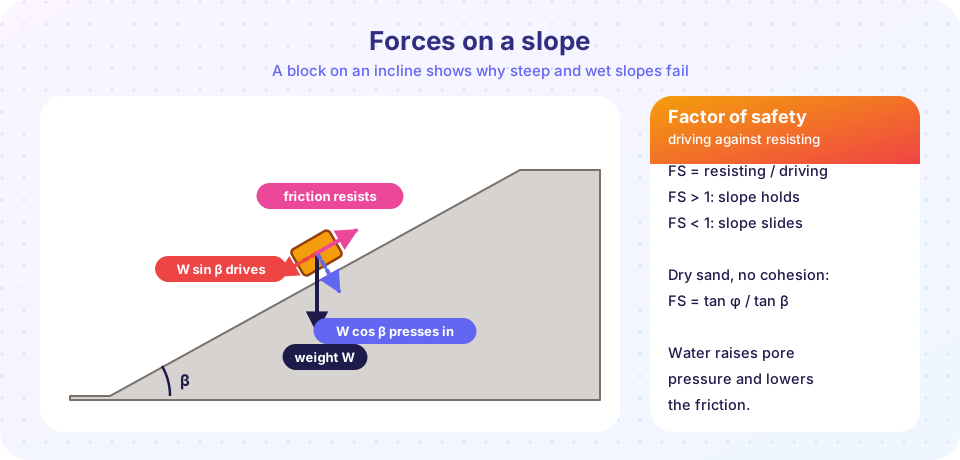
Take a block of weight W on an incline of angle β. The weight splits into two components:
driving force   = W sin β   (along the slope)
normal force    = W cos β   (into the slope)
Friction resists sliding, and the maximum friction force is N tan φ, where φ is the friction angle of the surface. The factor of safety is
FS = resisting force / driving force = (W cos β · tan φ) / (W sin β) = tan φ / tan β
The weight cancels, which is why a dry pile of sand stands at a slope angle equal to its friction angle φ, its angle of repose (about 30° to 35° for many sands). At β = φ, FS = 1 and the slope is on the edge of failure.
Water makes slopes weaker
Water in the pores pushes the grains apart and reduces the effective normal stress, so friction drops. If we call the pore pressure u, the general infinite-slope expression for soil with cohesion c at depth z and unit weight γ is
FS = [ c + (γ z cos²β − u) tan φ ] / (γ z sin β cos β)
For a cohesionless soil that is fully saturated with water flowing parallel to the slope, u = γw z cos²β, and the formula reduces to
FS = (1 − γw/γ) × tan φ / tan β
With γ = 20 kN/m³ and γw = 9.81 kN/m³, the factor (1 − γw/γ) is about 0.51. Saturation cuts the factor of safety roughly in half. For φ = 35°, a dry slope fails at 35°, but a saturated one fails at only about 20°. This explains why heavy rain triggers landslides on slopes that were stable for decades. Cohesion from clay and roots helps, which is why deforestation and wildfire increase landslide risk.
Reducing slope risk
- Drainage: surface ditches and subsurface drains lower pore pressure.
- Regrading: flatten the slope or remove weight from the top.
- Support: retaining walls, rock bolts, anchors and buttresses at the toe.
- Vegetation: roots bind soil and remove water.
- Avoidance and monitoring: mapping susceptible slopes, restricting development and installing sensors and rain-triggered warning systems.
Floods
A flood occurs when a river's discharge exceeds the capacity of its channel. The causes are heavy rain, rapid snowmelt, ice jams, dam failure and, on coasts, storm surge. Rivers have a natural floodplain, where water spreads, drops sediment and slows. Building on a floodplain brings people into the path of the water.
Flash floods rise within hours in small steep catchments after intense rain. River floods in large basins build over days. Urbanization increases flood peaks, because paved surfaces send rain to channels quickly instead of letting it soak in.
Return period and probability
The return period of a flood is the average time between floods of that size or larger. It is the inverse of the annual exceedance probability:
P = 1 / T
A "100-year flood" has T = 100 years and a 1 percent chance in any year. It does not mean it happens once every 100 years, or that it cannot happen two years in a row. Over a period of N years, the chance of at least one such flood is
P(at least one in N years) = 1 − (1 − 1/T)^N
For T = 100 and N = 30 (the length of a typical mortgage), this is 1 − 0.99^30 = 0.26, about 26 percent. For N = 100 it is 63 percent. That is why insurers and planners care about modest-sounding probabilities.
To find T from records, take a river's annual peak discharges, rank them from largest (m = 1) downward, and compute T = (n + 1) / m where n is the number of years. Plot discharge against T on a logarithmic axis, draw a line through the points, and read off the discharge for a chosen return period. Statistical distributions such as the Gumbel distribution formalize that line. Because records are short, the 100-year flood is an extrapolation and carries uncertainty.
Managing flood risk
Options include levees and flood walls (which can fail and may increase downstream peaks), reservoirs that store floodwater, floodplain zoning that keeps buildings out of the highest-risk land, natural flood management such as restoring wetlands, and warning systems based on river gauges and rainfall forecasts. Climate change is changing rainfall patterns, so past records are an imperfect guide for the future.
Common misconceptions
"A 100-year flood will not happen again for 100 years." It has a 1 percent chance in every year, regardless of the last one.
"Landslides happen only on steep cliffs." Gentle slopes with weak clay can slide too, especially when wet.
"Levees remove flood risk." They reduce it, but a levee failure or overtopping can be catastrophic, and they push water downstream.
"A dry hillside is a safe hillside." Water changes the balance quickly, which is why slope failures come after rain.
Try it
Press Run (or Ctrl + Enter) to see the result here.
Program input · what you'd type while the program runs
Type the answers before you press Run, one per line. Each time the program reads a line (with input()), it gets the next line from this box.
Press Run (or Ctrl + Enter) to see the result here.
Program input · what you'd type while the program runs
Type the answers before you press Run, one per line. Each time the program reads a line (with input()), it gets the next line from this box.
Press Run (or Ctrl + Enter) to see the console output here.
No output.
Check your understanding
Quick check · 6 questions
of 6 answered You scored / 6 · perfect!
-
1. A dry cohesionless slope has φ = 30°. At what slope angle is FS = 1?
FS = tan φ / tan β equals 1 when β = φ. -
2. How does water in the soil affect slope stability?
Pore pressure reduces effective stress and thus friction between grains. -
3. A 50-year flood has an annual probability of:
P = 1/T = 1/50 = 0.02. -
4. The chance of at least one 100-year flood in 30 years is about:
1 − 0.99^30 ≈ 0.26. -
5. Which type of mass movement is fastest and gives the least warning?
Falls detach suddenly from steep faces. -
6. A river record has 40 years. The largest flood on record is assigned a return period of:
T = (n + 1) / m = 41 / 1 = 41 years.
Summary
- Mass wasting includes falls, slides, flows and creep, triggered by rain, earthquakes, undercutting and human activity.
- Factor of safety = resisting / driving force; for dry cohesionless soil
FS = tan φ / tan β, and saturation roughly halves it. - Floods have a return period
Tand annual probability1/T; the chance over N years is1 − (1 − 1/T)^N. - Flood-frequency curves extrapolate from short records, so they carry uncertainty.
- Drainage, regrading, zoning and warning systems reduce risk.
Next: Chapter 7 review
Track your progress
Create a free account to tick off lessons and pick up where you left off on any device.
of Geology lessons completed