


















Lesson 28 of 48 · Geologic Time and Fossils
Relative dating: which came first?
Learn the principles of relative dating, from superposition and cross-cutting to unconformities and faunal succession, and sort a sequence of events with code.
Before anyone could measure the age of a rock in years, geologists worked out which rocks were older and which were younger. They did it with logic. If you can see that a crack cuts through a layer, the layer must have been there first. If a pebble sits inside a sandstone, the pebble's source rock must be older than the sandstone. These rules are called relative dating, and they still come first in every field study, even though radioactive clocks are now available.
Relative dating gives a sequence, not dates. But the sequence is the backbone of the geologic time scale. This lesson gives you each rule, the person behind it, and a program that applies the rules for you.
What you will learn
- The principles of superposition, original horizontality, lateral continuity, cross-cutting and inclusions.
- The three types of unconformity and what they mean.
- How fossils extend relative dating across continents.
- How to turn a set of "older than" statements into a time order.
Key terms
Superposition is the principle that in undisturbed layers the oldest are at the bottom and the youngest at the top.
Cross-cutting relationships say a feature that cuts across rock is younger than the rock it cuts.
Unconformity is a surface that represents a gap in the geologic record, caused by erosion or no deposition.
Inclusion is a fragment of one rock contained in another; the fragment is older than the host.
Faunal succession is the observation that fossil groups succeed each other in a definite, recognizable order.
The principles
Superposition and original horizontality
In 1669 the Danish scientist Nicolaus Steno (Niels Stensen) set out rules that now carry his name. Superposition: in a stack of layers that has not been turned over, each layer is younger than the one below. Original horizontality: sediment settles under gravity into nearly flat layers, so steeply tilted or folded layers have been deformed after they formed. Lateral continuity: a layer extends sideways until it thins to nothing or meets a barrier, so layers on opposite sides of a valley may once have been connected.
Cross-cutting relationships
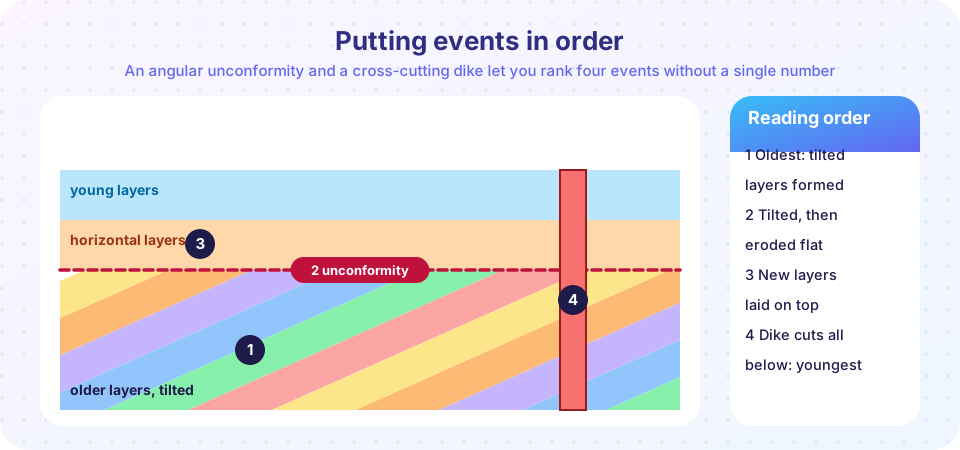
An igneous dike, a fault or a joint that passes through a rock is younger than that rock. If a fault is itself cut by a dike, the dike is younger than the fault. In the picture above, the dike slices through every layer, so it is the youngest event.
Contact clues support the logic. Heat from an intrusion bakes the surrounding rock, creating a narrow baked margin, and the intrusion has a chilled margin where it cooled quickly against the cooler host rock. Both show that the host was already there when the magma arrived.
Inclusions
A fragment inside a rock is older than the rock that holds it. A granite pebble inside a sandstone proves that the granite was exposed and eroded before the sandstone formed. A xenolith, a piece of wall rock caught up in magma, is older than the igneous rock around it.
Unconformities: missing pages
Layers do not record every moment. When deposition stops or erosion removes rock, there is a gap, and the surface across the gap is an unconformity. James Hutton found the most famous example at Siccar Point on the Scottish coast in 1788. There, nearly flat red sandstone lies on near-vertical gray beds. The tilted beds were deposited, folded up on end, eroded flat and then buried. Hutton's companion John Playfair later wrote that the mind "seemed to grow giddy by looking so far into the abyss of time". Hutton's insight was that such a sequence takes enormous time, and that processes seen today can account for it.
| Type | What it looks like | What it records |
|---|---|---|
| Angular unconformity | Tilted layers beneath flatter layers | Deposition, tilting or folding, erosion, new deposition |
| Disconformity | Parallel layers separated by an erosion surface | Pause or erosion without tilting; often subtle |
| Nonconformity | Sedimentary rock on top of igneous or metamorphic rock | The deeper rock was exposed by uplift and erosion before burial |
The Great Unconformity in the Grand Canyon, where Cambrian sandstone lies on much older rock, represents hundreds of millions of years missing at a single surface.
Fossils extend the logic: faunal succession
William Smith, an English canal surveyor, noticed around 1796 that rock layers in different places contained the same fossils in the same order, and that he could identify a layer from its fossils alone. In 1815 he published the first geologic map of England and Wales. The principle of faunal succession says that fossil groups appear and disappear in a definite order. Because of this, a layer containing trilobites of one species in Morocco can be matched with a layer containing the same species in Wales. Charles Darwin's explanation for this succession, evolution, came decades later.
Correlation steps are:
- Walk out the layers and match them by sight, by unusual rock types or by marker beds such as volcanic ash.
- Match them by fossils, especially index fossils (see the next lessons).
- Use radiometric dates of ash beds to pin the correlated layers to a number.
Worked example: reading a road cut
Picture a road cut. At the bottom are steeply tilted gray beds. Across the top of those beds, cutting them off, runs a nearly flat surface. Above it are horizontal red beds, and a thin vertical dike of dark rock slices through the red beds and the gray beds alike. Read it from the bottom: the gray beds formed first; they were tilted and eroded flat (the surface is an angular unconformity); the red beds were deposited on the flat surface; and finally the dike intruded and cut everything. Four events are ordered without a single number. If a pebble of gray sandstone turns up inside the red beds, that is a bonus check: it confirms that the gray beds were already exposed to erosion when the red beds formed.
Common misconceptions
"Superposition always works." Not if layers have been overturned by folding or thrust faulting. Always check for sedimentary clues that show which way is up.
"Thicker means older." Thickness reflects the rate and duration of deposition, not age.
"An unconformity is a flaw in the rocks." It is information: a record of a time when nothing was preserved or rock was removed.
"Relative dating is just a poor man's radiometric dating." The two work together. Radiometric ages are only meaningful when the relative order of the dated samples is known.
Try it
Press Run (or Ctrl + Enter) to see the result here.
Program input · what you'd type while the program runs
Type the answers before you press Run, one per line. Each time the program reads a line (with input()), it gets the next line from this box.
Press Run (or Ctrl + Enter) to see the result here.
Program input · what you'd type while the program runs
Type the answers before you press Run, one per line. Each time the program reads a line (with input()), it gets the next line from this box.
Check your understanding
Quick check · 5 questions
of 5 answered You scored / 5 · perfect!
-
1. A granite dike cuts through three layers of sandstone. What is the order from oldest to youngest?
A feature that cuts through rock is younger than that rock. -
2. Tilted layers are overlain by horizontal layers across an erosion surface. This is a:
Different dips on either side of the erosion surface define an angular unconformity. -
3. A pebble of schist is found inside a limestone. Which is older?
An inclusion is older than the rock that contains it. -
4. William Smith's principle of faunal succession says that:
Fossil groups replace each other in a consistent order, which allows correlation. -
5. At Siccar Point, Hutton showed that:
The unconformity shows repeated cycles that required vast time.
Summary
- Superposition, original horizontality and lateral continuity (Steno) order undisturbed layers.
- Cross-cutting and inclusions order features that interrupt layers.
- Unconformities (angular, disconformity, nonconformity) mark missing time.
- Faunal succession (Smith) lets fossils correlate rocks across regions.
- Relative dating gives a sequence; radiometric dating, next, adds numbers.
Next: Radiometric dating
Track your progress
Create a free account to tick off lessons and pick up where you left off on any device.
of Geology lessons completed