


















Lesson 35 of 48 · Resources and Hazards
Earthquakes and volcanoes
Understand elastic rebound, seismic waves, magnitude, how to locate an epicenter, volcano types, the VEI scale and why tsunamis travel so fast.
Earthquakes and volcanoes cluster along the same lines on a world map: the edges of tectonic plates. The ring around the Pacific Ocean holds most of Earth's volcanoes and about 80 percent of its largest earthquakes. They are two ways for the planet to release energy, one as sudden slip on a fault and the other as magma reaching the surface.
Both are hard to forecast exactly but they can be measured, mapped and prepared for. This lesson explains what happens in an earthquake, how seismologists locate and size one, how volcanoes differ and erupt, and why a tsunami can cross an ocean at jet speed.
What you will learn
- The elastic rebound explanation of earthquakes.
- The three kinds of seismic waves and how to locate an epicenter from S-P times.
- How moment magnitude is calculated and what each step means.
- Volcano types, the Volcanic Explosivity Index and the main volcanic hazards.
- How tsunamis form and why their speed depends on depth.
Key terms
Focus (hypocenter) is the point underground where fault slip starts; the epicenter is the point on the surface directly above it.
Seismic waves are vibrations that carry energy from the focus: P, S and surface waves.
Moment magnitude (Mw) is the standard measure of earthquake size, from the energy released by slip.
Pyroclastic flow is a fast, hot cloud of gas and volcanic fragments.
Tsunami is a series of long ocean waves, usually caused by sudden movement of the seafloor.
Earthquakes: elastic rebound
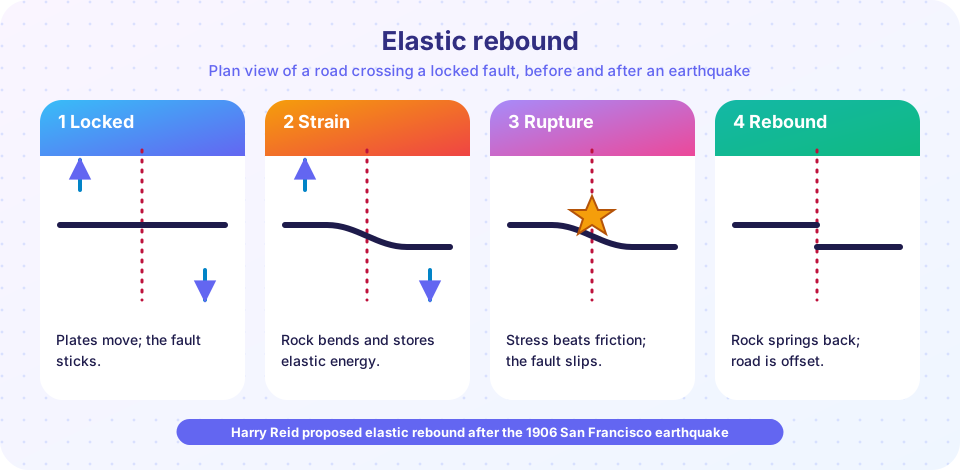
Plates move at centimeters per year, but faults are rough and stick. While the fault is locked, the rock on either side bends elastically and stores energy, like a drawn bow. When the stress exceeds friction, the fault slips and the stored energy is released as seismic waves. After the 1906 San Francisco earthquake, Harry Fielding Reid studied how fences and roads had been offset and proposed this elastic rebound theory.
Most earthquakes happen at plate boundaries. At subduction zones, thrust faults can generate the largest earthquakes. At transform boundaries such as the San Andreas, strike-slip earthquakes can be large and shallow. Some happen inside plates, on old faults.
Seismic waves
- P waves (primary): compressions that push and pull the rock in the direction of travel, like sound. The fastest, about 6 km/s in the crust, and they pass through solids and liquids.
- S waves (secondary): shear waves that move rock at right angles to travel. Slower, about 3.5 km/s in the crust, and they do not pass through liquids. That is how seismologists learned that Earth's outer core is liquid.
- Surface waves (Love and Rayleigh): travel along the surface, slower still, but with the largest amplitude. They cause most of the damage.
Locating an epicenter
A seismometer records P first and S later. The delay Δt = tS − tP grows with distance. With vP and vS as the wave speeds, the distance is
d = Δt × (vP × vS) / (vP − vS)
For vP = 6.0 km/s and vS = 3.5 km/s the factor is (6.0 × 3.5) / 2.5 = 8.4, so each second of delay means 8.4 km. A single station gives only a distance, so the epicenter lies on a circle. Three stations give three circles that intersect at the epicenter. This is called triangulation.
Magnitude and intensity
Charles Richter's 1935 scale was based on the amplitude on a particular seismometer. Today seismologists use moment magnitude, based on the seismic moment, the physical size of the slip:
M0 = μ × A × D          (N·m)
Mw = (2/3) × (log10(M0) − 9.1)
Here μ is the shear modulus of the rock (about 3 × 10¹⁰ Pa in the crust), A the rupture area and D the average slip. Example: a fault patch 100 km × 20 km (A = 2 × 10⁹ m²) slipping 2 m gives M0 = 3 × 10¹⁰ × 2 × 10⁹ × 2 = 1.2 × 10²⁰ N·m and Mw ≈ 7.3.
The scale is logarithmic. Each whole step up means about 10 times larger ground-motion amplitude and about 32 times (10^1.5) more energy released. A magnitude 7 earthquake releases about 1,000 times the energy of a magnitude 5.
Intensity is different from magnitude. It describes shaking and damage at a particular place, on the Modified Mercalli scale (I to XII). One earthquake has one magnitude but many intensities, which decrease with distance and depend on the ground.
Earthquake hazards
Shaking is the main cause of damage, but there are others: surface rupture along the fault, liquefaction (water-saturated sand temporarily behaves like a liquid and buildings tilt or sink), landslides and tsunamis. Earthquakes cannot be predicted in the sense of stating when and where, but long-term hazard maps give probabilities, and early warning systems detect P waves and send alerts seconds before the damaging S and surface waves arrive.
Volcanoes
Volcanoes form where magma finds its way to the surface: at subduction zones, at divergent boundaries and above hot spots such as Hawaii. What a volcano does depends mostly on the magma.
| Type | Magma | Behavior | Example |
|---|---|---|---|
| Shield volcano | Basaltic, runny | Gentle lava flows, wide low cone | Mauna Loa |
| Stratovolcano (composite) | Andesitic to dacitic, stickier | Alternating lava and ash, often explosive | Mount Fuji, Mount St. Helens |
| Caldera | Silica-rich | Giant eruptions emptying the magma chamber, then collapse | Yellowstone, Toba |
| Cinder cone | Basaltic | Small, short-lived, built of fragments | Parícutin, Mexico |
Viscosity and gas content decide explosivity. Silica-rich magma is thick, so gas cannot escape easily and builds pressure, like a shaken soda bottle. Runny basalt lets gas bubble out, so eruptions are effusive.
The Volcanic Explosivity Index (VEI) classifies eruptions on a scale of 0 to 8 mostly by the volume of material ejected: each step represents about ten times more volume. VEI 4 is at least 0.1 km³, VEI 5 at least 1 km³, VEI 6 at least 10 km³, VEI 7 at least 100 km³ and VEI 8 at least 1,000 km³. Examples: Mount St. Helens 1980 was VEI 5, Pinatubo 1991 VEI 6 and Tambora 1815 VEI 7. Tambora's aerosols cooled the climate so much that 1816 was called the "year without a summer" in Europe and North America.
Volcanic hazards
- Pyroclastic flows are the deadliest: avalanches of hot gas, ash and rock that race down slopes at tens of meters per second or more. They destroyed Pompeii and Herculaneum in 79 CE.
- Lahars are volcanic mudflows that can travel far down valleys.
- Ash fall collapses roofs, contaminates water and endangers aircraft.
- Volcanic gases such as carbon dioxide and sulfur dioxide can be lethal and affect climate.
- Lava flows destroy property but rarely kill, because people can move away.
Volcanologists monitor earthquake swarms, ground swelling, gas emissions and temperature, which together often give days to weeks of warning, though the size and exact timing remain uncertain.
Tsunamis
When a large earthquake displaces the seafloor, it lifts or drops a huge column of water. The disturbance spreads as a long wave. Unlike wind waves, the wavelength is hundreds of kilometers, so the whole water column moves. In water of depth d, the speed is
v = √(g × d)
In the deep ocean at d = 4,000 m, v = √(9.81 × 4000) ≈ 198 m/s ≈ 713 km/h, similar to a jet airliner. The wave is only a meter or less high in open water, so ships barely notice. Near the coast, where d drops to 10 m, the speed falls to about 10 m/s, and the wave's energy is compressed into a shorter, taller wave that can reach many meters. The 2004 Indian Ocean tsunami (Mw about 9.1) and the 2011 Tohoku tsunami in Japan (Mw about 9.1) show the danger. Tsunami warning centers use seismometers and ocean buoys and give hours of notice for distant coasts. For coasts near the source, the natural warning is the earthquake itself: move to high ground.
Common misconceptions
"A magnitude 8 is twice as big as a magnitude 4." It is thousands to millions of times larger in energy: each step is about 32 times more energy.
"Earthquakes can be predicted by animal behavior or weather." No reliable short-term prediction method exists.
"Tsunamis are tall breaking waves in the open ocean." In deep water they are low and fast; they grow only near shore.
"Magnitude and intensity are the same." Magnitude measures the source; intensity measures the effects at one place.
"All volcanoes explode." Many erupt calmly, as in Hawaii.
Try it
Press Run (or Ctrl + Enter) to see the result here.
Program input · what you'd type while the program runs
Type the answers before you press Run, one per line. Each time the program reads a line (with input()), it gets the next line from this box.
Press Run (or Ctrl + Enter) to see the result here.
Program input · what you'd type while the program runs
Type the answers before you press Run, one per line. Each time the program reads a line (with input()), it gets the next line from this box.
Press Run (or Ctrl + Enter) to see the console output here.
No output.
Check your understanding
Quick check · 6 questions
of 6 answered You scored / 6 · perfect!
-
1. Which seismic wave arrives first?
P waves are the fastest. -
2. The S-P delay at a station is 10 s. With vP = 6 km/s and vS = 3.5 km/s, the distance is about:
d = 10 × 8.4 = 84 km. -
3. A magnitude 7 earthquake releases about how many times more energy than a magnitude 5?
Two steps × 1.5 = 3 powers of ten, so about 1,000. -
4. Which volcano type is built from runny basaltic lava and has gentle slopes?
Basaltic lava flows far, making broad shields like Mauna Loa. -
5. Tsunami speed in 4,000 m of water is about:
v = √(9.81 × 4000) ≈ 198 m/s. -
6. Which describes elastic rebound?
This is Reid's explanation after the 1906 San Francisco earthquake.
Summary
- Earthquakes release stored elastic strain as a fault slips; P, S and surface waves carry the energy.
- Epicenters are located by triangulation from S-P times; Mw = (2/3)(log M0 − 9.1).
- Magnitude is logarithmic: one unit is about 32 times the energy.
- Volcano style depends on magma viscosity and gas; VEI measures eruption size.
- Tsunami speed
√(g d)makes them fast in deep water and tall near shore.
Next: Landslides and floods
Track your progress
Create a free account to tick off lessons and pick up where you left off on any device.
of Geology lessons completed