


















Lesson 12 of 48 · Igneous and Metamorphic Processes
Chapter 3 overview: Igneous and metamorphic processes
Chapter 3 overview: how rock melts, cools and crystallizes into igneous rock, and how heat and pressure transform rocks into metamorphic rock without melting.
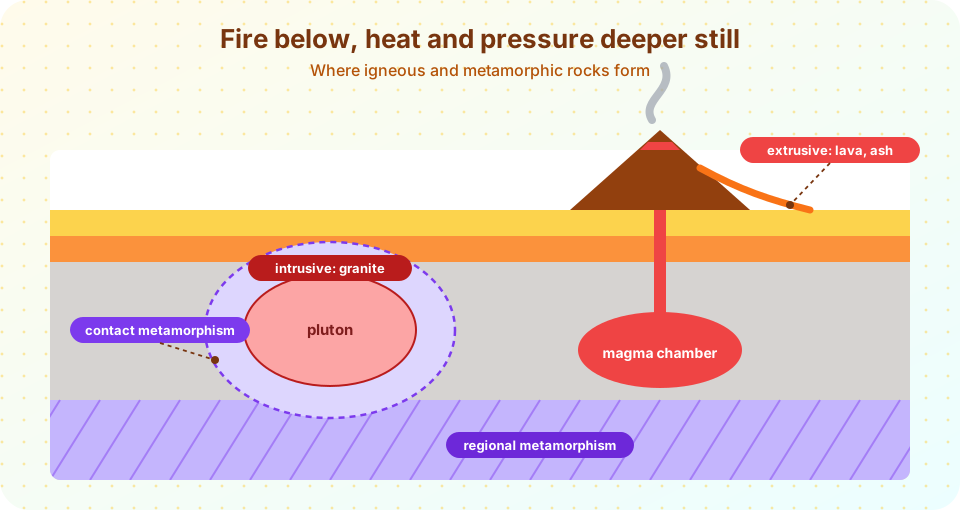
Two of the three great rock families come from the Earth's own heat. Igneous rocks crystallize from molten rock. Metamorphic rocks are older rocks that were heated and squeezed until their minerals changed, but never melted. Together they make up most of the crust. They hold the record of volcanoes, buried magma, mountain building and the deep roots of continents.
This chapter explains where the heat comes from, how rock melts, what controls the kind of rock that forms, and how to read the clues a rock gives about its history.
What you will learn
- How rock melts even though the interior is mostly solid
- What the chapter's five lessons cover
- How to tell the three rock families apart at a glance
Melting
Cooling
Changing
Key terms
Magma: molten rock below the surface; lava when it erupts. Crystallization: the growth of mineral crystals from a melt. Pluton: a body of igneous rock that cooled underground. Metamorphism: solid-state change of rock by heat, pressure or fluids. Foliation: a layered or banded texture of aligned minerals.
How rock melts
The mantle is solid, so how does magma ever form? There are three ways, and each one changes a different variable.
- Decompression melting. Rock deep in the mantle is hot but kept solid by the enormous pressure. When it rises, as under a mid-ocean ridge, the pressure drops and the same rock at the same temperature begins to melt. No extra heat is needed.
- Flux melting. Water released from a sinking oceanic plate rises into the hotter mantle above and lowers its melting temperature, rather like salt on an icy road. This feeds the volcanoes above subduction zones.
- Heat transfer. Rising magma can heat the crust around it and melt it, making silica-rich magma such as the kind that forms granite.
Rock does not melt all at once. A mixed rock melts over a range of temperatures, so the first melt is richer in silica, while the leftover solid is richer in iron and magnesium. This partial melting is one reason Earth has such a variety of igneous rocks.
Lessons in this chapter
- Magma and igneous rocks: composition, texture, Bowen's reaction series and the classification chart.
- Volcanoes and eruptions: why some volcanoes erupt gently and others explosively, volcano types and volcanic hazards.
- Metamorphic rocks: the agents of metamorphism, foliated and nonfoliated rocks, and the grade sequence.
- Chapter 3 review: recap and a ten-question quiz.
Three rock families at a glance
| Clue | Igneous | Sedimentary | Metamorphic |
|---|---|---|---|
| Grains | interlocking crystals, or glass | rounded or angular grains, cement | interlocking, often aligned |
| Layers | none, or flow bands | clear beds | banding or foliation |
| Fossils | none | often | rarely, usually destroyed |
| Typical examples | granite, basalt | sandstone, limestone | slate, schist, marble |
Common misconception: "Lava and magma are the same thing." Magma is underground and contains dissolved gas and crystals; lava is what is left after it erupts and loses gas.
Common misconception: "Metamorphic means melted." It means changed. If it melts, it is magma.
Common misconception: "Volcanoes only occur at plate boundaries." Most do, but hotspot volcanoes like Hawaii are in plate interiors.
Try it
The first example is a simple schematic of decompression melting. It compares an upwelling mantle parcel with the melting temperature of dry mantle rock. The numbers are rounded and illustrative.
Press Run (or Ctrl + Enter) to see the result here.
Program input · what you'd type while the program runs
Type the answers before you press Run, one per line. Each time the program reads a line (with input()), it gets the next line from this box.
The second example is a sorting game for the three rock families.
Check your understanding
Quick check · 4 questions
of 4 answered You scored / 4 · perfect!
-
1. Which process melts mantle rock beneath a mid-ocean ridge?
At ridges the mantle rises, pressure drops and the rock melts without extra heat. -
2. Water from a subducting plate helps form magma because it
Like salt on ice, water lowers the melting temperature, a process called flux melting. -
3. Which of these is a metamorphic rock?
Marble forms when limestone is recrystallized by heat and pressure. -
4. Why does a mixed rock produce a variety of magmas when it partly melts?
Different minerals melt at different temperatures, so partial melts have a different composition from the source rock.
Summary
- Magma forms by decompression, by added water (flux) or by heat from rising magma.
- Partial melting and slow or fast cooling create a wide variety of igneous rocks.
- Metamorphism changes rock in the solid state; foliation records pressure.
- This chapter covers igneous rocks, volcanoes, metamorphic rocks and a review.
Next: Magma and igneous rocks
Track your progress
Create a free account to tick off lessons and pick up where you left off on any device.
of Geology lessons completed