


















Lesson 2 of 48 · Getting Started
Earth systems and deep time
Learn how the geosphere, hydrosphere, atmosphere and biosphere interact, why geologists think in millions of years, and how rates multiply into landscapes.
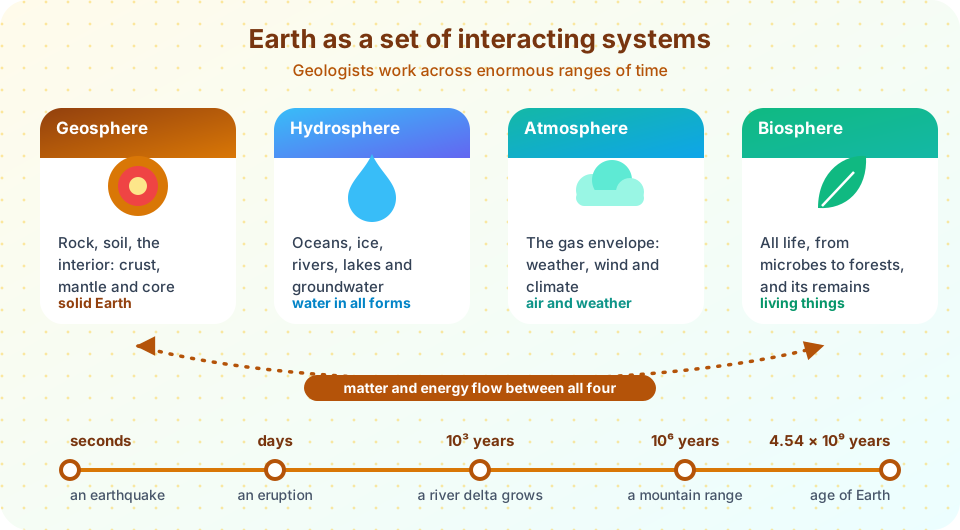
Stand beside a cliff, a river or a volcano and it is tempting to see a finished object. Geologists see a snapshot in a very long film. To read that film you need two big ideas. The first is that Earth works as a set of interacting systems: rock, water, air and life constantly exchange matter and energy. The second is deep time: the planet is about 4.54 billion years old, so even a very slow process adds up to something enormous.
This lesson introduces both ideas and gives you the habit of thinking in rates: distance per year, times the number of years.
What you will learn
- The four Earth spheres and an example of how they interact
- What uniformitarianism says and why it is useful but not the whole story
- How geologists divide time, from eons to epochs
- How to turn a slow rate and a long time into a distance
Key terms
Geosphere: the solid Earth, from the surface rocks to the core. Hydrosphere: all water: oceans, ice, rivers, lakes, groundwater and vapor. Atmosphere: the envelope of gases around Earth. Biosphere: all living things and the zone they occupy. Deep time: time measured in millions and billions of years.
Four spheres, one planet
It helps to divide Earth into four overlapping parts, called spheres. The geosphere is the solid planet: crust, mantle and core. The hydrosphere includes the oceans, which hold about 97% of Earth's water, plus ice sheets, lakes, rivers and groundwater. The atmosphere is the layer of gas, mostly nitrogen and oxygen, that holds weather. The biosphere is life, from bacteria in deep rock to forests. Some books add a fifth, the cryosphere, for ice and snow.
The spheres are not separate. A single raindrop shows how tightly they are linked. Water evaporates from the ocean (hydrosphere to atmosphere), falls on a mountain, and slowly dissolves minerals in the rock (atmosphere to geosphere, helped by carbon dioxide from the air and by soil organisms). Dissolved calcium washes to the sea, where shell-building animals use it to make limestone. Millions of years later that limestone might be pushed up into a new mountain range. One cycle touches all four spheres.
Two energy sources drive these exchanges. The Sun powers the atmosphere, oceans and weather, and with them the surface processes that wear rock down. Heat from inside the Earth, left over from its formation and made by radioactive decay, powers the interior processes that build mountains, cause earthquakes and feed volcanoes. Much of geology is the story of these two engines pulling against each other: one levels the land, the other lifts it.
Uniformitarianism: the present is the key to the past
In the late 1700s the Scottish naturalist James Hutton studied rock layers and argued that the same slow processes we see today (erosion, deposition, uplift) could, given enough time, explain the rocks. He famously saw "no vestige of a beginning, no prospect of an end". In the 1830s Charles Lyell popularized the idea in his book Principles of Geology, and it became known as uniformitarianism: the physical laws and processes that act today also acted in the past.
This is a powerful tool. If ripples form in modern river sand and the same ripples are frozen in an ancient sandstone, you can infer a river. You do not need a time machine, only careful observation of modern processes.
But uniformitarianism does not mean everything happens slowly and evenly. Geologists now recognize that the rates can vary. Most erosion happens during rare storms and floods. A large asteroid hit about 66 million years ago and helped end the age of the non-bird dinosaurs. Early Earth was hotter, had no free oxygen, and lacked animals. The best modern view is: the same laws always apply, but the intensity and the conditions can change, and rare sudden events matter.
Reading the time scale
Geologists divide Earth history using the geologic time scale, built from rocks and fossils and refined with radiometric ages (you will learn how in Chapter 6). The largest divisions are eons:
| Eon | Approximate span | Highlights |
|---|---|---|
| Hadean | 4.54 to 4.0 billion years ago | Earth forms, Moon-forming impact, oldest mineral grains |
| Archean | 4.0 to 2.5 billion years ago | First continents and early life |
| Proterozoic | 2.5 billion to 539 million years ago | Oxygen builds up, complex cells, first animals |
| Phanerozoic | 539 million years ago to now | Abundant visible life with shells and bones |
The Phanerozoic is split into three eras: Paleozoic (539 to 252 million years ago), Mesozoic (252 to 66 million years ago) and Cenozoic (66 million years ago to now). Eras are divided into periods such as the Cambrian, Jurassic and Quaternary, and periods into epochs. Notice that the first three eons, together, cover about 88% of Earth history, yet most of what you know about "ancient life" comes from the last 12%. That is because hard parts like shells make fossils much easier to find.
Scientists give ages in Ma (mega-annum, millions of years ago) and Ga (giga-annum, billions of years ago). So "4.54 Ga" and "66 Ma" are the age of Earth and the end of the non-bird dinosaurs. The age of Earth was first pinned down carefully by Clair Patterson in the 1950s, who measured lead isotopes in a meteorite and arrived at about 4.55 billion years. Today's figure, 4.54 billion, has an uncertainty of only about 1%.
Rates multiply into landscapes
Deep time is hard to feel, but the arithmetic is simple: distance = rate × time.
Take the Atlantic Ocean, which is widening because new crust is made along the Mid-Atlantic Ridge. The two sides move apart at about 25 millimeters per year, roughly how fast your fingernails grow. In 100 million years:
25 mm/yr × 100,000,000 yr = 2,500,000,000 mm = 2,500 km
That is about the width of the modern South Atlantic. A speed you could never see in a lifetime builds an ocean.
The same logic works for erosion. If a mountain range is worn down at 0.1 millimeters per year (a slow rate typical of a stable, dry area), then in 10 million years it loses 1,000 meters of rock. Whole mountain ranges can vanish in a few tens of millions of years unless something keeps pushing them up. That something is plate tectonics, the subject of lesson 3.
Common misconception: "Millions of years is just a very big number, so it does not matter." Large time is exactly what lets small effects win. A rate that is invisible in a lifetime, such as 1 mm of uplift per year, builds a 1-kilometer mountain in a million years.
Common misconception: "Uniformitarianism says nothing dramatic ever happens." It says the laws are constant. Huge, rare events such as giant volcanic eruptions and asteroid impacts obey the same laws and are fully part of geology.
Try it
The first example puts several processes on one logarithmic chart, so you can compare an earthquake with an ice age. Note how the bars span many orders of magnitude.
Press Run (or Ctrl + Enter) to see the result here.
Program input · what you'd type while the program runs
Type the answers before you press Run, one per line. Each time the program reads a line (with input()), it gets the next line from this box.
The second example is a rate calculator. Move the sliders and see how a small rate and a long time give a large distance. Try 25 mm per year for 100 million years.
Check your understanding
Quick check · 5 questions
of 5 answered You scored / 5 · perfect!
-
1. A raindrop dissolves calcium from a rock, the calcium ends up in a seashell. Which spheres were involved?
The rain (atmosphere, hydrosphere) acts on rock (geosphere) and the shell is made by life (biosphere). One chain touches all four. -
2. What does uniformitarianism state?
It is about the constancy of natural laws and processes, not about constant rates. Rare sudden events still obey the same laws. -
3. Plates move apart at 25 mm per year. How far apart do they move in 40 million years?
25 mm/yr x 40,000,000 yr = 1,000,000,000 mm = 1,000 km. -
4. Which eon contains the abundant visible shelled life we see in fossils?
Phanerozoic means 'visible life'. It began about 539 million years ago. -
5. Who first measured the age of Earth carefully, using lead isotopes in a meteorite?
Patterson's 1950s work gave about 4.55 billion years, close to today's 4.54.
Summary
- Earth is a system of four interacting spheres: geosphere, hydrosphere, atmosphere and biosphere.
- Heat from the Sun and from inside Earth drive surface and interior processes.
- Uniformitarianism: the same laws operated in the past; rates and conditions can differ, and rare events matter.
- The time scale runs from eons to epochs; Earth is 4.54 billion years old.
- Distance = rate x time, so slow rates can build oceans and mountains.
Next: Inside the Earth
Track your progress
Create a free account to tick off lessons and pick up where you left off on any device.
of Geology lessons completed