


















Lesson 44 of 48 · Projects and Practice
Project: reconstruct a geologic history
A guided mini-project: read a cross section, order its events with cross-cutting and unconformity rules, add radiometric ages and compute a rate and a gap.
This project asks you to do what a field geologist does with every new outcrop: look at a cross section, decide what happened and in what order, and then back the story with numbers. You will use the rules from Chapter 6, the structures from Chapter 5, and the map-and-section skills of Chapter 8, and you will check your answer with a short program.
There is no single trick. A good solution is a numbered list of events, each justified by a rule, and a few calculations. Work through the stages in order. Try each stage on paper before you run the code.
What you will learn
- How to turn a diagram into a list of "older than" statements.
- How to detect and handle contradictions in a proposed order.
- How radiometric ages bracket events and give the length of a gap.
- How to compute a deposition rate and present the result as a short report.
The section
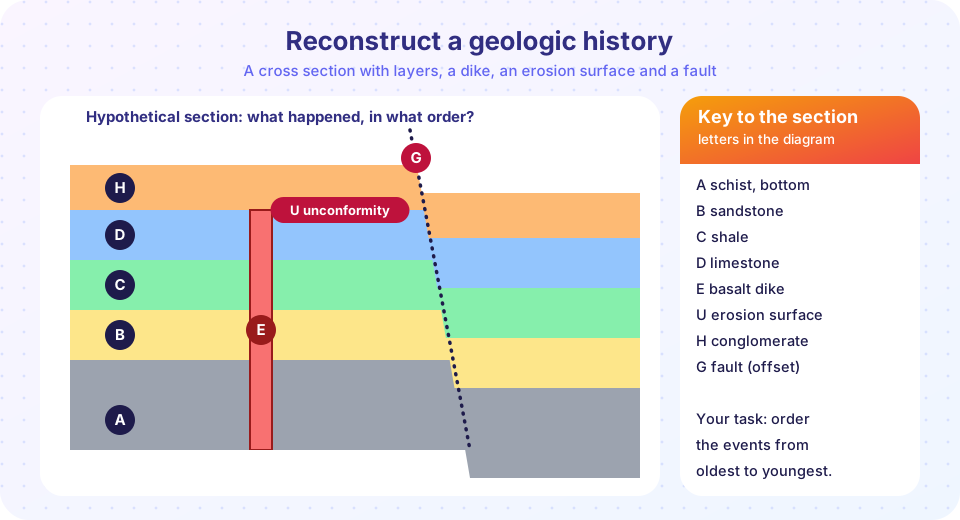
The diagram shows a hypothetical cross section. From the bottom up there is a schist (A), a sandstone (B), a shale (C) and a limestone (D), all flat-lying. A vertical basalt dike (E) cuts through A, B, C and D but does not continue upward. An irregular erosion surface (U) truncates the top of the limestone. On top of that surface lies a conglomerate (H) with pebbles of limestone. Finally a fault (G) cuts through all the units, including the conglomerate, and has dropped the block on the right.
Stage 1: write the observations
List what you can see before you interpret. Good observations are simple statements:
- The dike cuts A, B, C and D.
- The dike does not cut H.
- H sits on the erosion surface and contains limestone pebbles.
- The fault cuts every unit, including H and the dike.
- A is at the base, and B, C and D are stacked in order above it.
Notice that each statement describes the picture. Statements 2 and 3 are as important as the ones about cutting: a feature that stops at a surface is evidence that the surface is younger than the feature.
Stage 2: turn rules into "older than" pairs
Apply the principles from Chapter 6 to each observation.
| Observation | Rule | Pair (older, younger) |
|---|---|---|
| B above A, C above B, D above C | Superposition | A, B; B, C; C, D |
| Dike E cuts A to D | Cross-cutting | D, E |
| Dike E stops at U | Cross-cutting | E, U |
| U cuts D | Cross-cutting | D, U |
| H lies on U | Superposition | U, H |
| H contains limestone pebbles | Inclusion | D, H |
| Fault G cuts H | Cross-cutting | H, G |
| Fault G cuts E | Cross-cutting | E, G |
Be careful with the dike and the unconformity. Because the dike stops at the erosion surface, the dike formed before the surface was cut and before H was laid down. If the dike had cut H too, the order of E and H would be the other way round. The picture shows that it does not.
Stage 3: sort the events by program
Putting eight pairs in order by hand is easy for this picture, but the method matters for larger problems. The first TryIt builds the order automatically using a topological sort and detects contradictions. Add or remove a pair and see what happens. For example, adding the pair (G, A) would say the fault is older than the schist, which contradicts the fact that the fault cuts it, and the program reports a cycle.
Press Run (or Ctrl + Enter) to see the result here.
Program input · what you'd type while the program runs
Type the answers before you press Run, one per line. Each time the program reads a line (with input()), it gets the next line from this box.
Stage 4: add numbers
Suppose a laboratory has dated several rocks with uranium-lead on zircon:
- An ash bed in unit B: 210 million years.
- An ash bed in unit D: 190 million years.
- The dike E: 150 million years.
- An ash bed at the base of H: 120 million years.
- The fault G is not dated, but it cuts a layer of H.
Use these to answer three questions.
How long did the erosion surface U last? The dike (150 Ma) is older than U, and the base of H (120 Ma) is younger than U. So U formed in the interval between 150 and 120 million years ago. It cannot have lasted longer than 30 million years, but could have been much shorter. The gap between D and H is at most 190 − 120 = 70 million years from the youngest dated layer of D, and the dike narrows this.
What is the deposition rate between the two dated ash beds? Suppose the distance between the two ash beds in the section is 100 m. The time between them is 210 − 190 = 20 million years. The rate is 100 m / 20,000,000 years = 5 × 10⁻⁶ m per year, or 5 mm per thousand years, which is slow, typical of deep-water mud or limestone.
When did the fault move? It is younger than the base of H, so it is younger than 120 Ma. Only an additional constraint (such as a dated unit that covers the fault) could narrow it further.
Press Run (or Ctrl + Enter) to see the result here.
Program input · what you'd type while the program runs
Type the answers before you press Run, one per line. Each time the program reads a line (with input()), it gets the next line from this box.
Stage 5: write the report
A good geologic history has four parts: a sequence (numbered events), a justification for each step (the rule used), a numeric summary (ages, gaps, rates) and a list of uncertainties (what you assumed and what more data would settle). For this section, a model answer is:
- Schist A formed deep and was exposed at the surface (older than everything above; a nonconformity if B lies directly on it).
- Sandstone B, shale C and limestone D were deposited in that order (superposition), about 210 to 190 Ma.
- Basalt magma intruded as dike E about 150 Ma (cross-cutting; the dike cuts A to D).
- The area was uplifted and eroded, forming surface U between about 150 and 120 Ma.
- Conglomerate H was deposited on U, containing limestone pebbles from D (inclusion), starting about 120 Ma.
- Fault G cut the whole sequence after the base of H was laid down, younger than 120 Ma.
The uncertainties include the true duration of U, the age of fault G and whether D was originally thicker.
Extension tasks
- Redraw the section if the dike also cut H. How does the order change? How would the picture change?
- Sketch the section after restoring fault G (remove the offset). Which feature gives the amount of slip? Use the offset of a marker bed.
- Draw a topographic profile along the top surface, and describe how a stream would cross the fault.
- Compute the net slip if the vertical offset (throw) of the unconformity across the fault is 28 m and the fault dips 65° (see Chapter 5).
Check your understanding
Quick check · 5 questions
of 5 answered You scored / 5 · perfect!
-
1. The dike stops at the erosion surface and does not enter the conglomerate above it. What does this show?
A feature truncated by a surface and not found above it formed before the overlying layers. -
2. Limestone pebbles are found in conglomerate H. Which relationship does this show?
An inclusion is older than the rock that contains it. -
3. An ash bed in B is 210 Ma and in D is 190 Ma, with 100 m of rock between them. What is the deposition rate?
100 m / 20,000,000 years = 5 × 10⁻⁶ m per year = 5 mm per thousand years. -
4. If a proposed order puts the fault before the layer it cuts, a topological sort will report:
Contradictory pairs create a cycle, which has no valid order. -
5. The dike is dated at 150 Ma and the base of H at 120 Ma. The erosion surface lasted at most:
It formed between the two dates, so at most 150 − 120 = 30 Myr.
Summary
- Convert a diagram into observations, then into "older than" pairs using named rules.
- A sort that finds a cycle has exposed a contradiction.
- Radiometric ages bracket events; differences give gap lengths and deposition rates.
- A good report lists the sequence, the reason for each step, the numbers and the uncertainties.
Next: Practice problem set
Track your progress
Create a free account to tick off lessons and pick up where you left off on any device.
of Geology lessons completed