


















Lesson 1 of 48 · Getting Started
Course map
A guided tour of the whole Geology course: who it is for, how to study it, and what each of the nine chapters covers, from minerals to maps.
Geology is the science of the solid Earth: what it is made of, how it moves, how it got to be the way it is, and how people can live safely and wisely on it. It is also one of the most visual sciences. A road cut shows you a story that took millions of years to write, and a pebble in your hand can be older than any living thing.
This course takes you from "what is a rock?" to reading a geologic map and reasoning like a field geologist. You do not need any earlier geology. You need curiosity, basic arithmetic, and a willingness to look carefully at pictures, samples and data.
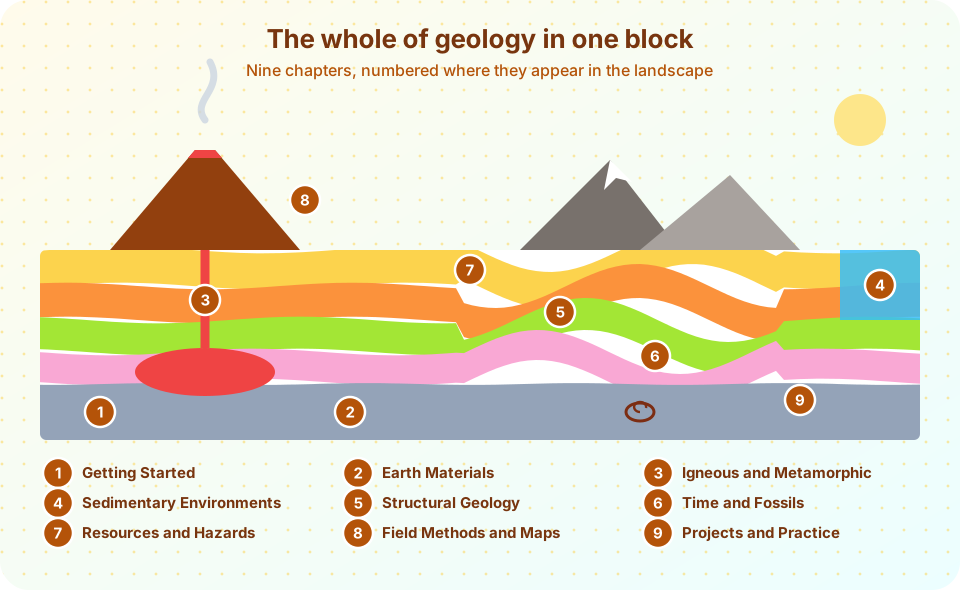
What you will learn
- Who this course is for and what you should know before you start
- How the nine chapters fit together into one story
- A study method that works for a visual, evidence-based science
- Where the interactive examples and quizzes appear
Who this course is for
The course follows the common core of international school geology and Earth science: Cambridge IGCSE and A Level, the IB, and US Earth science and AP Environmental Science all cover the same ideas. It is also a friendly start for adults who want to understand the landscapes they travel through. Everything uses SI units (meters, kilograms, degrees Celsius) and metric measurements, and US spelling.
You should be comfortable with fractions, percentages and reading a graph. A few lessons use small Python programs to draw graphs or run simple calculations. You never have to write code from scratch: you change a number, press Run, and watch what happens.
The nine chapters
Chapters 1 to 3
- Getting Started
- Earth Materials
- Igneous and Metamorphic
Chapters 4 to 6
- Sedimentary
- Structural Geology
- Time and Fossils
Chapters 7 to 9
- Resources and Hazards
- Field Methods
- Projects
Chapter 1 gives you the big frame: Earth as a set of systems, the layers inside the planet, and plate tectonics, the single theory that ties almost everything together. Chapter 2 introduces the materials: minerals, how to identify them, and the rock cycle. Chapter 3 explains rocks born from melting and from heat and pressure. Chapter 4 explains rocks built from the broken pieces of older rocks, and the environments in which they form.
Chapters 5 to 9 move on to deformation of rocks, geologic time and fossils, natural resources and hazards, field and map skills, and finally projects and practice. Each chapter begins with an overview lesson and ends with a review lesson that has a longer quiz.
How to study geology
Geology rewards a particular habit: always ask what process made this, and how long it took. A layer of sandstone is not just a "rock". It is a record of a river or a beach, and the grains tell you how fast the water moved. A fold in a mountain is a record of squeezing. If you practice turning each observation into a process, the facts stop being a list to memorize.
A few practical tips:
- Look at the picture first. Each lesson has an illustration near the top. Try to explain it in your own words before reading the text.
- Do the examples. The runnable examples are short on purpose. Change one number and predict the result before you press Run.
- Test yourself. The quiz at the end of each lesson is not a grade. Wrong answers are the most useful part, because each one comes with an explanation.
- Use real rocks. If you can, collect a few samples, a hand lens, a coin and a steel nail. Chapter 2 turns them into a mineral identification kit.
Key terms for the whole course. A mineral is a naturally occurring, solid, inorganic crystal with a definite chemistry. A rock is a solid mass made of one or more minerals (or mineral-like materials). Strata are layers of sedimentary rock. A geologic map shows which rocks are found at the surface of a region.
Common misconceptions
"The Earth's interior is a big ball of liquid lava." It is not. Almost all of the mantle is solid rock that flows extremely slowly. Only the outer core is liquid, and it is made of metal, not rock. Chapter 1 explains how we know.
"Geologic events are always slow." Most change is slow, but not all. An earthquake lasts seconds and a landslide can happen in minutes. Geology is about both slow processes and sudden ones.
Try it
The first example turns the age of the Earth into a single day, which is a classic way to feel deep time. Earth forms at midnight, and the present moment is the next midnight. You will meet each of these events later in the course.
Press Run (or Ctrl + Enter) to see the result here.
Program input · what you'd type while the program runs
Type the answers before you press Run, one per line. Each time the program reads a line (with input()), it gets the next line from this box.
The second example is a small explorer for this course. Click a chapter to see the guiding question it answers.
Check your understanding
Quick check · 4 questions
of 4 answered You scored / 4 · perfect!
-
1. Which description of the Earth's interior is correct?
The mantle is solid rock that creeps over millions of years. Only the outer core is liquid, and it is iron and nickel. -
2. What question should a geologist ask first about a rock or landform?
Geology links observations to processes and time. Color and names help, but the process question gives meaning. -
3. Which chapter of this course covers folds and faults?
Structural Geology (Chapter 5) is about how rocks deform: folds, faults and the forces behind them. -
4. On the 24-hour clock of Earth history, modern humans appear...
Humans have existed for roughly 300,000 years, a tiny fraction of 4.54 billion years.
Summary
- Geology studies the solid Earth: materials, structure, processes, time, resources and hazards.
- The course has nine chapters; each starts with an overview and ends with a review.
- Look at the picture, ask what process made it, and test yourself often.
- Earth is about 4.54 billion years old, and humans are a very recent arrival.
Track your progress
Create a free account to tick off lessons and pick up where you left off on any device.
of Geology lessons completed