


















Lesson 16 of 48 · Igneous and Metamorphic Processes
Chapter 3 review: Igneous and metamorphic processes
Review magma, igneous textures, volcanoes and metamorphic rocks with a recap table, a practice tool and a ten-question quiz.
Chapter 3 covered two families of rock born from the Earth's heat. You have seen how rock melts, how the silica content and cooling rate of magma make granite or basalt, why some volcanoes explode and others flow, and how heat and pressure rewrite rocks without melting them. This lesson collects the key ideas, gives you tools to practice with, and ends with a longer quiz.
What you will learn
- The main facts and numbers of the chapter
- How composition, texture and setting connect
- Where your understanding is solid and where it needs work
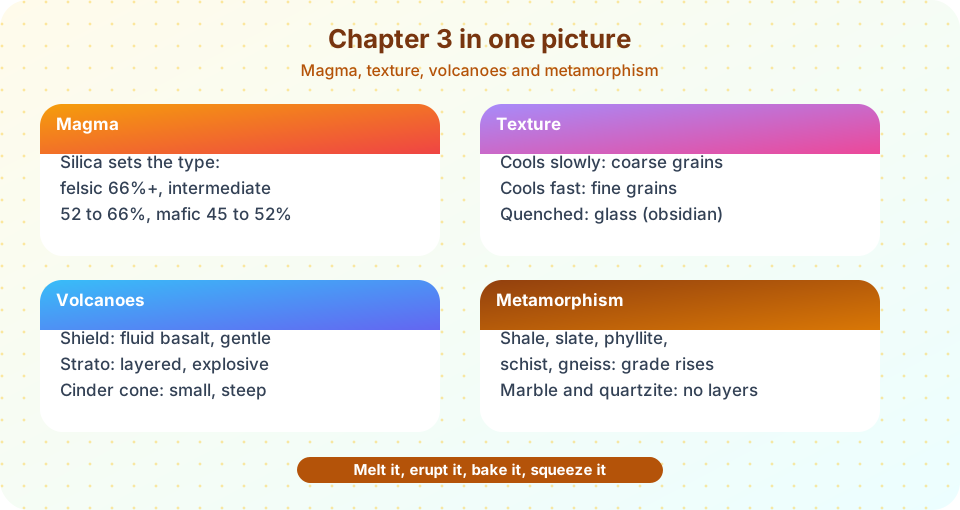
The chapter at a glance
| Topic | Main idea | Facts to know |
|---|---|---|
| Melting | Decompression, flux and heat transfer melt the mantle and crust | Mafic from mantle; felsic from crust or differentiation |
| Composition | Silica sets viscosity and color | Mafic 45 to 52%, intermediate 52 to 66%, felsic above 66% |
| Texture | Cooling rate controls grain size | Coarse: slow, intrusive; fine: fast, extrusive; glass: very fast |
| Bowen's series | Order of crystallization; explains differentiation | Olivine first, quartz last |
| Volcanoes | Viscosity plus gas decides explosiveness | Shield, strato, cinder cone, dome, caldera; VEI 0 to 8 |
| Metamorphism | Heat, pressure and fluids change rock in the solid state | Slate, phyllite, schist, gneiss; marble, quartzite |
Connecting the ideas
Chain the lessons together and a whole landscape makes sense. In a subduction zone, water from the sinking plate lowers the mantle melting point (flux melting). The resulting magma rises into the crust, where some crystallizes slowly as a granitic pluton and some erupts through a stratovolcano. The heat of the pluton bakes the surrounding rock into hornfels, while the collision that drives subduction builds a mountain belt where regional metamorphism turns shale into schist. One tectonic setting produces all of the rock types in this chapter.
A useful way to revise is to practice reading a hand sample. Look for crystals or not (texture), light or dark (composition), layers or bands (foliation), and then name the rock and the story. A coarse light rock with quartz is a granite and cooled slowly underground. A banded rock with light and dark layers is a gneiss and was once deeply buried and squeezed.
Exam tip. For every igneous rock question, answer two things: composition (felsic, intermediate, mafic) and texture (coarse, fine, glassy, vesicular). For every metamorphic rock question, name the protolith, the grade and whether it is foliated.
Common misconceptions
Magma and lava are the same (magma is underground). Dark rock is older (color reflects composition). All volcanoes erupt lava gently (viscosity and gas control the style). Metamorphic rocks are melted (they change in the solid state). Marble and quartzite are foliated (they are not).
Try it
The first example is a practice tool. It names a metamorphic rock from the protolith and the grade, and it uses a sticky-magma score to guess an eruption style. Edit the inputs.
Press Run (or Ctrl + Enter) to see the result here.
Program input · what you'd type while the program runs
Type the answers before you press Run, one per line. Each time the program reads a line (with input()), it gets the next line from this box.
The second example is a deck of flash cards for the chapter.
Check your understanding
Quick check · 10 questions
of 10 answered You scored / 10 · perfect!
-
1. Which pair of conditions gives the most explosive eruptions?
Sticky magma traps expanding gas, so pressure builds until the magma shatters. -
2. A fine-grained, dark, vesicular rock is most likely
Dark color indicates mafic composition; fine texture and holes indicate fast cooling with trapped gas. -
3. Which mineral appears first as a mafic magma cools?
Olivine is at the high-temperature end of Bowen's discontinuous branch. -
4. A sill is
A sill lies parallel to and between layers; a dike cuts across them. -
5. Limestone at medium grade becomes
Calcite recrystallizes into marble at all grades. -
6. What turns shale into slate?
Slate forms from shale in low-grade regional metamorphism. -
7. Which volcano type is built of alternating layers of lava and ash?
Stratovolcanoes build steep cones from alternating layers of lava and pyroclastic material. -
8. A volcanic eruption has VEI 6. Compared with VEI 4, it erupted roughly
Each step is about ten times, so two steps is about 100 times. -
9. Which of the following is NOT an agent of metamorphism?
Cementation is part of lithification of sediment. Metamorphism uses heat, pressure and fluids. -
10. Large crystals set in a fine groundmass indicate
Phenocrysts grew slowly at depth, and the groundmass cooled quickly later.
Summary
- Magma forms by decompression, flux melting or heat transfer; silica controls its stickiness.
- Texture records cooling rate; composition and texture name an igneous rock.
- Viscosity and gas decide whether a volcano flows or explodes.
- Metamorphism changes rock in the solid state; foliation reflects differential stress; grade rises from slate to gneiss.
Track your progress
Create a free account to tick off lessons and pick up where you left off on any device.
of Geology lessons completed