


















Lesson 34 of 48 · Resources and Hazards
Energy and groundwater
Learn how coal, oil and gas form and become trapped, how porosity and permeability control fluid flow, and how Darcy's law describes groundwater.
Two of the most valuable things geologists find are hidden in the pore spaces of rock: hydrocarbons and water. Oil and gas power transport and industry, and groundwater provides drinking water and irrigation for billions of people. Both are fluids that moved through rock and ended up in a place where something stopped them. Both are found with the same tools: understanding rock layers, structures and how fluids flow.
This lesson follows the story of each resource from source to storage, and gives you the equation that describes the slow flow of fluid through rock, Darcy's law. It connects the folds and faults of the earlier chapters to practical outcomes: a trap needs a structure.
What you will learn
- How coal forms and how its rank increases with burial.
- The five parts of a petroleum system and why timing matters.
- Porosity, permeability and hydraulic conductivity.
- How to use Darcy's law and understand aquifers, drawdown and groundwater hazards.
Key terms
Porosity is the fraction of a rock's volume that is empty space.
Permeability is how easily fluid can flow through connected pores.
Aquifer is a rock or sediment body that can store and transmit useful amounts of groundwater.
Water table is the top of the saturated zone in an unconfined aquifer.
Hydraulic conductivity (K) is a measure of how fast water moves through a material, in m/s.
Coal: buried plants
Coal forms when plant material piles up in swampy places faster than it rots, and then is buried and heated. Each step squeezes out water and gas and raises the share of carbon. This progression is the rank of the coal:
| Rank | Character |
|---|---|
| Peat | Loose, brown, still plainly plant material |
| Lignite | Soft brown coal with high moisture |
| Sub-bituminous and bituminous | Harder, black, higher energy content |
| Anthracite | Hard, shiny, highest carbon, deepest burial or most heat |
The great coal-forming swamps of the Carboniferous gave the period its name. Coal burning releases carbon dioxide stored for hundreds of millions of years, which links this lesson to climate science.
Oil and gas: the petroleum system
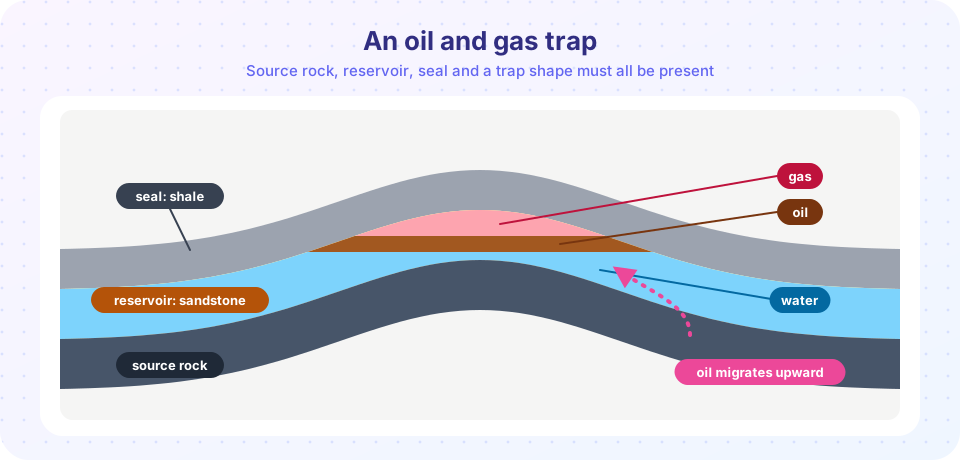
A petroleum accumulation needs five things at the right time.
- Source rock. Fine-grained rock, such as shale, rich in organic matter from algae and plankton. Buried and heated, the organic matter (kerogen) cracks into oil and then gas.
- Maturation. Heat is critical. With a geothermal gradient of about 25 to 30 °C per kilometer, the "oil window" of roughly 60 to 120 °C is found at depths of about two to four kilometers. Deeper still, only gas survives.
- Migration. Oil and gas are lighter than water, so they rise through permeable rock and along faults.
- Reservoir. A porous, permeable rock such as sandstone or fractured limestone, with porosity often 10 to 30 percent.
- Seal and trap. An impermeable cap rock, such as shale or salt, above a shape that holds the fluid. Structural traps include anticlines and fault traps. Stratigraphic traps form where a reservoir pinches out. Salt domes raise and tilt layers around them.
Inside a reservoir the fluids sort by density: gas on top, then oil, then water, with flat contacts between them. If the seal forms after the oil has already passed through, or the structure forms after migration has finished, the trap is empty. That is why timing matters as much as the presence of each ingredient.
Not all hydrocarbons are in classic traps. Shale gas and tight oil remain in the fine-grained source rock itself and are extracted by drilling long horizontal wells and fracturing the rock with pressurized fluid, a technique known as hydraulic fracturing. Geologists also manage risks such as induced earthquakes from wastewater injection.
Porosity and permeability
Two properties describe a reservoir or an aquifer.
Porosity is φ = V(pores) / V(total). A clean sandstone may have 25 percent; a granite 1 percent or less. Porosity measures how much fluid a rock can hold, not how easily it flows.
Permeability describes flow, and it depends on whether pores are connected and how wide the connections are. Clay can have a porosity of 40 percent or more yet almost no permeability, because its pores are microscopic. A fractured granite has tiny porosity but can yield water through connected cracks. In hydrogeology, permeability is expressed as hydraulic conductivity, K, in meters per second.
| Material | Typical K (m/s), order of magnitude |
|---|---|
| Clean gravel | 10⁻² |
| Clean sand | 10⁻⁴ |
| Silt | 10⁻⁷ |
| Clay | 10⁻¹⁰ or less |
The values span eight orders of magnitude, so permeability controls everything about groundwater.
Darcy's law
In 1856 Henry Darcy, an engineer working on the water supply of Dijon, France, found that the flow through a column of sand is proportional to the head loss and inversely proportional to the length. In modern form, the specific discharge (flow per unit area) is
q = K · i where i = Δh / L is the hydraulic gradient
The actual speed of water in the pores is larger, because water travels only through the pore space:
v = q / n_e (seepage velocity; n_e is the effective porosity)
Example: a sand with K = 1 × 10⁻⁴ m/s, a gradient i = 0.01 and n_e = 0.30 has q = 1 × 10⁻⁶ m/s and v = 3.3 × 10⁻⁶ m/s, which is about 0.29 meters per day. A pollutant would take about a year to move 100 meters. Groundwater is slow.
Aquifers and wells
An unconfined aquifer has a water table that you can reach by digging; it rises and falls with recharge from rain. A confined aquifer is sandwiched between low-permeability layers called aquitards and is under pressure, so a well in it may flow without pumping (an artesian well). Recharge areas, discharge areas such as springs and rivers, and flow paths together form the groundwater system.
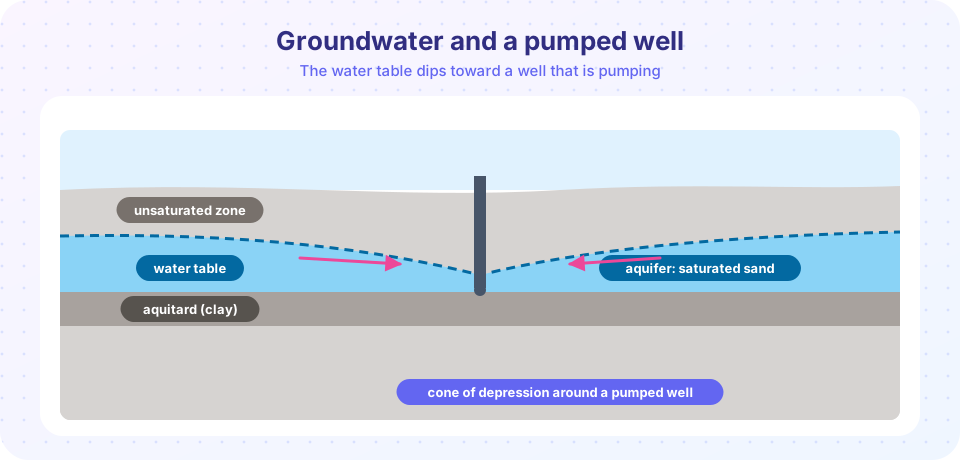
Pumping water out lowers the water table around the well, forming a cone of depression. If pumping exceeds recharge, the water table drops. Consequences include:
- Dry wells and loss of spring and river flow.
- Land subsidence, when drained clay layers compact. Parts of California's Central Valley and Mexico City have sunk by meters.
- Saltwater intrusion near coasts, when pumping pulls seawater into the aquifer.
- Contamination, since slow flow means that spills and leaking tanks can persist for decades. Protecting recharge areas and mapping flow paths is as important as managing quantity.
Common misconceptions
"Oil sits in underground lakes." It is held in the pore spaces of solid rock, like water in a sponge.
"Groundwater flows in underground rivers." Except in caves in limestone, it seeps through pores and fractures at meters per day or much less.
"More porosity always means a better aquifer." Clay is very porous and almost useless as an aquifer, because it is not permeable.
"Groundwater is renewable everywhere." Some aquifers are filled with water from ice-age climates and recharge extremely slowly.
Try it
Press Run (or Ctrl + Enter) to see the result here.
Program input · what you'd type while the program runs
Type the answers before you press Run, one per line. Each time the program reads a line (with input()), it gets the next line from this box.
Press Run (or Ctrl + Enter) to see the result here.
Program input · what you'd type while the program runs
Type the answers before you press Run, one per line. Each time the program reads a line (with input()), it gets the next line from this box.
Press Run (or Ctrl + Enter) to see the console output here.
No output.
Check your understanding
Quick check · 6 questions
of 6 answered You scored / 6 · perfect!
-
1. Which property describes how easily fluid flows through a rock?
Permeability describes connected pathways for flow; porosity just measures empty space. -
2. In an oil reservoir the fluids from top to bottom are:
They separate by density: gas, then oil, then water. -
3. K = 10⁻⁵ m/s and i = 0.02. What is the specific discharge q?
q = K × i = 10⁻⁵ × 0.02 = 2 × 10⁻⁷ m/s. -
4. What is a cone of depression?
Pumping draws the water table down near the well. -
5. Which coal rank has the highest carbon content?
Anthracite is the highest rank. -
6. Why is clay a poor aquifer despite high porosity?
Fine pores make flow extremely slow, so clay acts as an aquitard.
Summary
- Coal rank increases from peat to anthracite with heat and burial.
- A petroleum system needs source, maturation, migration, reservoir and seal in the right order.
- Porosity is storage; permeability (hydraulic conductivity) is flow.
- Darcy's law:
q = K i, and the seepage velocity isq / n_e. - Pumping makes cones of depression and can cause dry wells, subsidence and saltwater intrusion.
Track your progress
Create a free account to tick off lessons and pick up where you left off on any device.
of Geology lessons completed