


















Lesson 15 of 48 · Igneous and Metamorphic Processes
Metamorphic rocks
Learn how heat, pressure and fluids transform rocks, the difference between foliated and nonfoliated textures, metamorphic grade, facies and plate tectonic settings.
Metamorphic rocks are the Earth's rewritten stories. A soft gray shale is buried deep in a growing mountain range, and millions of years later it is a glittering schist full of garnets. A fossil-filled limestone becomes a gleaming marble statue. The word metamorphism comes from the Greek for "change of form": the rock changes, but it never completely melts.
This lesson explains what causes metamorphism, how to recognize the textures that result, and how the minerals tell you how hot and how deep a rock once was.
What you will learn
- The three agents of metamorphism: heat, pressure and fluids
- Contact and regional metamorphism, and where each happens
- How foliation forms and how to tell foliated from nonfoliated rocks
- The grade sequence from slate to gneiss, and index minerals
Key terms
Protolith: the original rock before metamorphism. Metamorphic grade: the intensity of metamorphism (low, medium or high). Foliation: a planar texture formed by the alignment of platy or elongated minerals. Recrystallization: growth of new mineral grains in the solid state. Index mineral: a mineral that appears at a particular grade, such as garnet or sillimanite.
Agents of metamorphism
Heat. Heat is the most important agent. It supplies the energy for atoms to rearrange into minerals that are stable at the new conditions. Heat comes from magma intrusions or from deep burial, because temperature rises with depth.
Pressure. Two kinds act. Confining pressure squeezes equally from all directions with depth, making minerals pack into denser structures. Differential stress is stronger in one direction, typical of mountain building where plates collide. It squashes the rock like a vice and produces foliation.
Chemically active fluids. Hot water rich in dissolved ions carries material in and out of the rock, speeding up reactions. When fluids change the bulk chemistry of a rock, the process is called metasomatism.
All three work together, and the protolith matters too: a shale and a limestone exposed to the same conditions make different rocks, because they started with different minerals.
Where does metamorphism happen?
Contact metamorphism happens next to an igneous intrusion. Heat from the magma "bakes" the surrounding rock in a halo called an aureole, which may be a few meters to a few kilometers wide. Pressure is low, so the rock often does not become foliated. Typical products are hornfels (dense, fine, tough) and marble.
Regional metamorphism happens over vast areas during mountain building, where rocks are buried deep and squeezed by colliding plates. It produces most foliated rocks. Large parts of the continental shields, the ancient cores of the continents, are exposed regional metamorphic rocks.
Other settings include fault zones (crushing and shearing produce mylonite), subduction zones (high pressure, low temperature: blueschist), burial metamorphism in deep sedimentary basins, hydrothermal alteration near hot springs and mid-ocean ridges, and impact metamorphism at meteorite craters, where extreme shock produces minerals like coesite.
Foliation: why minerals line up
Mica and chlorite crystals are flat, platy minerals. When rock is squeezed in one direction, these plates grow, rotate and recrystallize so that they lie perpendicular to the direction of maximum compression, like cards on a table pressed from above. The aligned plates make the rock split along parallel surfaces. This is foliation (from the Latin for "leaf").
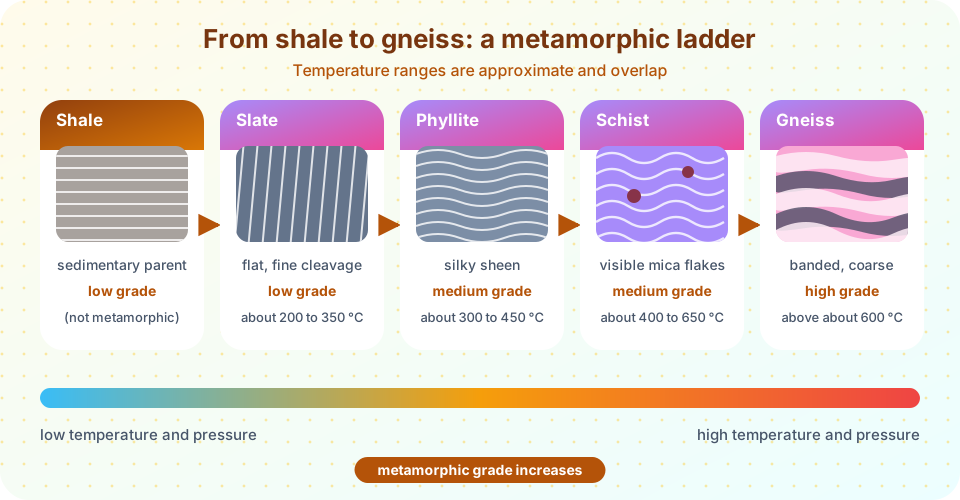
Foliated rocks form a sequence called the grade sequence, from low to high temperature and pressure:
- Slate (low grade): from shale or mudstone. Microscopic clay minerals become tiny mica. The rock splits into hard, flat sheets (slaty cleavage), useful for roofing and chalkboards.
- Phyllite: grains a little larger; a silky, wavy sheen from tiny aligned micas.
- Schist (medium grade): mica flakes big enough to see, giving a sparkly, wrinkled surface. Porphyroblasts (large crystals) of garnet, staurolite or kyanite may sit in the matrix.
- Gneiss (high grade): coarse bands of light (quartz and feldspar) and dark (biotite, amphibole) minerals separated by heat and pressure, giving gneissic banding. At even higher temperature the rock begins to melt partly, giving migmatite, a mixture of metamorphic and igneous rock.
Nonfoliated rocks
Some rocks have no foliation, either because the minerals are not platy or because stress was uniform.
- Marble: from limestone or dolostone. Calcite grains recrystallize into an interlocking mosaic, erasing fossils and layering. Sculptors have prized it for millennia.
- Quartzite: from quartz sandstone. Grains fuse into a dense, very hard rock that breaks through the grains rather than around them.
- Hornfels: fine, hard rock from contact metamorphism of shale or basalt.
- Anthracite: a hard, shiny, high-grade coal produced when coal is subjected to heat and pressure.
| Protolith | Low grade | Medium grade | High grade |
|---|---|---|---|
| Shale | slate | phyllite, schist | gneiss |
| Limestone | marble | marble | marble |
| Quartz sandstone | quartzite | quartzite | quartzite |
| Basalt | greenschist | amphibolite | granulite |
Reading grade from minerals
Different minerals are stable at different temperatures and pressures. In 1912 the Scottish geologist George Barrow noticed that in the Scottish Highlands the same shale contained a succession of new minerals as he moved toward more intensely metamorphosed areas: chlorite, then biotite, then garnet, then staurolite, then kyanite, then sillimanite. Each marks a higher grade. These are index minerals. The three aluminum silicate polymorphs (andalusite, kyanite and sillimanite, all Al₂SiO₅) are especially informative, because which one forms depends on pressure and temperature.
More generally, geologists group rocks into metamorphic facies, sets of minerals that form under the same conditions, such as greenschist (low to medium temperature), amphibolite (medium to high), granulite (high temperature), blueschist (high pressure, low temperature, at subduction zones) and eclogite (very high pressure). A mineral assemblage can therefore act like a thermometer and a pressure gauge, which lets geologists reconstruct how deeply a rock was buried and how hot it got.
Common misconception: "Metamorphic rocks are melted and refrozen." Metamorphism happens in the solid state. When melting does start, the rock begins turning into magma.
Common misconception: "Pressure and heat always make rocks harder and layered." Many metamorphic rocks (marble, quartzite) are not layered, and the type of rock depends on the starting material as much as on the conditions.
Common misconception: "Foliation is the same as bedding." Bedding is a sedimentary layering. Foliation forms by metamorphic alignment of minerals and often cuts across the original bedding.
Try it
The first example sketches the main metamorphic facies on a pressure-temperature diagram. The boundaries are schematic and overlap in reality. Notice where subduction zones plot compared with mountain belts.
Press Run (or Ctrl + Enter) to see the result here.
Program input · what you'd type while the program runs
Type the answers before you press Run, one per line. Each time the program reads a line (with input()), it gets the next line from this box.
The second example shows foliation forming. Differential stress squeezes the rock from the sides. As you increase it, the random flakes of mica rotate and line up perpendicular to the squeeze. It is a demonstration of the idea.
Check your understanding
Quick check · 6 questions
of 6 answered You scored / 6 · perfect!
-
1. Which pair is correctly matched (protolith, metamorphic rock)?
Limestone recrystallizes into marble; shale gives slate; quartz sandstone gives quartzite. -
2. Why do platy minerals in foliated rocks line up?
Under directed stress, mica crystals grow and rotate to lie perpendicular to the direction of greatest compression. -
3. Which rock sequence shows increasing metamorphic grade?
Slate is low grade, then phyllite, schist and finally high-grade gneiss. -
4. A 'baked' zone around a pluton is called
Heat from the intrusion causes contact metamorphism in a surrounding aureole. -
5. Which metamorphic facies forms at subduction zones (high pressure, low temperature)?
Cold, sinking oceanic crust is rapidly pressurized, producing blueschist and eclogite. -
6. Garnet appearing in a schist is an example of
Index minerals such as garnet mark specific metamorphic grades.
Summary
- Metamorphism changes rock in the solid state by heat, pressure and fluids; the protolith matters.
- Contact metamorphism is local (near intrusions); regional metamorphism is widespread (mountain belts).
- Foliation forms when platy minerals align perpendicular to differential stress.
- Grade sequence: slate, phyllite, schist, gneiss; nonfoliated: marble, quartzite, hornfels.
- Index minerals and facies reveal the pressure and temperature history.
Next: Chapter 3 review
Track your progress
Create a free account to tick off lessons and pick up where you left off on any device.
of Geology lessons completed