


















Lesson 4 of 48 · Getting Started
Plate tectonics basics
Understand plate tectonics: the evidence from Wegener to seafloor spreading, the three kinds of plate boundary, and what drives the plates.
Why are most volcanoes and earthquakes found in narrow belts instead of scattered at random? Why do the coastlines of South America and Africa look like jigsaw pieces? Why are the world's tallest mountains in lines? One theory explains all of this and much more: plate tectonics. It is to geology what evolution is to biology, the framework that makes the rest of the subject make sense.
The Earth's rigid outer shell, the lithosphere, is broken into pieces called plates. They move slowly over the weaker asthenosphere beneath. Where plates meet, the interesting things happen.
What you will learn
- The evidence that led from continental drift to plate tectonics
- The three kinds of plate boundary and a landform for each
- Why the oceanic crust is young and the continental crust is old
- What pushes and pulls the plates
Key terms
Plate: a rigid slab of lithosphere, oceanic or continental, or both. Divergent boundary: plates move apart and new crust forms. Convergent boundary: plates move together; one may sink in subduction. Transform boundary: plates slide past each other horizontally. Subduction: one plate sinking beneath another into the mantle.
From drifting continents to moving plates
In 1912 the German scientist Alfred Wegener proposed continental drift: the continents had once been joined in a supercontinent he called Pangaea ("all land") and had drifted apart. His evidence was strong. The coastlines fit, especially if you use the edge of the continental shelf. Identical fossils appear on continents now separated by oceans: the freshwater reptile Mesosaurus in South America and Africa, and the seed fern Glossopteris across India, Africa, Australia, South America and Antarctica. Rock layers and mountain chains match up across the Atlantic, and ancient glacial scratches point to an ice sheet that makes sense only if the continents were once together near the pole.
Most scientists rejected Wegener because he had no convincing mechanism. How could continents plough through solid ocean floor? He guessed at tidal forces and the Earth's spin, and those were far too weak.
The missing pieces arrived after World War II. Ships and submarines mapped the ocean floor and found a continuous mid-ocean ridge, an underwater mountain chain about 65,000 km long. Rocks dredged from the sea floor turned out to be young, nowhere older than about 180 million years, while continents have rocks over 4 billion years old. In 1962 Harry Hess proposed seafloor spreading: magma rises at the ridge, forms new oceanic crust, and the crust moves away on both sides, like two conveyor belts.
The proof came from magnetism. Iron-rich minerals in cooling basalt lock in the direction of Earth's magnetic field. The field has reversed many times, so the sea floor is striped in alternating normal and reversed bands that are mirror images on each side of a ridge. In 1963 Fred Vine and Drummond Matthews (and independently Lawrence Morley) explained this pattern. It is a tape recorder for the planet's magnetic history. By the late 1960s the pieces were combined into plate tectonics.
The three kinds of plate boundary
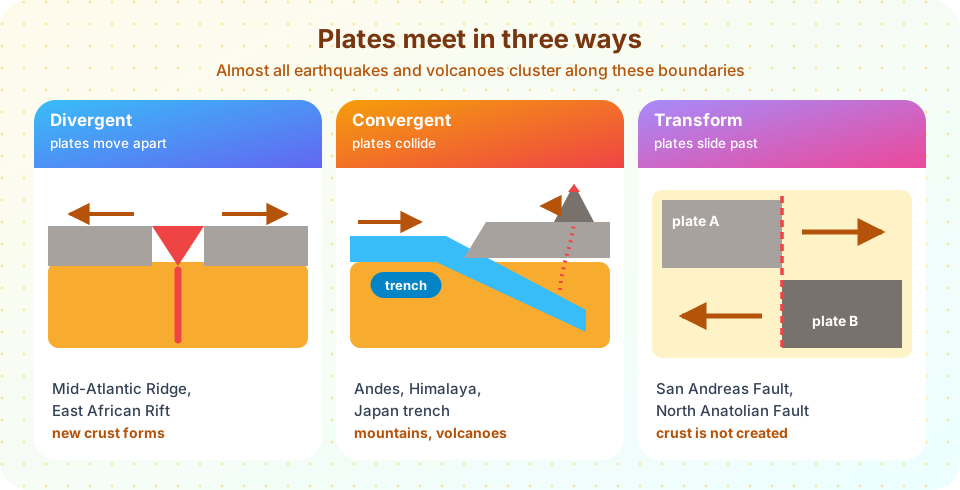
Divergent boundaries. Plates move apart. Hot mantle rock rises and partly melts as pressure drops, and the magma creates new crust. Under the ocean this builds mid-ocean ridges (the Mid-Atlantic Ridge, with a spreading rate around 2 to 5 cm per year). On land it splits continents, as in the East African Rift. Earthquakes are shallow and volcanism is mostly basaltic.
Convergent boundaries. Plates move together. What happens depends on which kinds of crust meet:
- Oceanic meets continental: the denser oceanic plate sinks beneath the continent in subduction, forming a deep ocean trench and, as the sinking plate releases water that triggers melting in the mantle above, a chain of volcanoes on the continent. The Andes of South America are the classic example.
- Oceanic meets oceanic: the older, colder, denser plate subducts and a curved line of volcanic islands (an island arc) forms: Japan, the Aleutians, the Mariana Islands.
- Continental meets continental: neither crust is dense enough to sink, so they crumple and thicken, making huge mountain ranges. India has been colliding with Eurasia for about 50 million years, raising the Himalaya.
Subduction zones host the world's largest earthquakes and the deepest ones, because the sinking slab can break as deep as about 700 km.
Transform boundaries. Plates slide past each other and crust is neither made nor destroyed. Friction locks the sides together until the stress releases in an earthquake. The San Andreas Fault in California, where the Pacific Plate moves northwest relative to the North American Plate at around 3 to 5 cm per year, is the famous example.
Most of the action is concentrated around the Pacific Ocean in the Ring of Fire, which hosts roughly 90% of the world's earthquakes and most active volcanoes. A few volcanoes sit in plate interiors above hotspots, such as Hawaii, where a plume of hot rock rises from deep in the mantle and the plate drifts over it, leaving a chain of older islands.
What moves the plates?
Plates move at about the speed fingernails grow, from roughly 1 or 2 cm per year up to more than 10 cm per year for the fastest. Scientists can now measure this directly with GPS stations that move a few centimeters each year. The driving forces are debated in detail, but the main ones are:
- Slab pull: the cold, dense subducting edge sinks and drags the rest of the plate behind it. This is thought to be the strongest force.
- Ridge push: newly formed lithosphere is elevated at the ridge and slides down the slope of the asthenosphere.
- Mantle convection: slow circulation of the mantle, driven by heat from the interior, helps organize the whole system.
This also explains why oceanic crust is young. It is created at ridges and destroyed at subduction zones, so it is continually recycled and never survives beyond roughly 180 million years. Continents are too buoyant to subduct, so pieces of them have survived for billions of years.
Common misconception: "Continents plough through the ocean floor." Continents ride with the oceanic crust on the same plate. It is the plates, not the continents alone, that move.
Common misconception: "Plates move on a sea of liquid magma." The asthenosphere is solid but weak, and flows very slowly. Magma forms only locally.
Common misconception: "Earthquakes happen only at plate edges." Most do, but intraplate earthquakes also occur, caused by old faults and stress passing through the plate.
Try it
The first example uses the relationship age = distance / spreading rate to compute how old the sea floor should be at different distances from a ridge, for slow, medium and fast spreading. The rates are example values.
Press Run (or Ctrl + Enter) to see the result here.
Program input · what you'd type while the program runs
Type the answers before you press Run, one per line. Each time the program reads a line (with input()), it gets the next line from this box.
The second example predicts what happens when two plates converge. Pick the types of crust and read the outcome.
Check your understanding
Quick check · 5 questions
of 5 answered You scored / 5 · perfect!
-
1. Which evidence did Wegener use for continental drift?
Wegener used the fit of coastlines and matching fossils, rocks and glacial deposits. Magnetic stripes and GPS came decades later. -
2. What happens at a continent-continent collision?
Continental crust is too buoyant to subduct, so the plates crumple and thicken, as in the Himalaya. -
3. Why is no oceanic crust older than about 180 million years?
Oceanic crust is created at ridges and destroyed at subduction zones, so it is constantly renewed. -
4. The San Andreas Fault is an example of which boundary?
Plates slide horizontally past each other at transform boundaries, and crust is neither made nor destroyed. -
5. Which force is thought to be the strongest driver of plate motion?
The cold, dense edge of a subducting plate sinks and drags the plate behind it.
Summary
- Plate tectonics: the lithosphere is broken into plates that move over the weaker asthenosphere.
- Wegener's drift hypothesis was confirmed by seafloor spreading and magnetic stripes in the 1950s and 1960s.
- Divergent, convergent and transform boundaries produce ridges, trenches, volcanic arcs, mountains and faults.
- Slab pull, ridge push and mantle convection drive motion at a few centimeters a year.
- Oceanic crust is young (under about 180 million years) because it is recycled.
Next: Chapter 1 review
Track your progress
Create a free account to tick off lessons and pick up where you left off on any device.
of Geology lessons completed