


















Lesson 20 of 48 · Sedimentary Environments
Depositional environments
Learn how rivers, deltas, beaches, reefs and the deep sea each leave distinct sedimentary rocks, and how Walther's law and rock clues reveal ancient environments.
The surface of the Earth is a patchwork of places where sediment accumulates: river floodplains, desert dunes, deltas, beaches, coral reefs, the deep ocean floor. Each leaves its own signature in the rock it eventually becomes. A geologist who finds cross-bedded sandstone with mud cracks and plant fossils can say, with some confidence, that it was once a river floodplain, even if the rock now sits on a mountaintop.
That is the key idea of this lesson: the present is the key to the past. By studying modern environments, we learn to decode ancient ones.
What you will learn
- The main continental, transitional and marine environments
- The sediments, structures and fossils each environment produces
- What a facies is, and how Walther's law links vertical and lateral change
- How to interpret a vertical sequence of rock layers
Key terms
Depositional environment: the physical, chemical and biological setting where sediment accumulates. Facies: a body of sediment with distinctive characteristics that reflect its environment. Transgression: the sea advancing over the land as sea level rises. Regression: the sea retreating as sea level falls. Turbidite: a graded deposit from a turbidity current, a sediment-laden underwater flow.
Continental environments
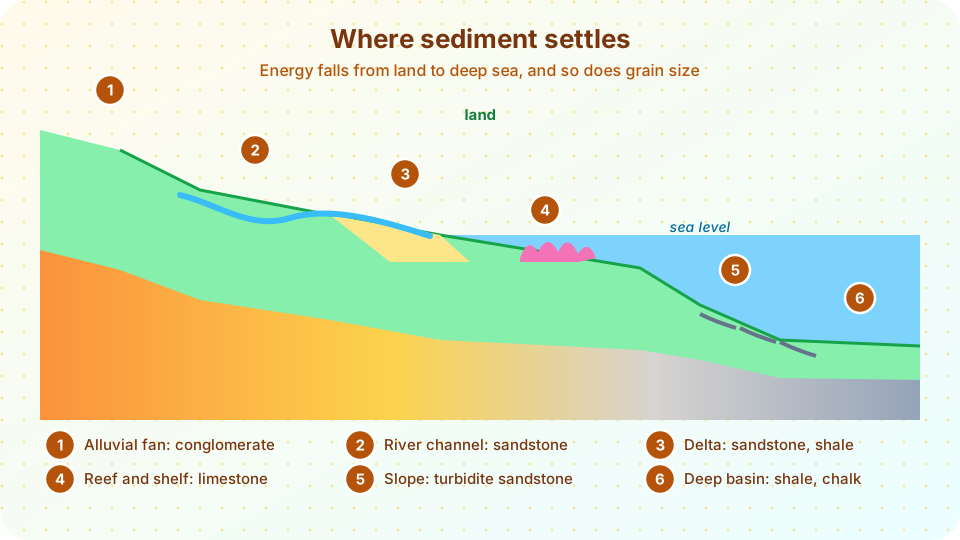
Alluvial fans are fan-shaped aprons of gravel and sand at the foot of mountain fronts, where a steep stream suddenly spreads out onto flat land and loses energy. The deposits are coarse, poorly sorted and often angular: conglomerate and breccia.
Rivers come in two main styles. Braided rivers have many shifting channels and abundant sand and gravel, typical of steep or glacier-fed streams. Meandering rivers wind across a floodplain. Their deposits form a recognizable fining-upward sequence: coarse sand and gravel at the base of the channel, then cross-bedded sand, then silt and mud on the floodplain that were deposited during floods. Mud cracks, root traces and plant fossils are common.
Lakes accumulate fine mud, often finely laminated in thin layers called varves that record the seasons, along with freshwater fossils. Deserts produce well-sorted, well-rounded sand in large-scale cross-bedded dunes, often red from iron oxide. Glaciers deposit poorly sorted till, a jumble of clay, sand and boulders.
Transitional environments
Deltas form where a river meets a standing body of water and slows down. The Mississippi, the Nile and the Ganges deltas are the large modern examples. A delta builds seaward in a predictable pattern: coarse sand near the river mouth, fine silt and mud farther out, and as the delta advances the coarse sediment is laid over the fine, giving a coarsening-upward sequence. Deltas are rich in plant matter, which is why many coal beds originated in ancient deltas and swamps.
Beaches and barrier islands are the realm of waves. Wave energy winnows away fine particles, leaving well-sorted, well-rounded sand with symmetrical ripple marks and cross-bedding.
Tidal flats and estuaries are muddy, with burrows and tidal rhythms.
Marine environments
The continental shelf is the shallow, sunlit sea floor around continents, down to about 200 meters. Sand is deposited nearer to the shore and mud farther out, resulting in sandstone and shale full of marine fossils.
Reefs grow in warm, clear, shallow, sunlit water. They are built by corals and algae. Their carbonate skeletons form limestone, often full of fossils. In warm shallow seas without much river sediment, limestone dominates; the modern Bahamas and the Great Barrier Reef are examples. Evaporites form in restricted, hot, dry basins where seawater evaporates faster than it is replenished.
The continental slope and deep sea floor receive fine material that settles slowly: clay and the shells of microscopic plankton, forming shale and, in some places, chalk. Occasionally an underwater avalanche, a turbidity current, rushes down the slope and spreads out over the deep sea floor. As it slows, the heavy particles settle first. The result is a turbidite with graded bedding: coarse at the bottom, fine at the top. The pattern was described in detail by Arnold Bouma in 1962.
Facies and Walther's law
A facies is a rock unit characterized by its features: grain size, structures and fossils. Sandstone with cross-bedding and shells is a "shoreface facies"; fine laminated shale with fish scales is a "lake facies".
In 1893 the German geologist Johannes Walther noticed something elegant. The environments that sit side by side today (beach next to shallow sea next to deep sea) appear on top of one another in a vertical stack of rock, as long as they were deposited without a break. This is Walther's law: the vertical succession of facies reflects the lateral arrangement of environments that existed side by side at the time.
This lets geologists read sea-level history. If a vertical section goes from beach sand, to shallow-marine sand, to offshore mud, then the sea was getting deeper: a transgression, as the shoreline moved landward over the site. If the section goes from mud to sand to river deposits, the sea retreated: a regression. Repeated cycles of sea-level rise and fall, driven by ice ages or by tectonics, create the layer-cake patterns of many sedimentary basins.
Reading a sequence step by step
- Describe each layer: grain size, sorting, rounding, structures, fossils, color.
- Match the features with modern environments.
- Look at the vertical trend: fining up or coarsening up?
- Propose a history, and check it against the rest of the evidence.
A rock described as "well-sorted fine sandstone with asymmetric ripples, mud cracks, and dinosaur footprints" points to a tidal flat or river margin. "Dark shale with fossils of floating plankton and no bottom-dwelling animals" suggests a deep, oxygen-poor basin.
Common misconception: "Each rock type belongs to one environment." The same rock can form in several settings. Sandstone forms in rivers, beaches and deserts. Use several clues together.
Common misconception: "Marine rocks mean the sea once covered the whole continent." Seas have flooded parts of the continents many times, but each seaway had edges, and the continents themselves have also moved.
Common misconception: "Deep sea sediment accumulates fast." Pelagic mud may accumulate at only about a millimeter per thousand years, while delta sediments can pile up meters per century.
Try it
The first example draws two typical stratigraphic columns: a transgression (fining upward as the sea deepens) and a regression (coarsening upward as the sea retreats). The grain sizes are idealized to illustrate Walther's law.
Press Run (or Ctrl + Enter) to see the result here.
Program input · what you'd type while the program runs
Type the answers before you press Run, one per line. Each time the program reads a line (with input()), it gets the next line from this box.
The second example is an environment detective. Tick the clues you observe in a rock and see which environments fit best. It is a simplified guide, since real interpretation needs many more clues.
Check your understanding
Quick check · 6 questions
of 6 answered You scored / 6 · perfect!
-
1. Which sequence is typical of a meandering river deposit?
As a meander migrates, coarse channel deposits are overlain by finer overbank sediment. -
2. Graded bedding, with coarse sediment at the base and fine at the top, is characteristic of
A turbidity current drops its heaviest grains first as it slows. -
3. Walther's law states that
Environments that were side by side stack vertically as the shoreline moves. -
4. A vertical section that goes from beach sand to deep marine mud records
Deeper-water facies on top of shallow-water facies means the sea deepened. -
5. Limestone with abundant coral fragments most likely formed in
Corals need warm, clear, shallow, sunlit water. -
6. Which deposit is typically poorly sorted?
Ice carries and dumps all sizes together without washing.
Summary
- Each environment (alluvial fan, river, desert, delta, beach, shelf, reef, deep sea) leaves characteristic sediments, structures and fossils.
- Rivers give fining-upward sequences; deltas give coarsening-upward sequences; turbidites are graded.
- Walther's law connects vertical sequences with lateral environments, and reveals transgressions and regressions.
- Use many clues together to interpret ancient environments.
Next: Chapter 4 review
Track your progress
Create a free account to tick off lessons and pick up where you left off on any device.
of Geology lessons completed