


















Lesson 30 of 48 · Geologic Time and Fossils
Fossils, the time scale and mass extinctions
How fossils form, how index fossils date rocks, how the geologic time scale is organized and what caused the five great mass extinctions.
A fossil is any preserved evidence of ancient life. Most living things leave nothing behind, because soft tissue is eaten or rots within days. A fossil is a rare exception that needed fast burial and the right chemistry to survive. Yet from these rare survivors, paleontologists have reconstructed life across more than three billion years.
Fossils do two jobs for geologists. They tell stories about ancient environments and evolution, and they work as clocks. Because life has changed through time, and because each species lasted for a limited span, a rock's fossils say roughly when it formed. Put together with radiometric dates, fossils produced the geologic time scale.
What you will learn
- The main ways organisms become fossils, and why the record is biased.
- What makes a good index fossil and how fossils bracket the age of rock.
- The structure of the geologic time scale: eons, eras and periods.
- The Big Five mass extinctions, their likely causes and the evidence.
Key terms
Body fossil is preserved remains of an organism itself, such as a shell, bone or leaf.
Trace fossil is evidence of behavior, such as a footprint, burrow or coprolite (fossil dung).
Index fossil is a species that is abundant, easy to recognize, widespread and lived for a short interval, making it a time marker.
Mass extinction is a short interval when a large share of species disappears worldwide.
Taphonomy is the study of what happens to an organism between death and fossilization.
How things become fossils
Hard parts such as shells, teeth and bones preserve best, and sea-floor sediment buries organisms quickest. Common routes include:
- Permineralization: minerals in groundwater fill pores in bone or wood. Petrified Forest wood is the classic case.
- Replacement: original material dissolves and is replaced by another mineral, such as silica or pyrite.
- Molds and casts: a shell dissolves, leaving a hollow mold; the mold fills with sediment to form a cast.
- Carbonization: leaves and soft tissues are squashed to a thin carbon film.
- Amber: tree resin traps insects and seals them away from decay, preserving fine detail.
- Freezing and drying: rare but spectacular, as in mammoths in permafrost.
- Trace fossils: tracks, trails, burrows, nests and bite marks. They record behavior and the environment even when the animal's body is not preserved.
The fossil record is biased. Marine animals with shells are overrepresented, soft-bodied animals are underrepresented, and species living on land in places where erosion dominates are rarely preserved. Geologists estimate that only a small fraction of species that ever lived have left fossils. Taphonomy tells us how to correct for this.
Reading environments
Fossils tell what a place was like. Corals imply warm, clear, shallow sea. Fern leaves imply a wet forest. A bed packed with broken shells suggests strong wave action. Fossils that sit where they lived are in situ; fossils moved after death are transported, and a jumble of sorted shells may mean a storm deposit.
Index fossils and correlation
A good index fossil has four traits: it was widespread, abundant, easy to identify and short-lived (geologically speaking). Trilobites in the Cambrian, graptolites in the Ordovician and Silurian, ammonites in the Mesozoic and tiny planktonic foraminifera in the Cenozoic are all used this way. Microfossils are especially valuable in oil exploration, since a small drill core still contains thousands of them.
Fossil ranges allow bracketing. If a layer contains species A (which lived 500 to 470 million years ago) and species B (480 to 440 Ma), the layer must be 480 to 470 Ma, the overlap. If it also lacks species C, which lived 460 to 430 Ma, that fits too. The last TryIt works through this logic.
The geologic time scale
The time scale is a hierarchy.
| Eon | Era | Period | Began (Ma) |
|---|---|---|---|
| Phanerozoic | Cenozoic | Quaternary | 2.58 |
| Neogene | 23.0 | ||
| Paleogene | 66.0 | ||
| Mesozoic | Cretaceous | 143.1 | |
| Jurassic | 201.4 | ||
| Triassic | 251.9 | ||
| Paleozoic | Permian | 298.9 | |
| Carboniferous | 358.9 | ||
| Devonian | 419.6 | ||
| Silurian | 443.1 | ||
| Ordovician | 486.9 | ||
| Cambrian | 538.8 | ||
| Proterozoic | 2,500 | ||
| Archean | 4,000 | ||
| Hadean | 4,540 |
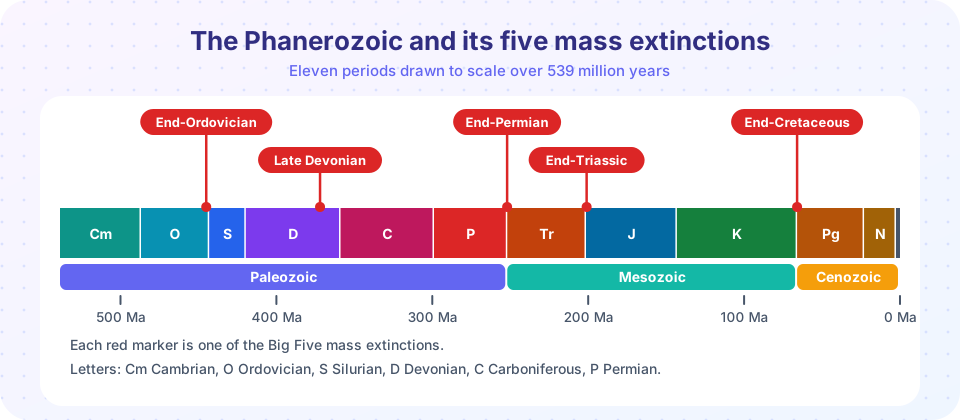
Boundaries are defined in a particular rock section by a "golden spike" and dated by radiometric methods on nearby ash beds. The International Commission on Stratigraphy refines these numbers every few years, so you will see small differences between sources. The three eras of the Phanerozoic mean "old life" (Paleozoic), "middle life" (Mesozoic) and "new life" (Cenozoic). Their boundaries are placed at the two biggest extinctions, at the end of the Permian and the end of the Cretaceous.
The Big Five mass extinctions
Extinction is normal: species have lifetimes of a few million years. A mass extinction is when a large percentage of species, often three quarters or more, vanish in a geologically brief interval.
| Event | Age | Leading explanation |
|---|---|---|
| End-Ordovician | about 445 Ma | Glaciation and sea-level fall, then warming and loss of oxygen in the sea |
| Late Devonian | about 372 Ma | Spreading ocean oxygen loss, likely tied to climate change and the spread of land plants |
| End-Permian | about 252 Ma | Huge Siberian Traps volcanism, extreme warming, acidification and ocean oxygen loss; the worst crisis, perhaps 80 to 90 percent of marine species gone |
| End-Triassic | about 201 Ma | Eruptions of the Central Atlantic Magmatic Province as Pangea began to split |
| End-Cretaceous | 66 Ma | An asteroid impact at Chicxulub, Mexico, plus Deccan Traps volcanism |
The end-Cretaceous case is the best documented. In 1980 Luis and Walter Alvarez and colleagues reported a thin clay layer at the boundary rich in iridium, an element rare in Earth's crust but more abundant in asteroids. Later work found shocked quartz, spherules of melted rock and a buried crater roughly 180 km wide at Chicxulub on the Yucatán coast. Non-bird dinosaurs, ammonites and many marine plankton disappeared. Debate continues about how much volcanism contributed, but the impact is widely accepted as a major driver.
After each event, recovery took millions of years. The survivors diversified into empty niches, a process called adaptive radiation. Mammals diversified after the Cretaceous. Dinosaurs rose after the Triassic. Many scientists argue we may be in a sixth mass extinction driven by human activity, but whether it matches the scale of the Big Five depends on how fast the current losses continue.
Common misconceptions
"Fossils are bones." Most are shells, wood, footprints or molds. Bones are only a minority.
"Index fossils are the oldest species." They are chosen for being short-lived and widespread, not for being old.
"The dinosaurs died in a single day." The impact effects began within hours, but the extinction in the rock record unfolded over a geologically brief interval of perhaps thousands to tens of thousands of years.
"Mass extinctions have a single cause." Most combine several stresses, such as volcanism, climate shifts and changes in ocean chemistry.
Try it
Press Run (or Ctrl + Enter) to see the result here.
Program input · what you'd type while the program runs
Type the answers before you press Run, one per line. Each time the program reads a line (with input()), it gets the next line from this box.
Press Run (or Ctrl + Enter) to see the result here.
Program input · what you'd type while the program runs
Type the answers before you press Run, one per line. Each time the program reads a line (with input()), it gets the next line from this box.
Press Run (or Ctrl + Enter) to see the console output here.
No output.
Check your understanding
Quick check · 6 questions
of 6 answered You scored / 6 · perfect!
-
1. Which is a trace fossil?
Trace fossils record behavior, such as tracks and burrows. -
2. Which trait does NOT help an index fossil?
An index fossil must be abundant enough to find easily. -
3. A layer contains species A (500 to 470 Ma) and species B (480 to 440 Ma). Its age is:
Only the overlap of the two ranges, 480 to 470 Ma, fits both. -
4. Which mass extinction is linked to the Chicxulub impact?
The Chicxulub impact and Deccan Traps are tied to the extinction 66 million years ago. -
5. Why is the fossil record biased?
Burial speed and body hardness strongly affect preservation. -
6. The Paleozoic and Mesozoic are separated by which event?
The end-Permian extinction, about 252 Ma, marks the Paleozoic to Mesozoic boundary.
Summary
- Fossils form by permineralization, replacement, molds and casts, carbonization, amber and more; trace fossils record behavior.
- The record is biased toward hard-shelled marine life.
- Index fossils are abundant, widespread, recognizable and short-lived, and bracket the age of layers.
- The time scale divides the Phanerozoic into three eras and twelve periods; boundaries are dated with radiometric ages.
- Five mass extinctions (445, 372, 252, 201, 66 Ma) reshaped life, each with multiple stressors.
Next: Chapter 6 review
Track your progress
Create a free account to tick off lessons and pick up where you left off on any device.
of Geology lessons completed