


















Lesson 22 of 48 · Structural Geology
Structural geology: the big picture
Meet structural geology: how forces deform rock into folds, faults and joints, and why geologists read these shapes to reconstruct Earth's history.
Rocks are not born in the positions where you find them. A layer of sandstone that began as flat sand on a beach can end up tilted on a mountainside, folded like a rug, or sliced in two by a crack that moved ten meters in a single earthquake. Structural geology is the study of those shapes and of the forces that created them. It is the part of geology that turns a rock outcrop into a story about pushing, pulling and sliding.
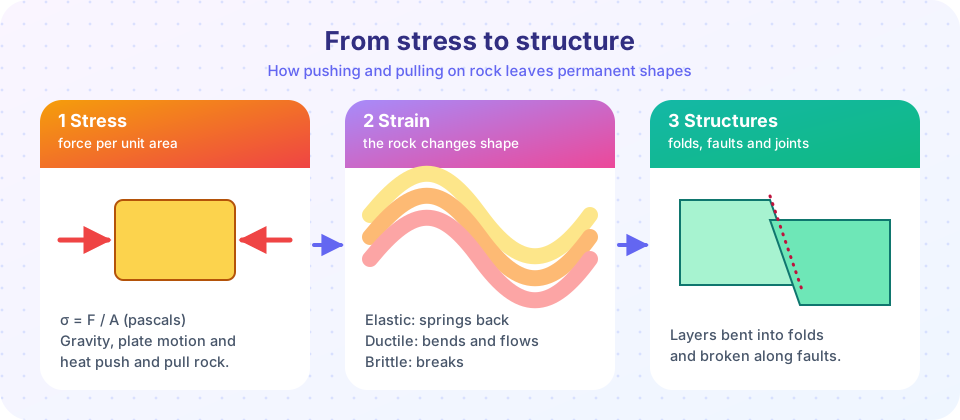
This chapter gives you the vocabulary and the physics to read that story. You will learn what stress and strain are, why the same rock can bend like clay in one place and snap like glass in another, how folds and faults are built, and how to measure them. Everything here prepares you for the geologic maps and cross sections in Chapter 8.
What you will learn in this chapter
- How geologists define stress and strain, and the three kinds of stress.
- Why rock behaves elastically, ductilely or brittly depending on conditions.
- How to describe a fold, a fault and a joint using the standard words.
- How to use simple formulas to estimate pressure, fault offset and shortening.
The chapter at a glance
Rock is under constant stress
Strain is the response
Folds record bending
Faults record breaking
Your map of the chapter
| Lesson | What it covers |
|---|---|
| Stress and strain | Forces inside rock, the three stress types, elastic, ductile and brittle behavior, and the Mohr-style stress calculation. |
| Folds | Anticlines, synclines, limbs, hinges, plunge and how much a fold shortens a region. |
| Faults and joints | Normal, reverse and strike-slip faults, Anderson's rules, throw and heave, and joints. |
| Chapter review | One picture, one table and ten questions. |
Why geologists care
Structures are the reason mountains stand where they do, why oil collects in some places and not others, and why earthquakes strike along particular lines. A civil engineer who builds a dam wants to know where the faults are. A mining geologist follows the folded layer that holds the ore. A geophysicist reads the pattern of faults to work out which way a continent was stretched millions of years ago.
Because most deformation happens slowly, you cannot watch it. You see only the result. That is why geologists measure carefully and think in terms of cause and effect: if a layer is shortened by 30 percent, something compressed it. If it has been broken into long, parallel blocks, something pulled it apart.
How to study this chapter
Structural geology rewards drawing. For every new term, sketch it: an anticline in cross section, a normal fault with arrows on both blocks, a block with compression arrows. Then check your sketch against the rule of ages (oldest rock in an anticline's core) or the hanging-wall rule. Another habit is to ask the same three questions of every structure: what stress made it, what does it record about movement, and how could I measure it? The lessons are built around those questions. By the end you should be able to look at a photograph of a road cut and say which way the crust was pushed or pulled, and roughly by how much.
A first taste of numbers
The rock beneath your feet is already stressed. Every kilometer of rock above adds weight. The pressure at depth h in rock of density ρ is P = ρ g h, where g = 9.81 m/s². For typical crust (ρ ≈ 2,700 kg/m³) that comes to roughly 26 megapascals for every kilometer. Try it.
Press Run (or Ctrl + Enter) to see the result here.
Program input · what you'd type while the program runs
Type the answers before you press Run, one per line. Each time the program reads a line (with input()), it gets the next line from this box.
This plot is a calculator that applies the formula, not a measurement. Real crust varies in density, but the straight-line trend is a good first estimate.
Press Run (or Ctrl + Enter) to see the console output here.
No output.
Check your understanding
Quick check · 3 questions
of 3 answered You scored / 3 · perfect!
-
1. What does structural geology study?
Structural geology is about deformation structures such as folds, faults and joints, and the stresses that formed them. -
2. Which formula gives pressure at depth from the weight of overlying rock?
Pressure equals density times gravitational acceleration times depth. -
3. Roughly how fast does lithostatic pressure grow with depth in typical crust?
2,700 kg/m³ × 9.81 m/s² × 1,000 m is about 26.5 MPa.
Summary
- Structural geology reads folds, faults and joints to reconstruct past forces.
- Stress is force per area; strain is the resulting change in shape.
- Pressure increases about 26 MPa per kilometer in typical crust.
- This chapter builds the tools you need for maps and cross sections later.
Next: Stress and strain
Track your progress
Create a free account to tick off lessons and pick up where you left off on any device.
of Geology lessons completed