


















Lesson 26 of 48 · Structural Geology
Chapter 5 review: structural geology
Review stress, strain, folds, faults and joints with a one-page picture, a recap table and a ten-question quiz mixing the whole chapter.
You now have the core vocabulary of structural geology. Rocks record the forces that acted on them: compression leaves folds and reverse faults, tension leaves normal faults, shear leaves strike-slip faults. This review pulls the chapter into one picture, one table and one quiz.
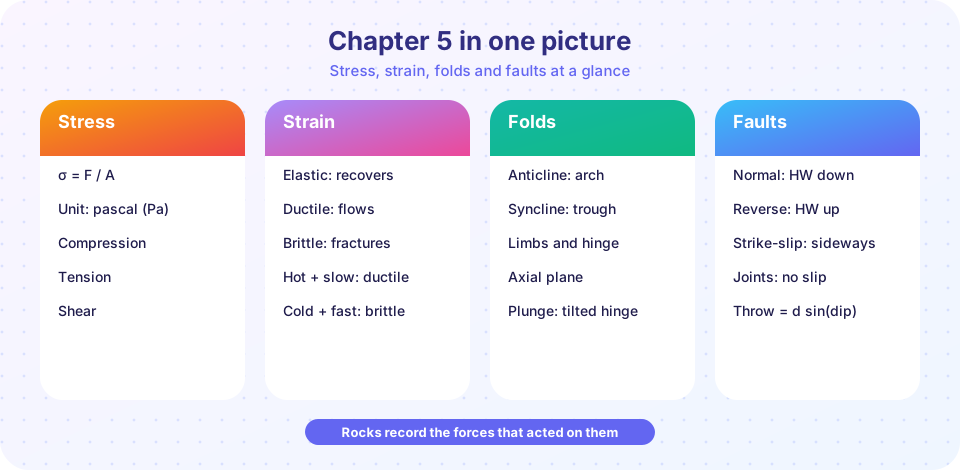
Recap table
| Idea | Key facts | Formula |
|---|---|---|
| Stress | Force per area, in Pa. Compression, tension, shear. | σ = F / A |
| Pressure at depth | About 26 MPa per km in crust. | P = ρ g h |
| Strain | Dimensionless change in size or shape. | ε = ΔL / L0 |
| Behavior | Elastic, ductile, brittle; heat and slow loading favor ductile. | σ = E ε (elastic) |
| Stress on a plane | Normal and shear stress at angle θ from σ1. |
σn = (σ1+σ3)/2 + (σ1−σ3)/2 cos 2θ |
| Fault angle | Forms at 45° − φ/2 to σ1. |
τ = c + μ σn |
| Folds | Anticline: oldest in core. Syncline: youngest in core. | shortening = (L0 − L) / L0 |
| Faults | Normal (HW down), reverse (HW up), strike-slip (sideways). | throw = d sin δ, heave = d cos δ |
| Joints | Fractures with no displacement. | none |
Which structure for which stress?
Compression
Tension
Shear
How the ideas connect
Everything in this chapter is one chain of cause and effect. Plate motion and gravity set up a stress field. The rock responds with elastic, ductile or brittle strain, depending on its temperature, the confining pressure, its composition and how fast it is loaded. Ductile strain leaves folds; brittle strain leaves faults and joints. Anderson's reasoning ties the chain together: because the ground surface cannot carry shear, one principal stress is vertical near the surface, and which one it is (σ1, σ2 or σ3) tells you whether faults will be normal, strike-slip or reverse.
A worked mini-problem
A normal fault dips 60° and has 150 m of net slip. The throw is 150 × sin 60° = 130 m and the heave is 150 × cos 60° = 75 m, so this one fault has stretched the crust by 75 m. If four similar faults cross a section, the total extension is about 300 m. If the section was originally 5,000 m long, the extension is 300 / 5,000 = 6 percent. The same chain of reasoning, from slip to components to total strain, turns any set of faults into a number you can compare with plate motion.
Common exam traps
- Mixing up hanging wall and footwall on a vertical fault. The terms apply only to inclined faults.
- Reading "anticline" as "hill". It is a shape of layers, not of topography.
- Using degrees in a calculator set to radians, or the reverse.
- Forgetting that shortening is a ratio of lengths, not the difference alone.
- Treating strain as stress. Stress is the cause, in pascals; strain is the effect, without units.
Try it
Press Run (or Ctrl + Enter) to see the result here.
Program input · what you'd type while the program runs
Type the answers before you press Run, one per line. Each time the program reads a line (with input()), it gets the next line from this box.
Press Run (or Ctrl + Enter) to see the console output here.
No output.
Check your understanding
Quick check · 10 questions
of 10 answered You scored / 10 · perfect!
-
1. Which of these is the unit of stress?
Stress is force per area, measured in pascals (N/m²). -
2. Pressure at 4 km depth in rock of density 2,700 kg/m³ is about:
2,700 × 9.81 × 4,000 ≈ 106 MPa. -
3. Why do deep rocks tend to flow instead of fracture?
At depth, heat and confining pressure make creep easier than cracking. -
4. A fault forms 30° from σ1. Which principal stress is vertical for a thrust?
For thrust faults the vertical stress is the smallest; the horizontal squeeze is the largest. -
5. The oldest layers are exposed in the middle of an eroded fold. The fold is:
Right-way-up layers with oldest rock in the core indicate an anticline. -
6. A layer originally 500 m long now spans 400 m. Shortening is:
(500 − 400) / 500 = 0.20. -
7. A 40° dipping fault with 100 m of slip has a heave of about:
Heave = 100 × cos 40° ≈ 76.6 m. -
8. Which describes a graben?
A graben drops down between faults; a horst stays up. -
9. Which structure shows NO displacement across it?
Joints are fractures without measurable movement. -
10. In which direction does the closed end of a plunging anticline point on a map?
The nose of a plunging anticline points in the direction of plunge.
Summary
- Stress causes strain; the strain type depends on temperature, pressure, rate and rock.
- Compression builds folds and reverse faults, tension builds normal faults, shear builds strike-slip faults.
- Use the formulas for pressure, shortening, throw and heave to put numbers on structures.
- These tools return in Chapter 8, where you read structures from maps.
Track your progress
Create a free account to tick off lessons and pick up where you left off on any device.
of Geology lessons completed