


















Lesson 45 of 48 · Projects and Practice
Practice problem set: structures, time, hazards and maps
Fourteen worked-style practice problems on structures, dating, resources, hazards and maps, with a runnable answer key and a self-checking tool.
You learn calculations by doing them. This lesson gathers fourteen problems that mix the four chapters you have just finished. Each is short and each uses one idea from the lessons. Work them out on paper with a calculator first, keeping units in view, and only then run the answer key. If your answer differs, find where your working diverges rather than just copying the key.
Good habits for any numerical geology problem: write down what is given and what is asked, convert to SI units first, choose the formula, substitute, and then check whether the answer is reasonable. A magnitude 12 earthquake or a dip of 140° should make you stop and look for a mistake.
What you will learn
- How to choose the right formula for a word problem.
- How to carry units through a calculation.
- How to judge whether a result is reasonable.
- Where your own weak spots are, using the self-checking tool.
The problems
Structures (Chapter 5)
- Pressure. Rock of density 2,800 kg/m³ lies above a point 8 km deep. What is the lithostatic pressure in MPa? Use
g = 9.81 m/s². - Strain. A rock layer 400 m long is shortened to 310 m by folding. What is the strain, and what percentage shortening is that?
- Fault geometry. A normal fault dips 50° and has 80 m of net slip. Find the throw and the heave.
- Failure angle. A rock has a coefficient of friction of 0.7. At what angle from
σ1does a new fault form?
Time (Chapter 6)
- Zircon age. A zircon has
D/P = 0.50for U-238 → Pb-206, with a half-life of 4.468 billion years. How old is it? - Radiocarbon. A charcoal sample has 25 percent of its original carbon-14. What is its age, using a half-life of 5,730 years?
- Bracketing. A layer contains fossil X (range 450 to 430 Ma) and fossil Y (range 440 to 420 Ma). Between which ages must the layer have formed?
Resources and hazards (Chapter 7)
- Ore. A deposit has 12 million tonnes of ore at 1.5 percent zinc, and processing recovers 90 percent. How many tonnes of zinc are recovered? If costs are 60 dollars per tonne of ore and zinc sells for 2,500 dollars per tonne, is the ore above the cut-off grade? (Illustrative prices.)
- Groundwater. A sand aquifer has
K = 2 × 10⁻⁴ m/s. Two wells 150 m apart have a head difference of 3 m, and the effective porosity is 0.25. What is the seepage velocity in meters per day? - Epicenter. A station records an S-P delay of 18 s. With
vP = 6.0 km/sandvS = 3.5 km/s, how far away is the earthquake? - Magnitude. A rupture 60 km long and 15 km wide slips 1.2 m on average, with
μ = 3 × 10¹⁰ Pa. Find the seismic moment and the moment magnitude. - Slope. A cohesionless soil has
φ = 32°. For a slope of 22°, find the factor of safety when dry and when saturated with parallel seepage (γw/γ = 0.49).
Maps (Chapter 8)
- Contours. On a 1:25,000 map the contour interval is 20 m and two contours are 8 mm apart. What is the slope angle?
- Apparent dip. A bed dips 55° toward the east, strike 000°. A section line runs 25° from the strike. Find the apparent dip. Then state the dip direction and the right-hand-rule strike of a bed with dip direction 250°.
Two worked examples
Problem 5, the zircon age. The age equation is t = (1/λ) ln(1 + D/P) with λ = ln 2 / T½. Here T½ = 4.468 billion years, so λ = 0.6931 / 4.468 = 0.1551 per billion years. With D/P = 0.5, ln(1.5) = 0.4055, so t = 0.4055 / 0.1551 = 2.61 billion years. A quick check: a ratio of 1.0 would mean exactly one half-life (4.47 billion years), so a ratio of 0.5 must give less than that. The answer passes.
Problem 11, the magnitude. The rupture area is 60,000 m × 15,000 m = 9 × 10⁸ m². The seismic moment is M0 = μ A D = 3 × 10¹⁰ × 9 × 10⁸ × 1.2 = 3.24 × 10¹⁹ N·m. Its base-ten logarithm is 19.51, so Mw = (2/3)(19.51 − 9.1) = 6.94, about 6.9. A quick check: a rupture 60 km long with about a meter of slip should be a strong but not a great earthquake, which matches a magnitude near 7.
Strategy hints
Problem 4 uses 45° − φ/2 with φ = arctan(μ). Problem 7 asks for the overlap of two ranges. Problem 8 has two parts: first compute recovered metal, then compare the grade with cost / (recovery × price). Problem 9 needs the hydraulic gradient i = Δh / L before Darcy's law. For problem 11 compute M0 = μ A D in newton-meters, remembering that 60 km × 15 km is 9 × 10⁸ m². For problem 12 the saturated factor is (1 − γw/γ) tan φ / tan β. In problem 14 remember that apparent dip never exceeds the true dip.
The answer key
Run the code only after you have tried the problems. It prints each answer with the working, so you can find where your own working differs.
Press Run (or Ctrl + Enter) to see the result here.
Program input · what you'd type while the program runs
Type the answers before you press Run, one per line. Each time the program reads a line (with input()), it gets the next line from this box.
Check yourself
Enter your own answers in the helper below. It compares each with the key within a tolerance and tells you which topic to revisit. Replace the null values with your numbers.
Press Run (or Ctrl + Enter) to see the result here.
Program input · what you'd type while the program runs
Type the answers before you press Run, one per line. Each time the program reads a line (with input()), it gets the next line from this box.
Common mistakes
Unit slips. Convert kilometers to meters and millimeters to meters before you multiply.
Mixing log bases. Magnitude formulas use base 10 logarithms; the age equation uses natural logarithms.
Degrees versus radians. Calculators and programs need the right mode: NumPy uses radians.
Forgetting the hydraulic gradient. Darcy's law uses Δh / L, not the head difference alone.
Using true dip on an oblique section. Convert to apparent dip first.
Check your understanding
Quick check · 4 questions
of 4 answered You scored / 4 · perfect!
-
1. Which unit conversion is needed before using ρ g h with depth in kilometers?
With density in kg/m³ and g in m/s², depth must be in meters to get pascals. -
2. Which logarithm appears in the magnitude formula Mw = (2/3)(log M0 − 9.1)?
Magnitude scales are logarithmic in base ten. -
3. A sanity check: a calculated dip of 140° is:
Dip is measured from the horizontal and ranges from 0° to 90°. -
4. What is the first step in Darcy's law problems with two wells?
Specific discharge is K times the gradient.
Summary
- Write givens and unknowns, convert units, choose a formula, substitute and check reasonableness.
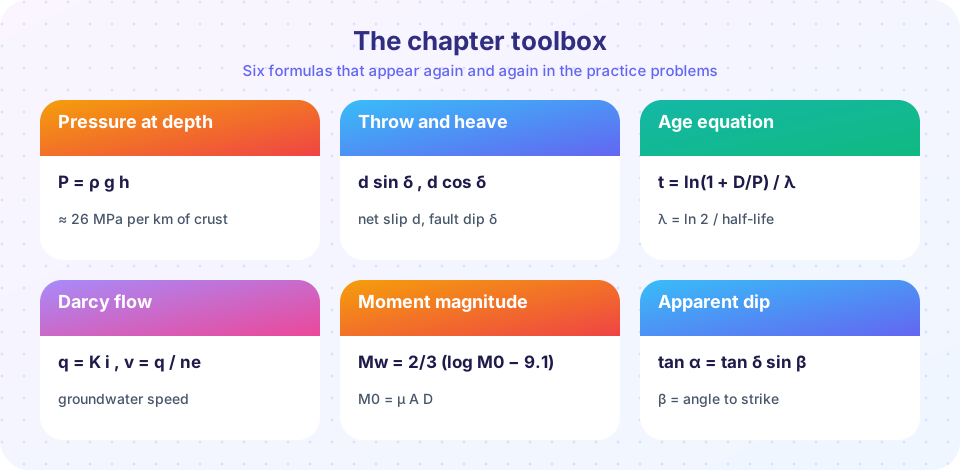
- The six formulas in the toolbox cover most of the problems in this set.
- Use the answer key to find where your working diverges, not just to see the number.
- Common errors are unit slips, log bases, radians versus degrees and forgetting the gradient.
Next: Glossary
Track your progress
Create a free account to tick off lessons and pick up where you left off on any device.
of Geology lessons completed