


















Lesson 19 of 48 · Sedimentary Environments
Sedimentary rocks
Learn how to classify sedimentary rocks by grain size, composition and origin, how sediment is lithified, and what sorting, rounding and structures reveal.
Sedimentary rocks are the Earth's history books. Their pages are layers called beds, their handwriting is the size and shape of the grains, and their illustrations are fossils. A single cliff of sandstone and shale can tell you that a river once flowed here, that a shallow sea later flooded the land, and that a desert came after.
To read them you need to know how they are classified and what features to look for. This lesson gives you both.
What you will learn
- The three groups of sedimentary rock and examples of each
- The grain-size scale, and the meaning of sorting and rounding
- How compaction and cementation turn sediment into rock
- Common sedimentary structures and what they say about the environment
Key terms
Clastic: made of fragments (clasts) of older rock. Sorting: how uniform the grain sizes in a sediment are. Porosity: the fraction of a rock's volume that is empty pore space. Cement: minerals precipitated between grains, such as calcite, silica or iron oxide. Bedding: the layering of sedimentary rock.
The three groups
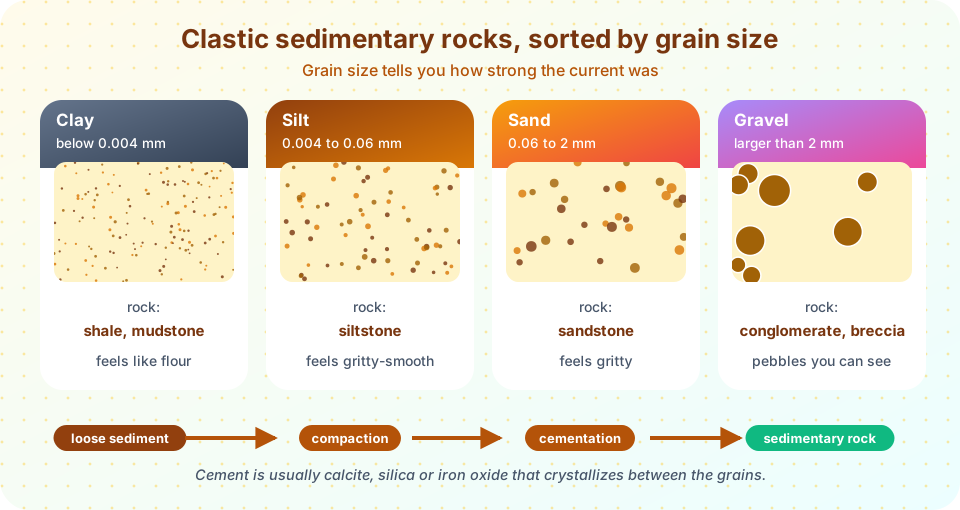
Clastic sedimentary rocks are made of grains from weathered rock. They are named by grain size, using a scale devised by Chester Wentworth in 1922:
| Grain | Size | Rock |
|---|---|---|
| Clay | under 0.004 mm | shale, mudstone (with silt) |
| Silt | 0.004 to 0.06 mm | siltstone |
| Sand | 0.06 to 2 mm | sandstone |
| Gravel (granules, pebbles, cobbles, boulders) | over 2 mm | conglomerate (rounded) or breccia (angular) |
Shale splits into thin sheets because its flat clay particles settled flat. Sandstone feels gritty, and you can see and count the grains with a hand lens. A conglomerate contains rounded gravel that has been tumbled in a river or on a beach; a breccia contains sharp, angular fragments that did not travel far, as with a landslide or a rockfall.
Sandstones are also classified by what they contain. A quartz arenite is nearly pure quartz sand: a mature sediment that has been through much weathering and transport. An arkose has a lot of feldspar and is typical of sand that was buried quickly near a granite source. A graywacke is a dark, poorly sorted "dirty" sandstone with abundant clay, deposited by underwater avalanches.
Chemical sedimentary rocks form when minerals precipitate from water. In dry climates, evaporation of seawater or lake water leaves evaporites: halite (rock salt) and gypsum. Hot springs and caves precipitate travertine (calcite). Some limestones form directly from seawater as small spherical grains called ooids, and chert forms from silica precipitating from water.
Biochemical (organic) sedimentary rocks come from living things. Fossiliferous limestone is made of shells and skeletons of marine organisms. Chalk is a soft, fine limestone made of microscopic plankton shells. Coal forms from plant matter buried in swamps. As burial deepens, peat becomes lignite, then bituminous coal, then anthracite (which, strictly, is metamorphic). Coquina is a rock of loosely cemented shell fragments, and diatomite consists of microscopic glass shells.
A quick field test: limestone (calcite) fizzes in dilute acid; dolostone (dolomite) fizzes only when powdered; and sandstone does not fizz.
Sorting and rounding
Two features of grains reveal how the sediment was moved.
Sorting describes how similar the grains are in size. Beach sand, tumbled by waves for thousands of years, is well sorted: nearly every grain is the same size. Glacial till, which is dumped by melting ice without any washing, is poorly sorted: clay, sand and boulders are all mixed together. Well-sorted sediment means a steady current that carried away other sizes.
Rounding describes how smooth the corners are. Angular grains have traveled a short distance, because collisions during transport wear off corners. Rounded grains have a long history of transport, or were reworked several times.
A sediment that is both well sorted and well rounded, and made only of quartz, is called mature. Such sandstones can be recycled many times, from older sandstones to younger ones.
From sediment to rock: lithification
Loose sediment has a lot of empty space, which is called porosity. Fresh sand may be about 40% pore space, and fresh mud as much as 60 to 80% water by volume. As more layers pile on top, two things happen.
- Compaction. The weight of overlying material squeezes grains closer together and squeezes out water. Mud compacts a lot, because flat clay flakes rotate to lie parallel.
- Cementation. Water that flows through the pores deposits minerals between the grains. Calcite, silica (quartz) and iron oxide are the most common cements. Iron oxide cement makes sandstone red. Cement is the glue, and a well-cemented sandstone is hard enough for buildings.
These processes occur at depths of hundreds to a few thousand meters and temperatures well below those of metamorphism. When burial goes deeper and hotter, the change continues into metamorphism: shale becomes slate, sandstone becomes quartzite.
Sedimentary structures: reading the layers
Layers are the signature of sedimentary rock. Other features add detail.
- Bedding (strata). Each bed marks a change in conditions or supply. Graded bedding, with coarse grains at the bottom fading to fine at the top, comes from a single flow that slowed, typical of turbidity currents on a sea floor.
- Cross-bedding. Inclined layers within a bed record the downwind slope of a dune or the downstream slope of a river sandbar. They show the direction of the ancient current.
- Ripple marks. Symmetrical ripples form under waves; asymmetrical ones under a current flowing one way.
- Mud cracks. Polygonal cracks show that wet mud dried out, and so that the environment sometimes lay above water.
- Fossils. They tell you the age and the environment: marine shells in a sandstone mean it was laid down in the sea.
Two principles from Nicolas Steno (the same Steno of crystal fame) guide interpretation: the law of original horizontality says that beds are laid down nearly flat, so tilted or folded beds have been deformed later. The law of superposition says that in undisturbed layers, the oldest is at the bottom. Chapter 5 and Chapter 6 develop these further.
Common misconception: "All sedimentary rocks contain fossils." Many do not, because fossils need rapid burial and suitable conditions, and they are destroyed by later change.
Common misconception: "Sandstone is made of sand that was melted together." It is made of sand cemented by minerals deposited between the grains, with no melting.
Common misconception: "Limestone and marble are the same." Marble is limestone that has been metamorphosed; its calcite grains have recrystallized.
Try it
The first example performs a sieve analysis. It takes the percentage of a sample retained in each size class, finds the median grain size and uses the Folk and Ward method to describe the sorting. Compare a beach sample with glacial till.
Press Run (or Ctrl + Enter) to see the result here.
Program input · what you'd type while the program runs
Type the answers before you press Run, one per line. Each time the program reads a line (with input()), it gets the next line from this box.
The second example shows compaction. Slide the burial depth and see how much pore space is left in sand and in mud, using typical exponential porosity curves (after Sclater and Christie, 1980). Real rocks vary a lot, so these are averages.
Check your understanding
Quick check · 6 questions
of 6 answered You scored / 6 · perfect!
-
1. A rock made of sharp, angular pebbles in a finer matrix is a
Breccia has angular fragments that traveled only a short distance; conglomerate has rounded pebbles. -
2. Which rock forms from the evaporation of seawater?
Halite is a chemical sedimentary rock that precipitates when seawater evaporates. -
3. Well-sorted, well-rounded quartz sand suggests
Extended transport removes weaker minerals, rounds grains and sorts them by size. -
4. Cross-bedding in sandstone is most useful for finding
Inclined layers record the downcurrent slope of dunes or bars. -
5. Which cement gives many sandstones a red color?
Iron oxide (hematite) cement stains sandstone red. -
6. Which test distinguishes limestone from sandstone quickly?
Limestone is calcite and reacts with acid; quartz sandstone does not.
Summary
- Clastic rocks are named by grain size (shale, siltstone, sandstone, conglomerate, breccia); chemical rocks precipitate from water; biochemical rocks come from organisms.
- Sorting and rounding show how far and how energetically grains traveled.
- Lithification: compaction squeezes out water; cementation by calcite, silica or iron oxide glues grains.
- Beds, graded bedding, cross-bedding, ripple marks, mud cracks and fossils tell the environment.
- Steno's laws: superposition and original horizontality.
Track your progress
Create a free account to tick off lessons and pick up where you left off on any device.
of Geology lessons completed