


















Lesson 27 of 48 · Geologic Time and Fossils
Geologic time and fossils: the big picture
Get the big picture of deep time: how geologists order events, put numbers on them with radioactive clocks, and read life's history in fossils.
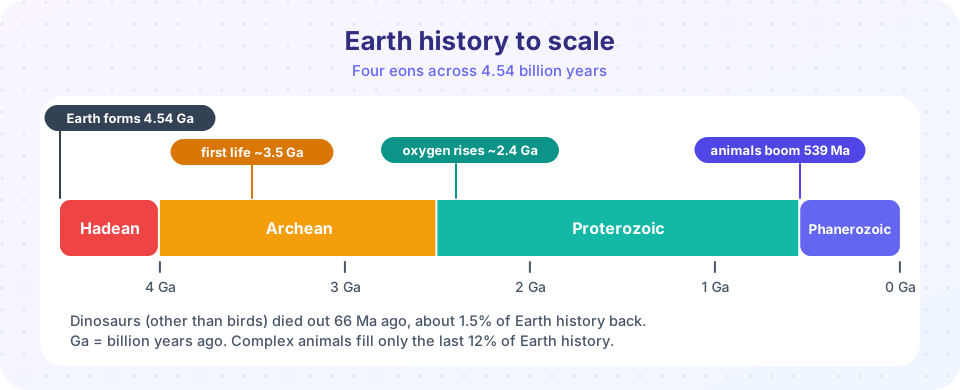
Earth is 4.54 billion years old. That number is so large that it is hard to feel. If every year of Earth history took one second to watch, the film would run for about 144 years. Geology depends on this vast span of time, because the slow processes you met in earlier chapters, such as erosion, deposition and folding, need it to build mountains and basins.
This chapter answers a deceptively hard question: how do we know how old a rock is? The answer has two halves. First, geologists work out the order of events using simple logic about layers and cross-cutting relationships. Then they add numbers using radioactive decay. Fossils tie the two together, because the sequence of life forms is the same worldwide.
What you will learn in this chapter
- The rules that let you decide which of two features is older.
- How half-lives and isotope ratios become ages in years.
- What fossils are, how they form and why index fossils date rocks.
- How the geologic time scale is organized and what the five mass extinctions were.
The chapter at a glance
Step 1: put events in order
Step 2: add numbers
Step 3: read the fossils
The result: a time scale
Your map of the chapter
| Lesson | What it covers |
|---|---|
| Relative dating | Steno's laws, Hutton's unconformities, William Smith's faunal succession, and a program that sorts events. |
| Radiometric dating | Decay equations, isotope pairs, closure temperature and the age of Earth. |
| Fossils and mass extinctions | How fossils form, index fossils, the time scale and the Big Five. |
| Chapter review | One picture, one table and ten questions. |
Why deep time matters
Deep time explains why sandstone at the top of a mountain once lay under a sea, why a coal seam exists beneath a desert, and why life has changed so much. It also lets scientists measure the pace of present-day change against the past. The carbon released by humans in two centuries is being compared with changes that took many thousands of years in the geologic record. Without a reliable clock, those comparisons would be impossible.
It is worth knowing how recent the human story is. Scale Earth history to a single year, with January 1 as the formation of Earth and midnight on December 31 as today. Modern humans appear in the last few minutes. The next TryIt works it out.
Three ideas to keep in mind
First, time is the main ingredient. Many geologic processes are too slow to see, but they leave clear results over millions of years. A river that lowers its bed by a fraction of a millimeter a year can carve a canyon. Second, the record is incomplete. Layers form only some of the time, and erosion removes some of what formed; unconformities are the proof. Third, independent methods should agree. When a fossil range, an ash bed's uranium-lead age and a rock's position in a sequence tell the same story, confidence is high. When they disagree, geologists look for the cause: a reworked fossil, a disturbed clock or a missing layer. That habit of cross-checking is the thread running through the next four lessons.
Try it
Press Run (or Ctrl + Enter) to see the result here.
Program input · what you'd type while the program runs
Type the answers before you press Run, one per line. Each time the program reads a line (with input()), it gets the next line from this box.
The calendar is a model, not a measurement: it rescales real dates into a year so that you can feel the proportions.
Press Run (or Ctrl + Enter) to see the console output here.
No output.
Check your understanding
Quick check · 3 questions
of 3 answered You scored / 3 · perfect!
-
1. Which two kinds of information combine to give a full picture of geologic time?
Relative dating gives the sequence; radiometric dating adds numbers in years. -
2. About what fraction of Earth history does the Phanerozoic cover?
539 million years out of 4,540 million is roughly 12 percent. -
3. Why are fossils useful for correlating rocks across continents?
Faunal succession means each time interval has its own characteristic fossils.
Summary
- Earth is about 4.54 billion years old and the Phanerozoic is the last 12 percent.
- Relative dating gives the order of events; radiometric dating gives numbers; fossils link the two worldwide.
- The chapter covers dating rules, decay clocks, fossils and the five mass extinctions.
Next: Relative dating
Track your progress
Create a free account to tick off lessons and pick up where you left off on any device.
of Geology lessons completed