


















Lesson 46 of 48 · Projects and Practice
Glossary: structures, time, hazards and maps
A searchable glossary of more than seventy geology terms from the structural geology, geologic time, resources and hazards, and field methods chapters.
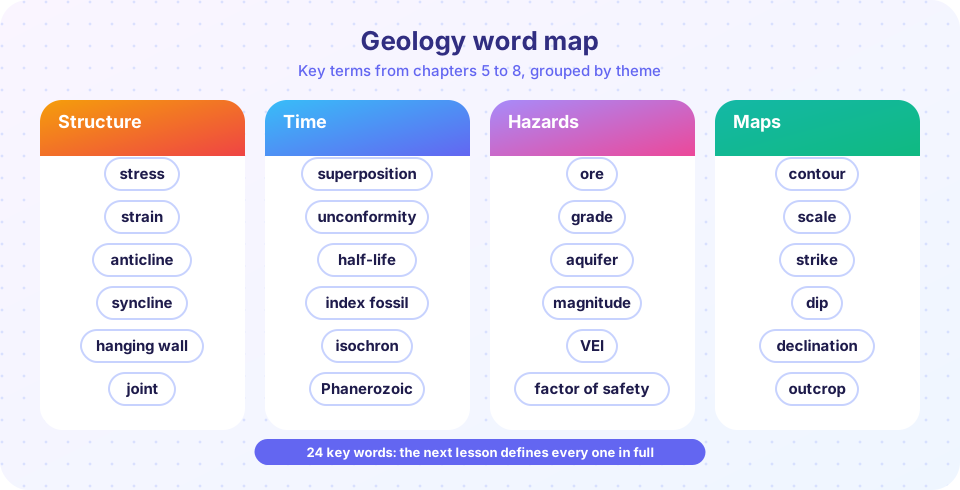
Geology has a rich vocabulary, and much of the difficulty of the subject is learning to use its words precisely. A term like "dip" or "grade" has an exact meaning that differs from everyday speech. This glossary collects the terms from Chapters 5 to 8, grouped by chapter and listed alphabetically within each group. Use it as a reference while you read, as a revision list before a test, or as a source of flash cards.
Each definition is deliberately short. When you need more, follow the lesson in which the term appears. A good habit is to try to define a word in your own words first, and then compare your sentence with the entry.
What you will learn
- The precise meaning of about seventy terms from the second half of the course.
- How the terms group by theme, which helps memory.
- How to use the terms to test yourself.
Structure (Chapter 5)
| Term | Meaning |
|---|---|
| Anticline | A fold shaped like an arch, with older rock in the core when layers are the right way up. |
| Axial plane | The surface that joins the hinge lines of all layers in a fold. |
| Brittle | Behavior in which rock fractures; typical of cold, shallow, fast deformation. |
| Compression | Stress that squeezes rock together, shortening it and building folds and reverse faults. |
| Ductile | Behavior in which rock bends and flows without breaking; typical of hot, deep, slow deformation. |
| Elastic strain | Strain that disappears when the stress is removed, as in the rock that carries seismic waves. |
| Fault | A fracture along which rock on one side has moved relative to the other. |
| Footwall | The block below an inclined fault plane. |
| Hanging wall | The block above an inclined fault plane. |
| Heave | The horizontal component of the slip on a dip-slip fault, equal to net slip times cosine of dip. |
| Hinge | The line of greatest curvature on a folded layer. |
| Joint | A fracture with no measurable displacement across it. |
| Limb | The relatively flat side of a fold, between hinges. |
| Lithostatic pressure | The equal-in-all-directions pressure from the weight of overlying rock, about 26 MPa per kilometer in crust. |
| Monocline | A fold in which flat layers step down in a single bend. |
| Normal fault | A fault where the hanging wall moves down, formed by tension. |
| Plunge | The angle between a fold's hinge line and the horizontal. |
| Reverse fault | A fault where the hanging wall moves up, formed by compression. |
| Shear | Stress that makes two sides of a body slide past each other, producing strike-slip faults. |
| Strain | The change in size or shape of a body caused by stress; it has no units. |
| Stress | Force per unit area, measured in pascals. |
| Strike-slip fault | A fault along which blocks slide horizontally, parallel to the fault. |
| Syncline | A fold shaped like a trough, with younger rock in the core when layers are the right way up. |
| Tension | Stress that pulls rock apart, lengthening it and forming normal faults. |
| Throw | The vertical component of the slip on a dip-slip fault, equal to net slip times sine of dip. |
| Thrust fault | A reverse fault with a gentle dip, usually below about 30°. |
Time (Chapter 6)
| Term | Meaning |
|---|---|
| Absolute age | An age in years, usually from radiometric dating. |
| Angular unconformity | An erosion surface with tilted older layers below and flatter younger layers above. |
| Closure temperature | The temperature below which a mineral keeps its daughter atoms, so its isotopic clock runs. |
| Cross-cutting relationships | The rule that a feature cutting across rock is younger than the rock it cuts. |
| Daughter isotope | The stable product of radioactive decay. |
| Decay constant | The probability per unit time that an atom decays, equal to ln 2 divided by the half-life. |
| Disconformity | An erosion surface between parallel layers, often hard to see. |
| Faunal succession | The principle that fossil groups succeed each other in a definite, recognizable order. |
| Half-life | The time for half of a radioactive isotope in a sample to decay. |
| Inclusion | A fragment of one rock within another; the fragment is older than the host. |
| Index fossil | A widespread, abundant, easily identified and short-lived species used to date rock. |
| Isochron | A line on a plot of isotope ratios whose slope gives the age of a rock. |
| Mass extinction | A brief interval when a large share of species disappears worldwide. |
| Nonconformity | An erosion surface between igneous or metamorphic rock below and sedimentary rock above. |
| Parent isotope | The unstable isotope that decays. |
| Phanerozoic | The eon from about 539 million years ago to now, the time of abundant animal fossils. |
| Relative dating | Determining which of two events is older without giving years. |
| Superposition | In undisturbed layers, older beds lie below younger ones. |
| Taphonomy | The study of what happens to an organism between death and fossilization. |
| Trace fossil | Preserved evidence of behavior, such as a track or burrow. |
| Unconformity | A surface that represents a gap in the geologic record. |
Resources and hazards (Chapter 7)
| Term | Meaning |
|---|---|
| Acid mine drainage | Acidic, metal-rich water produced when sulfide minerals are exposed to air and water. |
| Aquifer | A rock or sediment body that stores and transmits useful amounts of groundwater. |
| Aquitard | A layer of low permeability that slows groundwater flow, such as clay. |
| Cut-off grade | The lowest grade that can be mined and processed at a profit. |
| Factor of safety | The ratio of resisting to driving forces on a slope; below 1 the slope fails. |
| Grade | The concentration of the valuable material in ore, as a percent or grams per tonne. |
| Hydraulic conductivity | A measure of how readily water moves through a material, in meters per second. |
| Lahar | A volcanic mudflow of water, ash and debris. |
| Liquefaction | Loss of strength of water-saturated sand during shaking, so that it flows like a liquid. |
| Moment magnitude | The standard measure of earthquake size, based on rupture area, slip and rock stiffness. |
| Ore | Rock from which a valuable material can be extracted at a profit. |
| Permeability | How easily fluid flows through connected pores. |
| Placer | A deposit of heavy minerals concentrated by flowing water. |
| Porosity | The fraction of rock volume that is empty space. |
| Pyroclastic flow | A fast, hot cloud of gas and volcanic fragments that moves along the ground. |
| Reservoir rock | A porous, permeable rock that holds oil, gas or water. |
| Return period | The average time between floods of a given size or larger, equal to the inverse of annual probability. |
| Seal | An impermeable rock that traps oil and gas in a reservoir. |
| Source rock | A fine-grained, organic-rich rock that generates oil and gas when heated. |
| Tsunami | A set of long ocean waves, usually caused by sudden seafloor movement. |
| VEI | The Volcanic Explosivity Index, a scale from 0 to 8 for eruption size. |
| Water table | The top of the saturated zone in an unconfined aquifer. |
Field methods and maps (Chapter 8)
| Term | Meaning |
|---|---|
| Apparent dip | The dip seen in a vertical section that is not perpendicular to the strike; never greater than the true dip. |
| Contour interval | The vertical distance between neighboring contour lines. |
| Declination | The angle between true north and magnetic north at a place. |
| Dip | The angle between a plane and the horizontal, measured down the steepest slope. |
| Dip direction | The compass direction in which a plane slopes down, equal to strike plus 90° by the right-hand rule. |
| Gradient | The change in elevation divided by the horizontal distance. |
| Index contour | A thicker, labelled contour line, usually every fifth line. |
| Outcrop | A place where bedrock is exposed at the surface. |
| Relief | The difference in elevation between the highest and lowest points of an area. |
| Scale | The ratio between a distance on a map and the real distance. |
| Strike | The compass direction of the line where an inclined plane meets a horizontal plane. |
| UTM | The Universal Transverse Mercator grid, which gives positions in meters within 6° zones. |
| Vertical exaggeration | The ratio of the vertical scale to the horizontal scale of a profile or section. |
Try it
Press Run (or Ctrl + Enter) to see the console output here.
No output.
Press Run (or Ctrl + Enter) to see the console output here.
No output.
Check your understanding
Quick check · 5 questions
of 5 answered You scored / 5 · perfect!
-
1. Which pair of terms describes the vertical and horizontal parts of fault slip?
Throw is vertical and heave is horizontal. -
2. A deposit of heavy minerals concentrated by river water is a:
Placers form where flowing water sorts dense grains. -
3. The angle between true and magnetic north is called:
Declination must be applied to compass readings. -
4. Which term means the time for half of a radioactive isotope to decay?
Half-life is the decay interval for half of the parent atoms. -
5. The top of the saturated zone in an unconfined aquifer is the:
The water table separates the saturated zone below from the unsaturated zone above.
Summary
- The glossary covers about seventy terms from structure, time, resources and hazards, and field methods.
- Learn terms in groups; the grouping mirrors the chapters.
- Test yourself by defining each term before reading the entry.
Next: Cheat sheet
Track your progress
Create a free account to tick off lessons and pick up where you left off on any device.
of Geology lessons completed