


















Lesson 17 of 48 · Sedimentary Environments
Chapter 4 overview: Sedimentary environments
Chapter 4 overview: how weathering, erosion, transport and deposition build sedimentary rocks, and what you will learn about grain size and depositional environments.
Walk along a river and you are watching a sedimentary rock being made. The water is carrying sand and mud that came from a mountain far upstream. Eventually the river will slow, and that sediment will settle in a delta, a lake or the sea. Buried under thousands of meters of newer material, it will be squeezed and cemented into stone.
Sedimentary rocks cover most of the land surface and hold nearly all of the fossil record. They are also where we find most of our fuel, building stone and groundwater. This chapter follows sediment on its journey from source to sink.
What you will learn
- The journey of sediment: weathering, erosion, transport, deposition and burial
- What each lesson in the chapter covers
- Why grain size tells you about the energy of the environment
The sediment journey
Becoming rock
Reading the layers
Key terms
Sediment: loose particles of rock, mineral or organic origin. Weathering: the breakdown of rock at or near the surface. Erosion: the removal and transport of weathered material. Deposition: settling of sediment when the transporting energy falls. Lithification: compaction and cementation of sediment into rock.
The big picture: from source to sink
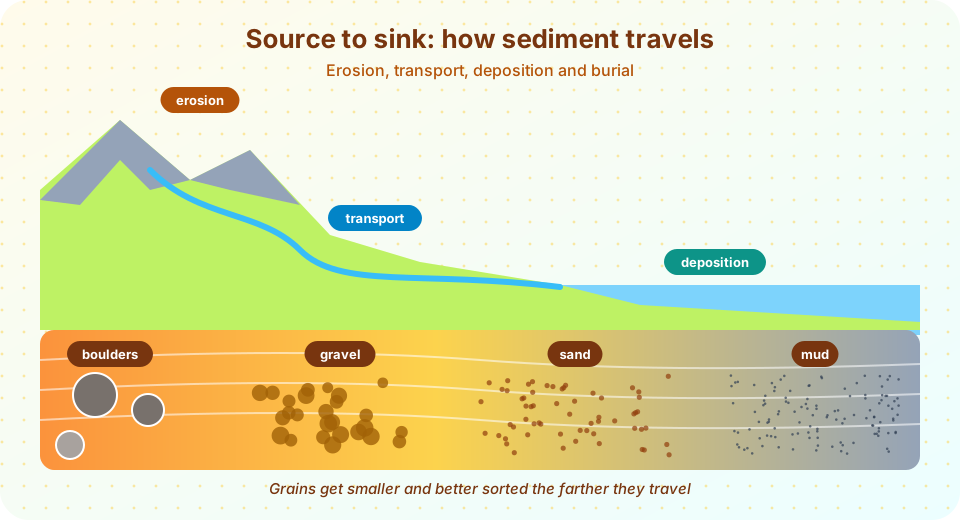
Every sedimentary rock has a source (the rock that was weathered) and a sink (the place where the sediment ended up). Between them lie four stages.
- Weathering breaks rock apart mechanically and dissolves or alters it chemically.
- Erosion and transport carry the pieces by rivers, wind, glaciers or waves. Moving grains collide, so they become smaller and rounder with distance. Weaker minerals, such as feldspar, gradually break down, leaving durable quartz.
- Deposition happens when the current slows and can no longer carry the load. The heaviest grains settle first.
- Burial and lithification turn the loose layers into rock.
Sedimentary rocks fall into three main groups: clastic (made of broken fragments: sandstone, shale), chemical (precipitated from solution: rock salt, some limestone) and biochemical (made from the remains of organisms: coal, shell limestone, chert). Lesson 3 explains them in detail.
Lessons in this chapter
- Weathering and erosion: frost wedging, chemical weathering, soil and the agents that move sediment.
- Sedimentary rocks: clastic, chemical and biochemical rocks, grain size, sorting, lithification and structures.
- Depositional environments: rivers, deltas, beaches, reefs and the deep sea, and how to read them from rocks.
- Chapter 4 review: recap and a ten-question quiz.
Common misconception: "Sediment is always sand." Sediment ranges from boulders to clay, and also includes dissolved minerals and shell fragments.
Common misconception: "Erosion and weathering are the same." Weathering breaks rock in place. Erosion moves the pieces away.
Common misconception: "Sedimentary rocks are soft and unimportant." Many are hard and durable, and together they record most of Earth's history.
Try it
The first example uses Stokes' law to show how fast grains of different sizes settle in still water. The law holds for small particles (up to about 0.1 mm). It explains why mud takes days to settle while sand falls in seconds.
Press Run (or Ctrl + Enter) to see the result here.
Program input · what you'd type while the program runs
Type the answers before you press Run, one per line. Each time the program reads a line (with input()), it gets the next line from this box.
The second example shows downstream fining. Move the slider downstream and watch the typical grain size fall. The curve is an idealized exponential, as found in many rivers, not a measurement.
Check your understanding
Quick check · 4 questions
of 4 answered You scored / 4 · perfect!
-
1. Which stage comes first in the sediment journey?
Rock must first be weathered into pieces before it can be eroded, transported and deposited. -
2. Why does quartz dominate beach sand?
Durable quartz survives weathering and transport, while feldspar and others are broken down. -
3. Which type of sedimentary rock forms from dissolved minerals precipitating from water?
Chemical sedimentary rocks, such as rock salt, form when minerals precipitate from solution. -
4. As sediment travels farther from its source, it generally becomes
Collisions and sorting reduce size, round grains and separate them by weight.
Summary
- Sediment travels from source to sink: weathering, erosion, transport, deposition, burial and lithification.
- Clastic, chemical and biochemical rocks are the three groups of sedimentary rock.
- Grain size, rounding and sorting reveal how far and how energetically sediment moved.
- This chapter covers weathering, sedimentary rocks, depositional environments and a review.
Next: Weathering and erosion
Track your progress
Create a free account to tick off lessons and pick up where you left off on any device.
of Geology lessons completed