


















Lesson 3 of 48 · Getting Started
Inside the Earth
Explore the layers of the Earth, how seismic waves reveal them, and how crust, mantle and core differ in composition, state, density and temperature.
The deepest hole ever drilled, the Kola Superdeep Borehole in Russia, reached about 12.2 kilometers. The Earth's radius is 6,371 kilometers, so that is less than 0.2% of the way to the center. Yet we know the planet has a thin crust, a thick mantle, a liquid outer core and a solid inner core, and we know their depths to within a few kilometers. How?
The answer is a lovely piece of detective work. We cannot go down, so we let earthquake waves travel through the planet and read what they tell us on the way out.
What you will learn
- The four main layers and what each is made of
- How seismic P and S waves reveal liquid and solid regions
- The difference between layers by composition and layers by strength
- Typical values of density, pressure and temperature with depth
Key terms
Crust: the thin, rocky outer skin, 5 to 70 km thick. Mantle: the thick layer of hot, solid rock between crust and core. Core: the iron-rich center, liquid on the outside and solid on the inside. Lithosphere: the rigid outer shell (crust plus the top of the mantle). Seismic wave: a vibration that travels through the Earth after an earthquake.
The layers by composition
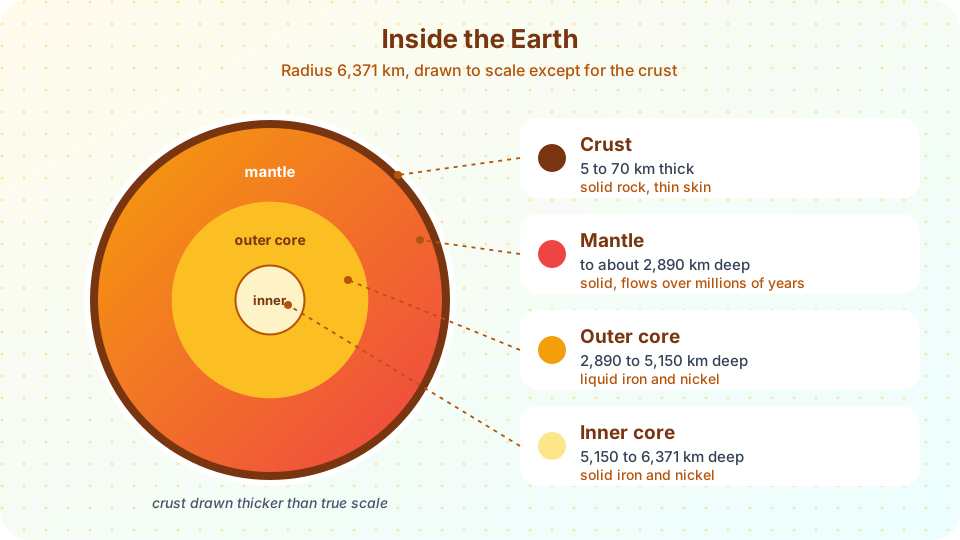
The crust comes in two kinds. Oceanic crust is thin (about 5 to 10 km) and made mostly of basalt and gabbro, dark rocks rich in iron and magnesium. Continental crust is thicker (about 30 to 50 km on average, up to roughly 70 km under the Himalaya) and is on average more like granite: lighter in color and in density. Oceanic crust is denser, about 3.0 grams per cubic centimeter, than continental crust, about 2.7. This density difference matters in lesson 4, because it decides which plate sinks.
The mantle extends down to about 2,890 km and makes up roughly 84% of Earth's volume. It is mostly a dense silicate rock called peridotite, rich in the mineral olivine. It is solid, yet on time scales of millions of years it flows like extremely stiff putty, which is what lets plates move.
The core is an iron-nickel alloy with a small amount of lighter elements. The outer core, from about 2,890 to 5,150 km, is liquid. The inner core, with a radius of about 1,221 km, is solid even though it is hotter, because the immense pressure squeezes the iron into a crystal structure. Churning in the liquid outer core generates Earth's magnetic field, which shields us from the solar wind.
The boundary between crust and mantle is called the Mohorovičić discontinuity, or Moho for short, after the Croatian seismologist Andrija Mohorovičić who found it in 1909 by noticing that waves speed up at a certain depth. The boundary between mantle and core, found around 2,890 km, is the core-mantle boundary.
How we know: seismic waves
When an earthquake happens, it sends out two main kinds of body waves.
- P waves (primary) are compressional, like sound or a push along a spring. They travel through solids and liquids and are the fastest.
- S waves (secondary) shake the material sideways. They travel only through solids, because a liquid cannot support a shear motion.
In 1906 Richard Oldham noticed that S waves never arrived on the far side of the planet, and in 1914 Beno Gutenberg located the core-mantle boundary: S waves are blocked by something liquid. Because the liquid core also bends P waves, there are "shadow zones" on the far side of the Earth where direct P waves do not arrive. In 1936 the Danish seismologist Inge Lehmann noticed faint P waves in the shadow zone and realized that they had bounced off a solid center inside the liquid. She had discovered the inner core.
Other evidence supports the picture. The mean density of the whole Earth, 5.5 grams per cubic centimeter, is double that of surface rocks, so the interior must be dense metal. Iron meteorites look like pieces of an ancient planet's core. Some volcanoes bring up rocks from the mantle. And Earth's magnetic field needs a moving liquid metal to run it.
Layers by strength
Geologists also divide the outer Earth by how it behaves, not by what it is made of. The lithosphere is the cool, rigid outer shell, about 100 km thick on average, made of the crust plus the uppermost mantle. It is broken into the tectonic plates. Below it the asthenosphere is hotter and weaker. It is not liquid, but it can flow slowly, so the plates ride on it. Deeper, the mesosphere (the lower mantle) is stiffer again because of pressure.
This is an important distinction. "Crust" and "lithosphere" are not the same thing: the lithosphere includes part of the mantle.
Temperature, pressure and density with depth
Temperature rises with depth. Near the surface the average geothermal gradient is roughly 25 degrees Celsius per kilometer, though it is much smaller in old stable regions and much larger near volcanoes. That rate cannot continue to the center. Estimates put the temperature near the top of the inner core at about 5,000 to 6,000 degrees Celsius, similar to the surface of the Sun.
Pressure rises because of the weight of the rock above. In the crust you can estimate it with P = ρ × g × h, where ρ is density (about 2,800 kg/m³), g is 9.8 m/s² and h is depth in meters. At 10 km depth:
P = 2800 × 9.8 × 10,000 = 274,400,000 Pa ≈ 274 MPa
That is about 2,700 times atmospheric pressure. At the center of the Earth pressure reaches roughly 360 gigapascals.
Density increases too, from about 2.7 g/cm³ in continental crust, through 3.3 to 5.6 in the mantle, to about 10 to 13 g/cm³ in the core. Dense material sank to the center when the young Earth was partly molten. This process, called differentiation, is why the planet has layers.
Common misconception: "Under the crust there is a sea of magma." There is no global magma ocean now. The mantle is solid. Magma forms only in local places where the rock partly melts, such as under volcanoes and mid-ocean ridges.
Common misconception: "The inner core is solid because it is cooler." It is the hottest part. It is solid because the pressure is so high.
Try it
The first example plots simplified seismic wave speeds against depth. The values are rounded from standard Earth models. Notice that S waves drop to zero in the outer core, which is how liquid was detected.
Press Run (or Ctrl + Enter) to see the result here.
Program input · what you'd type while the program runs
Type the answers before you press Run, one per line. Each time the program reads a line (with input()), it gets the next line from this box.
The second example is a depth explorer. Slide down through the crust and read off the pressure from P = ρgh and a typical temperature from the geothermal gradient. The numbers are typical values, not measurements of one place.
Check your understanding
Quick check · 5 questions
of 5 answered You scored / 5 · perfect!
-
1. Why do S waves not pass through the outer core?
S waves are shear waves, which need a rigid material. A liquid cannot support them, so they are blocked. -
2. Who discovered the solid inner core from faint P waves in the shadow zone?
Inge Lehmann explained the faint P waves in 1936 by a solid inner core inside the liquid outer core. -
3. The lithosphere is best described as
The lithosphere is defined by strength. It includes the crust and the top of the mantle, and it is broken into plates. -
4. The pressure at 20 km depth in rock of density 2,800 kg/m3 is about
P = 2800 x 9.8 x 20,000 = about 549,000,000 Pa, which is about 550 MPa. -
5. Why is the inner core solid even though it is the hottest layer?
Melting temperature rises with pressure. At the center the pressure is so high that iron stays solid.
Summary
- Layers by composition: crust (5 to 70 km), mantle (to about 2,890 km), outer core (liquid), inner core (solid).
- P waves pass through everything, S waves only through solids; this revealed the liquid outer core and the inner core.
- Layers by strength: rigid lithosphere, weak asthenosphere, stiffer lower mantle.
- Temperature, pressure and density all rise with depth; the crust-pressure formula is
P = ρgh.
Next: Plate tectonics basics
Track your progress
Create a free account to tick off lessons and pick up where you left off on any device.
of Geology lessons completed