


















Lesson 32 of 48 · Resources and Hazards
Resources and hazards: the big picture
An overview of geologic resources and hazards: how ore, oil and groundwater form, and why earthquakes, volcanoes and landslides happen where they do.
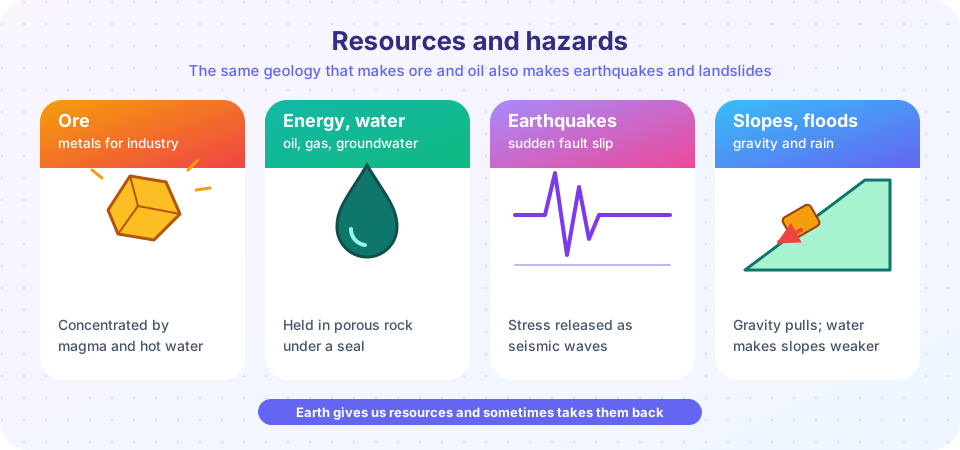
Almost everything you use began in the ground. The copper in wiring, the iron in steel, the sand in concrete, the water in a well and the fuel in a power station all come from geologic processes. Geology also decides where the ground shakes, where mountains erupt and where slopes give way. The same plate tectonics that builds ore deposits builds the faults that cause earthquakes.
This chapter is about that double face of Earth. You will learn how resources form and how geologists find them, and how hazards work and how risk is measured. You will also calculate with real equations: ore grades, groundwater flow, earthquake magnitude, tsunami speed and slope stability.
What you will learn in this chapter
- How ore deposits form and what makes a deposit worth mining.
- How oil, gas, coal and groundwater are stored and move through rock.
- How earthquakes and volcanoes are measured, and why tsunamis are so fast.
- How geologists assess landslide and flood risk with simple numbers.
The chapter at a glance
Resources start with concentration
Hazards start with energy release
Risk = hazard x exposure
Your map of the chapter
| Lesson | What it covers |
|---|---|
| Ore and mineral resources | Ore, grade, deposit types and the economics of mining. |
| Energy and groundwater | Coal, oil and gas systems, porosity and permeability, Darcy's law and aquifers. |
| Earthquakes and volcanoes | Elastic rebound, seismic waves, magnitude, eruption types and tsunamis. |
| Landslides and floods | Slope stability, factor of safety, return periods and flood probability. |
| Chapter review | One picture, one table and ten questions. |
Hazard, exposure and risk
A hazard is a natural event; a disaster is what happens when people are in its path. Geologists therefore talk about risk:
risk = hazard × exposure × vulnerability
An earthquake of the same size can be a minor event in an empty desert and a catastrophe in a dense city with weak buildings. Mapping where faults and volcanoes are (hazard), where people live (exposure) and how buildings are built (vulnerability) is how governments decide on building codes, evacuation plans and insurance.
Resources have a similar logic. A mineral occurrence is only an ore deposit if it can be mined at a profit, which depends on its size, grade, depth and the price of the metal. Geology gives the raw situation, and economics decides what counts as a resource.
How to think about resources and hazards
A habit that will serve you through this chapter is to turn every statement into a number with a unit. "A big earthquake" becomes a moment magnitude and a rupture length. "A rich ore" becomes a grade and a tonnage. "A fast-flowing aquifer" becomes a hydraulic conductivity in meters per second. Numbers let you compare, and they expose what you do not know. Notice also that resource problems and hazard problems are often two sides of one question. Groundwater that makes a valley valuable also carries contamination; volcanic rocks that host rich ore also erupt. Good decisions weigh benefit and risk together, and geologists supply the evidence on which that weighing rests.
Try it
Press Run (or Ctrl + Enter) to see the result here.
Program input · what you'd type while the program runs
Type the answers before you press Run, one per line. Each time the program reads a line (with input()), it gets the next line from this box.
Press Run (or Ctrl + Enter) to see the console output here.
No output.
Check your understanding
Quick check · 3 questions
of 3 answered You scored / 3 · perfect!
-
1. What distinguishes an ore deposit from a mineral occurrence?
Ore is rock from which a valuable material can be extracted economically. -
2. Which expression describes risk?
Risk combines how likely the hazard is, who is exposed and how vulnerable they are. -
3. Which two hazards share a root cause in plate tectonics?
Both cluster along plate boundaries.
Summary
- Resources are concentrations of useful material; hazards are releases of energy or gravity.
- Both come from tectonics, heat, water and gravity.
- Risk combines hazard, exposure and vulnerability.
- The chapter covers ore, energy and water, earthquakes and volcanoes, and slopes and floods.
Track your progress
Create a free account to tick off lessons and pick up where you left off on any device.
of Geology lessons completed