


















Lesson 24 of 48 · Structural Geology
Folds: arches, troughs and plunging noses
Understand anticlines, synclines, limbs, hinges and plunge, how to classify folds, and how to calculate how much a fold shortens the crust.
Fold a sheet of paper and you get a crease. Squeeze a stack of paper from both ends and you get waves. Rock layers do the same thing, only on a scale of centimeters to hundreds of kilometers and over millions of years. A fold is a bend in originally flat layers, and it is the most visible record of compression in the crust.
Folds matter in practice. Oil and gas collect at the top of arches. Ore bodies are often thickened in fold hinges. Roads and railways follow the troughs. Learning to describe a fold in a few standard words lets you picture a three-dimensional structure from a short field description.
What you will learn
- The names of the parts of a fold: limb, hinge, crest, trough, axial plane.
- The difference between anticlines, synclines, domes, basins and monoclines.
- How to classify folds by tightness and orientation, and what plunge means.
- How to calculate shortening from the shape of a folded layer.
Key terms
Anticline is a fold shaped like an arch, with the oldest layers in its core (when the layers are the right way up).
Syncline is a fold shaped like a trough, with the youngest layers in its core.
Limb is the relatively flat side of a fold between two hinges.
Hinge line is the line of greatest curvature along a folded layer; the axial plane connects the hinge lines of all layers.
Plunge is the angle that a hinge line makes with the horizontal.
The parts of a fold
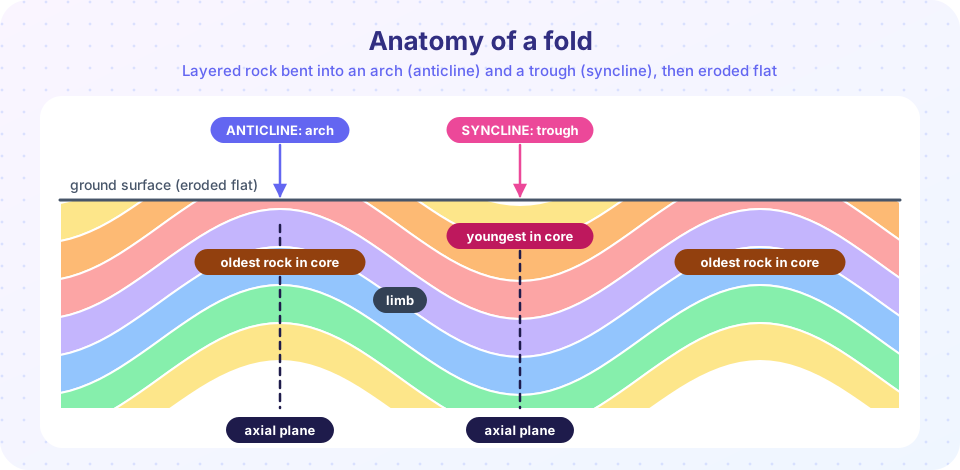
Picture a single folded layer in cross-section. The layer curves most sharply along a line called the hinge, and flattens toward the limbs. If you draw the hinge of every layer in the fold, they line up in a surface called the axial plane (or axial surface, since it can curve). The axial plane splits the fold into two halves. A fold is symmetric if the limbs have equal dips and asymmetric if not.
The rule of ages is the first thing to learn:
- In an anticline the layers dip away from the axis, and the oldest rocks are in the center.
- In a syncline the layers dip toward the axis, and the youngest rocks are in the center.
The rule of ages assumes layers are the right way up. If an overturned fold has been flipped, the logic must be checked with sedimentary clues such as graded bedding or ripple marks (see the sedimentary chapter). When you do not know the ages, use the neutral words antiform (arch-shaped) and synform (trough-shaped).
Other fold shapes
- A dome is an anticline that dips away in all directions, like an upturned bowl. A basin is the opposite. The Michigan Basin and the Black Hills dome in the United States are classic examples.
- A monocline is a single step in otherwise flat layers: one limb steeply dipping between two flat regions, often over a buried fault.
- A chevron fold has straight limbs and sharp hinges, like a folded fan.
Tightness and orientation
How tight is it? Geologists use the interlimb angle, the angle between the two limbs:
| Interlimb angle | Name |
|---|---|
| 180° to 120° | Gentle |
| 120° to 70° | Open |
| 70° to 30° | Close |
| 30° to 0° | Tight |
| about 0° | Isoclinal (limbs parallel) |
How is it tilted? An upright fold has a vertical axial plane. An inclined fold's axial plane is tilted. An overturned fold has one limb flipped upside down. A recumbent fold has a nearly horizontal axial plane, so the whole fold lies on its side. Recumbent folds are the signature of enormous compression and are common in the Alps.
Plunge and what it does to the map
Most folds are not level along their length. The hinge line tilts downward in one direction, and the fold is then plunging. The plunge is measured as an angle below horizontal and a compass direction.
When a plunging fold is eroded flat, the outcrop pattern on a map is a set of nested U or V shapes. A plunging anticline has the closed end of the pattern (the nose) pointing in the direction of plunge. For a plunging syncline the closed end points the opposite way. This is one of the most useful tricks for reading geologic maps in Chapter 8.
How folds form
Three mechanisms matter.
- Buckling. A strong layer (a competent layer, such as limestone or sandstone) squeezed along its length bends into waves, much like a ruler compressed between your hands. If it sits between weak layers (shale, salt) the wavelength is controlled by the thickness and stiffness of the strong layer: thicker, stiffer layers give longer folds.
- Flexural slip. Layers slide over each other like the pages of a book as it bends. The slip can leave striations on bedding surfaces.
- Passive folding. Layers are only markers and flow like putty in a shear zone, thickening in the hinges. Such folds are called similar folds, in contrast to parallel folds, where each layer keeps constant thickness.
Folds can also form without horizontal squeezing: as sediment drapes over a growing fault, or as salt rises through denser layers and domes the rock above it.
How much does a fold shorten the crust?
A folded layer is longer than the horizontal distance it spans. The shortening is
shortening (%) = (L0 − L) / L0 × 100
where L0 is the original, unfolded length of the layer (its arc length) and L is the present horizontal span. For a sine-shaped fold with amplitude A and wavelength λ, the maximum limb dip is arctan(2πA / λ). If A = 50 m and λ = 200 m, then 2πA/λ ≈ 1.57 and the limbs dip about 58°. Calculating the arc length shows the layer is about 1.5 times longer than the span, a shortening of about a third. You will compute it in the first TryIt below.
This is a core idea of balanced cross sections: if you can measure folded and faulted layers, you can undo the folding on paper and work out how much the crust has been shortened.
Common misconceptions
"An anticline is always a hill and a syncline always a valley." Topography is set by erosion. Hard rock in a syncline can form a ridge, and soft rock in the core of an anticline can erode into a valley.
"Folds are always made by horizontal squeezing." Draping over faults and salt movement also produce folds.
"The oldest rocks are always in the core of an anticline." True only when the layers are the right way up.
Try it
Press Run (or Ctrl + Enter) to see the result here.
Program input · what you'd type while the program runs
Type the answers before you press Run, one per line. Each time the program reads a line (with input()), it gets the next line from this box.
Press Run (or Ctrl + Enter) to see the result here.
Program input · what you'd type while the program runs
Type the answers before you press Run, one per line. Each time the program reads a line (with input()), it gets the next line from this box.
Press Run (or Ctrl + Enter) to see the console output here.
No output.
Check your understanding
Quick check · 5 questions
of 5 answered You scored / 5 · perfect!
-
1. Erosion has cut a series of upright, right-way-up folds flat. In the center of one fold you find the oldest rock. What is it?
In an anticline the layers dip away from the axis and the oldest rock lies in the core. -
2. An interlimb angle of 50° describes a fold that is:
Interlimb angles of 70° to 30° are called close. -
3. A fold has a nearly horizontal axial plane. It is:
Recumbent folds lie on their side, with an almost horizontal axial plane. -
4. A layer originally 300 m long is folded so that it spans 240 m horizontally. What is the shortening?
(300 − 240) / 300 = 0.20, or 20 percent. -
5. Which words are used for fold shapes when you do not know which layers are older?
Antiform means arch-shaped and synform means trough-shaped, with no assumption about age.
Summary
- A fold is a bend in layered rock. Anticlines are arches with older rock in the core; synclines are troughs with younger rock in the core.
- Limbs flank the hinge, and the axial plane joins the hinges of all layers.
- Folds are classified by interlimb angle (gentle to isoclinal) and by axial-plane orientation (upright, inclined, overturned, recumbent).
- Plunging folds make U- or V-shaped outcrop patterns on maps.
- Shortening =
(L0 − L) / L0, and a fold with 50 m amplitude and 200 m wavelength shortens its layer by roughly a third.
Next: Faults and joints
Track your progress
Create a free account to tick off lessons and pick up where you left off on any device.
of Geology lessons completed