


















Lesson 11 of 48 · Earth Materials
Chapter 2 review: Earth materials
Review minerals, identification, silicate structures and the rock cycle with a recap table, practice tools and a ten-question quiz.
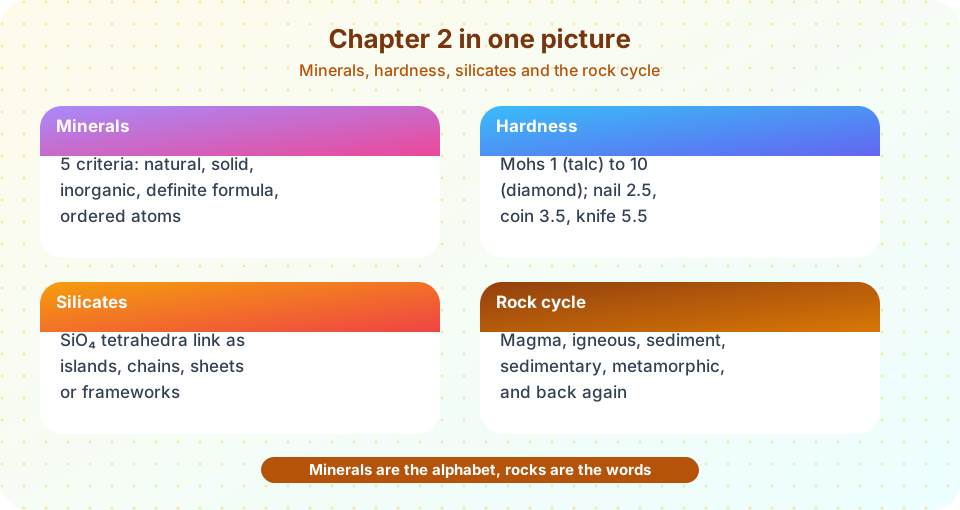
Chapter 2 gave you the vocabulary of Earth materials. You now know what a mineral is, how to identify one with a handful of tests, why silicates dominate the planet, and how rocks are reshaped in the rock cycle. This review ties these threads together and gives you practice before you meet specific rocks in Chapters 3 and 4.
What you will learn
- How the four lessons of Chapter 2 build on each other
- Which facts and numbers to know by heart
- Where to focus your revision, using a ten-question quiz
The chapter at a glance
| Topic | Main idea | Facts to know |
|---|---|---|
| Elements | Eight elements make 98% of the crust | O 46.6%, Si 27.7% (about 74% together) |
| Minerals | Natural, solid, generally inorganic, definite chemistry, ordered atoms | Steno's law; polymorphs (diamond, graphite); solid solutions (olivine) |
| Identification | Luster, hardness, cleavage, streak, specific gravity; color is least reliable | Mohs 1 to 10; nail 2.5, coin 3.5, glass 5.5; SG = air / (air − water) |
| Silicates | SiO₄⁴⁻ tetrahedra, linked by sharing oxygen | Isolated, single chain, double chain, sheet, framework |
| Rock cycle | Igneous, sedimentary, metamorphic and magma linked by processes | Cooling, weathering, lithification, metamorphism, melting |
How the lessons connect
The elements decide which minerals can form, and since oxygen and silicon dominate, silicates dominate. The structure of the silicate (how tetrahedra link) decides cleavage and hardness, which are exactly the properties you test to identify a mineral. Minerals then combine into rocks, and the rock cycle shows how those rocks are broken, buried, heated and melted.
A good way to revise is to take any property and trace it down to atoms. Why does mica have one perfect cleavage? Because it is a sheet silicate with weak bonds between the sheets. Why is quartz common in sand? Because its framework of strong bonds in all directions resists weathering. When you can explain a property by structure, you have understood it and not just memorized it.
Exam tip. Questions about identification usually give you two or three clues and ask you to name the mineral. Work through the order: luster, hardness, cleavage or fracture, then streak. Eliminate options with each clue.
Common misconceptions
Rocks and minerals are the same thing (a rock is an aggregate). Color identifies a mineral (it is unreliable). The rock cycle runs in one order (it has many shortcuts). Metamorphic rocks are melted rocks (they change in the solid state). Hardness means toughness (a diamond can still be cleaved).
Try it
The first example is a practice tool for mixed calculations from this chapter: specific gravity, oxygen sharing and hardness bracketing. Edit the inputs and check by hand.
Press Run (or Ctrl + Enter) to see the result here.
Program input · what you'd type while the program runs
Type the answers before you press Run, one per line. Each time the program reads a line (with input()), it gets the next line from this box.
The second example is a flash-card deck for the key facts of the chapter.
Check your understanding
Quick check · 10 questions
of 10 answered You scored / 10 · perfect!
-
1. Which two elements make up roughly three quarters of the crust by mass?
Oxygen (46.6%) plus silicon (27.7%) is about 74%. -
2. Which of the following is NOT required for a substance to be a mineral?
Minerals can be opaque, translucent or transparent. Transparency is not part of the definition. -
3. Graphite and diamond are both
They share the formula C but have different crystal structures. -
4. A mineral is scratched by a steel knife but not by a copper coin. Its hardness is about
A coin is about 3.5, so the mineral is harder; a knife is about 5.5, so the mineral is softer than that. -
5. A sample weighs 90 g in air and 56 g in water. Its specific gravity is about
SG = 90 / (90 - 56) = 90 / 34 = 2.65, matching quartz. -
6. Which structure type does mica have?
Mica is a sheet silicate, which is why it peels into thin flakes. -
7. Which pairing of structure and example is correct?
Olivine has isolated tetrahedra. Quartz is a framework, pyroxene a single chain and amphibole a double chain. -
8. Which process turns sediment into sedimentary rock?
Lithification squeezes and glues grains together. -
9. Which statement about the rock cycle is correct?
The rock cycle has many paths and shortcuts and continues today. -
10. Which energy source drives melting and mountain building in the rock cycle?
Internal heat powers plate tectonics, melting and metamorphism. The Sun powers weathering and erosion.
Summary
- Oxygen and silicon dominate the crust, so silicate minerals dominate rocks.
- A mineral meets five criteria; identify minerals by luster, hardness, cleavage, streak and specific gravity.
- Silicate structure (isolated, chains, sheets, frameworks) explains cleavage and durability.
- The rock cycle links igneous, sedimentary and metamorphic rocks, driven by the Sun and Earth's heat.
Track your progress
Create a free account to tick off lessons and pick up where you left off on any device.
of Geology lessons completed