


















Lesson 31 of 48 · Geologic Time and Fossils
Chapter 6 review: geologic time and fossils
Review relative dating, radiometric clocks, fossils and the time scale with a chapter picture, a recap table and a ten-question mixed quiz.
You have followed the whole recipe for deep time: rank events by logic, put numbers on them with radioactive clocks, and cross-check with fossils. This review puts it into one picture, one table and one quiz.
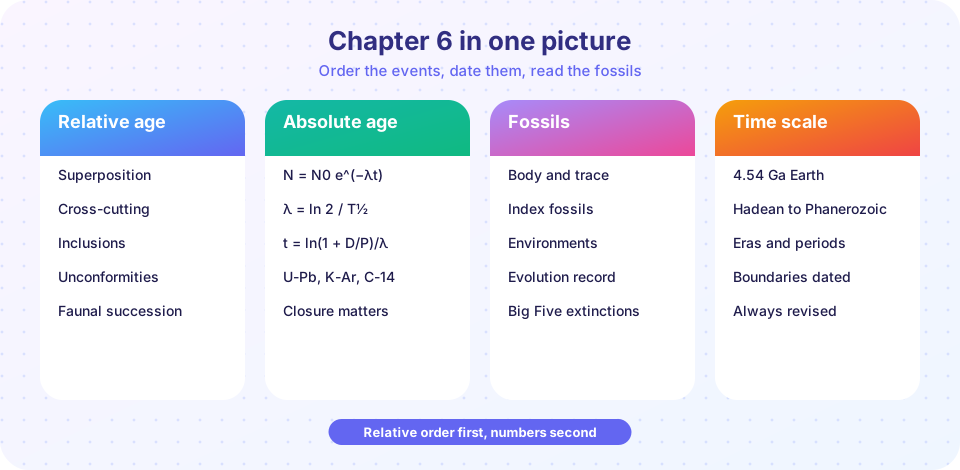
Recap table
| Topic | Key ideas | Remember |
|---|---|---|
| Relative dating | Superposition, original horizontality, lateral continuity, cross-cutting, inclusions, faunal succession | A cut or an included fragment is older or younger by simple logic |
| Unconformities | Angular, disconformity, nonconformity | Each is a gap in the record |
| Decay law | N = N0 e^(−λt), λ = ln 2 / T½ |
After n half-lives a fraction 1/2^n is left |
| Age equation | t = (1/λ) ln(1 + D/P) |
Needs a closed system and a known start |
| Isotope pairs | U-238 4.47 Ga, U-235 0.704 Ga, K-40 1.25 Ga, Rb-87 about 49 Ga, C-14 5,730 yr | Pick the clock to fit the age and rock |
| Fossils | Body, trace; index fossils | Record is biased toward hard-shelled marine life |
| Time scale | Four eons; Phanerozoic = Paleozoic, Mesozoic, Cenozoic | Earth is about 4.54 Ga |
| Big Five | 445, 372, 252, 201, 66 Ma | Several stressors each; end-Permian worst |
Two questions, two tools
Cross-checking
How the pieces fit
The chapter's three tools answer different questions. Relative dating answers "which came first?" and needs only a cross section and a few rules. Radiometric dating answers "how many years ago?" and needs a closed system, a known half-life and a measured ratio. Fossils answer "what else of this age exists elsewhere?" and let you carry an age from a dated ash bed to an undated rock far away. A strong interpretation uses all three: the order from relative dating must agree with the order of the radiometric ages, and both must agree with the order of the fossils.
A worked mini-problem
A sandstone contains fossil A, known from 500 to 470 million years ago, and lies directly beneath an ash bed dated at 478 million years. Because the ash overlies the sandstone, the sandstone is older than 478 Ma. Because it holds fossil A, it is younger than 500 Ma. The sandstone is therefore between 500 and 478 million years old. Notice that superposition and the fossil range both did work, and neither alone gave the result.
Common exam traps
- Treating a half-life as a total lifetime. After two half-lives a quarter remains, not nothing.
- Dating a sedimentary rock directly from its grains, which dates the source rock, not the deposit.
- Treating an unconformity as an error. It is information.
- Using carbon-14 on rocks. Its half-life is far too short.
Explain it to yourself
Try answering these aloud without notes. Why does a cut feature have to be younger than what it cuts? Why can a mineral date the rock it sits in only after it has cooled below its closure temperature? Why does a species with a short, wide range make a better index fossil than one that lasted a hundred million years? Why did it take the discovery of radioactivity to settle the argument over Earth's age? If any answer feels shaky, return to the matching lesson and reread that section.
Try it
Press Run (or Ctrl + Enter) to see the result here.
Program input · what you'd type while the program runs
Type the answers before you press Run, one per line. Each time the program reads a line (with input()), it gets the next line from this box.
Press Run (or Ctrl + Enter) to see the console output here.
No output.
Check your understanding
Quick check · 10 questions
of 10 answered You scored / 10 · perfect!
-
1. A basalt dike cuts a limestone. Which statement is correct?
A feature that cuts rock is younger than the rock. -
2. Which kind of unconformity has igneous or metamorphic rock below sedimentary rock?
A nonconformity separates crystalline rock from overlying sedimentary rock. -
3. How much of a parent isotope remains after four half-lives?
(1/2)^4 = 1/16. -
4. A zircon has D/P = 1 for U-238 (half-life 4.468 Ga). Its age is:
D/P = 1 means one half-life has passed. -
5. Which is the best method for a 3,000-year-old wooden beam?
Carbon-14 works for organic materials younger than about 50,000 years. -
6. Which is NOT a characteristic of a good index fossil?
An index fossil must be geographically widespread to correlate distant rocks. -
7. The Paleozoic ended with which event?
The end-Permian event, about 252 Ma, closes the Paleozoic. -
8. What does the slope of a Rb-Sr isochron give?
The slope equals e^(λt) − 1, so the age follows. -
9. Why does a sedimentary rock usually not get a direct radiometric age?
Grains come from older sources, so geologists date interleaved ash beds or use the youngest grains for a maximum age. -
10. About what fraction of Earth's history is the Phanerozoic?
539 Myr out of 4,540 Myr.
Summary
- Relative dating gives order; radiometric dating gives numbers; fossils connect distant places.
- The decay law and age equation turn isotope ratios into ages.
- The time scale has four eons, with the Phanerozoic split into three eras and twelve periods.
- Five mass extinctions punctuate the fossil record and mark major boundaries.
Track your progress
Create a free account to tick off lessons and pick up where you left off on any device.
of Geology lessons completed