


















Lesson 37 of 48 · Resources and Hazards
Chapter 7 review: resources and hazards
Review ore deposits, petroleum systems, groundwater, earthquakes, volcanoes, landslides and floods with a chapter picture, recap table and ten-question quiz.
This chapter showed two sides of the same planet. Heat, water, tectonics and gravity concentrate ore and trap oil, and they also shake the ground, erupt volcanoes and drop slopes. The review below gathers the formulas and ideas, and the quiz mixes all four lessons.
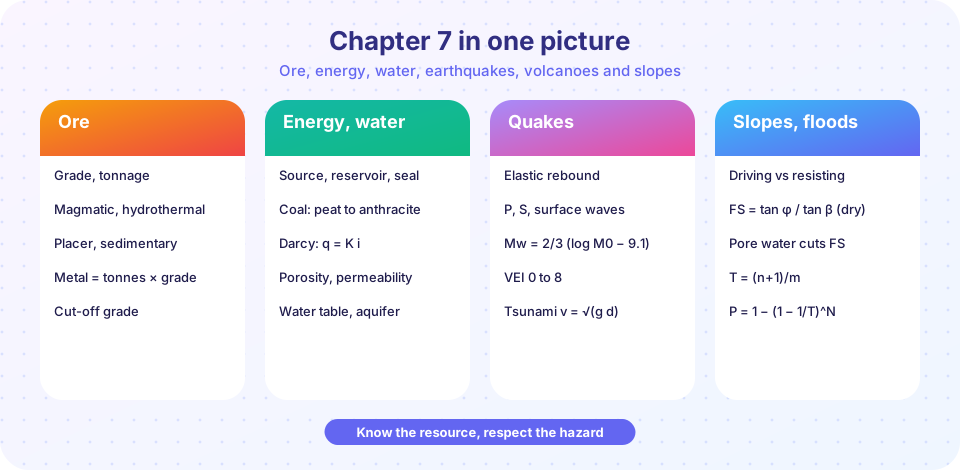
Recap table
| Topic | Key ideas | Formulas |
|---|---|---|
| Ore | Grade, tonnage, cut-off grade; magmatic, hydrothermal, sedimentary, residual deposits | contained metal = tonnage × grade; cut-off = cost / (recovery × price) |
| Petroleum | Source, maturation, migration, reservoir, seal; timing | oil window roughly 60 to 120 °C |
| Groundwater | Porosity (storage), permeability (flow), aquifer, aquitard, cone of depression | q = K i, v = q / n_e |
| Earthquakes | Elastic rebound; P, S and surface waves; magnitude vs intensity | d = Δt vP vS / (vP − vS), Mw = (2/3)(log M0 − 9.1) |
| Volcanoes | Shield, strato, caldera, cinder cone; VEI 0 to 8 | each VEI step is about 10 times the volume |
| Tsunami | Long waves; fast in deep water | v = √(g d) |
| Slopes | Mass wasting types; water cuts friction | FS = tan φ / tan β (dry cohesionless) |
| Floods | Return period; exceedance probability | P = 1/T; 1 − (1 − 1/T)^N |
Concentration makes resources
Release makes hazards
How the pieces fit
Four threads run through the chapter. Concentration: ore, oil and groundwater are all places where a useful material has been gathered by a process such as hot fluids, buoyant migration or slow percolation. Release: earthquakes, eruptions and slides are releases of stored energy, whether elastic strain, gas pressure in magma or gravitational potential, once a threshold is crossed. Scaling: many of the important variables are logarithmic or span many orders of magnitude (magnitude, VEI, permeability, probability), so small changes in inputs can cause huge changes in outputs. Uncertainty: nearly every quantity is estimated from limited data, from the grade of an undrilled block to the 100-year flood.
A worked mini-problem
A town sits above a sand aquifer with K = 5 × 10⁻⁵ m/s. The hydraulic gradient toward the river is 0.004 and the effective porosity is 0.25. The specific discharge is q = K i = 2 × 10⁻⁷ m/s, so the seepage velocity is v = q / n = 8 × 10⁻⁷ m/s, which is about 0.069 m per day or 25 m per year. A fuel leak 300 m from the river would therefore need about 12 years to arrive, which gives time to monitor and clean up. This kind of estimate is how hydrogeologists set the spacing of monitoring wells.
Common exam traps
- Confusing magnitude with intensity.
- Reading a 100-year flood as "once per century".
- Using porosity as if it were permeability.
- Forgetting that the cut-off grade moves with price.
- Applying FS = tan φ / tan β to a wet or cohesive slope without adjustment.
Try it
Press Run (or Ctrl + Enter) to see the result here.
Program input · what you'd type while the program runs
Type the answers before you press Run, one per line. Each time the program reads a line (with input()), it gets the next line from this box.
Press Run (or Ctrl + Enter) to see the console output here.
No output.
Check your understanding
Quick check · 10 questions
of 10 answered You scored / 10 · perfect!
-
1. What is the cut-off grade?
It is the break-even grade set by cost, recovery and price. -
2. Which element of a petroleum system keeps oil from escaping upward?
An impermeable seal caps the reservoir. -
3. K = 10⁻⁴ m/s, i = 0.01, n = 0.25. The seepage velocity is:
q = 10⁻⁶ m/s; v = q / n = 4 × 10⁻⁶ m/s. -
4. S waves cannot pass through:
Liquids do not support shear, which revealed the liquid outer core. -
5. An Mw 8 earthquake releases about how many times more energy than an Mw 6?
Two steps × 1.5 = 3 powers of ten. -
6. Which volcano type is typically built by fluid basaltic lava?
Fluid lava spreads far and builds broad shields. -
7. How fast does a tsunami travel in 2,500 m of water?
v = √(9.81 × 2500) ≈ 157 m/s ≈ 564 km/h. -
8. Saturating a cohesionless slope with parallel seepage roughly halves its FS because:
Pore water pressure reduces the effective normal stress. -
9. A 20-year flood has what annual probability?
P = 1/20 = 0.05. -
10. Magnitude differs from intensity because:
One earthquake has one magnitude and many intensities.
Summary
- Resources are concentrations; hazards are releases of energy or gravity.
- Formulas for grade, Darcy flow, S-P distance, magnitude, tsunami speed, factor of safety and flood probability put numbers on each.
- Risk is hazard times exposure times vulnerability.
- The next chapter teaches you how to read the maps and cross sections geologists use to find and describe all of these.
Track your progress
Create a free account to tick off lessons and pick up where you left off on any device.
of Geology lessons completed