


















Lesson 18 of 48 · Sedimentary Environments
Weathering and erosion
Learn how rock breaks down by mechanical and chemical weathering, which minerals weather fastest, how soil forms, and how water, wind, ice and gravity erode.
Rock looks permanent, yet no rock at the Earth's surface lasts forever. Rain, frost, roots, acid and gravity are constantly working on it. This surface breakdown, called weathering, is the first step of the sedimentary story: it makes the raw material. The movement of that material is called erosion.
Understanding these two processes explains why mountains are not infinitely high, why soil exists at all, why caves form in limestone, and why some ancient stones still carry carvings while others have crumbled.
What you will learn
- The main kinds of mechanical and chemical weathering
- Why some minerals weather faster than others
- The factors that control weathering rate, including surface area
- How soil forms, and how water, wind, ice and gravity erode
Key terms
Mechanical weathering: physical breakup without changing the minerals. Chemical weathering: reactions that change or dissolve minerals. Regolith: loose, weathered material covering bedrock; soil is its upper, organic-rich part. Mass wasting: downslope movement of rock and soil under gravity. Differential weathering: unequal weathering that creates ridges, arches and hoodoos.
Mechanical weathering
Mechanical weathering breaks rock into smaller pieces. The rock's composition stays the same, but the surface area it exposes grows dramatically.
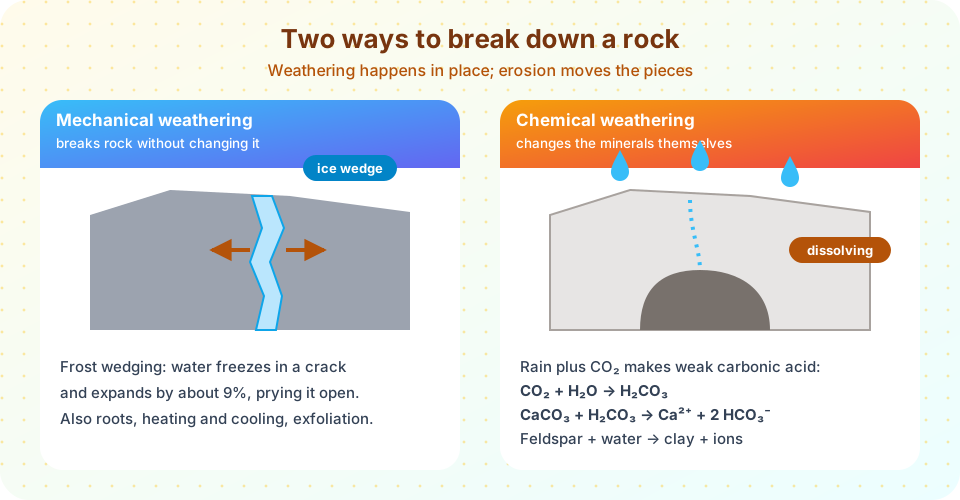
- Frost wedging. Water seeps into cracks and freezes. Ice has about 9% more volume than the liquid water that formed it, and the expansion pries the crack wider. After many freeze-thaw cycles the rock splits. It is the main process in cold, wet mountain regions and in potholed roads.
- Exfoliation (pressure release). Granite that formed deep underground is under great pressure. When erosion removes the overlying rock, the granite expands and peels off in curved sheets like the layers of an onion. Half Dome in Yosemite and many rounded granite domes show this.
- Thermal expansion. Repeated heating and cooling may stress rocks, especially in deserts, though its importance is debated.
- Salt crystal growth. Salty water in pores evaporates, and growing salt crystals push the grains apart. This attacks coastal stone and ancient buildings.
- Biological activity. Tree roots wedge into cracks, and burrowing animals expose fresh rock.
- Abrasion. Rocks carried by rivers, glaciers or wind scratch and round each other.
Chemical weathering
Chemical weathering alters minerals into new, more stable ones, or dissolves them into water. It needs water, and it is faster in warm, wet climates.
- Dissolution. Some minerals dissolve directly. Halite dissolves easily. Calcite dissolves in slightly acidic water.
- Carbonation. Carbon dioxide from the air and from soil dissolves in rain to make weak carbonic acid:
CO₂ + H₂O → H₂CO₃. This acid dissolves limestone:CaCO₃ + H₂CO₃ → Ca²⁺ + 2 HCO₃⁻. Over thousands of years it carves caves and sinkholes in karst landscapes. - Hydrolysis. Water reacts with silicate minerals and breaks their structure. Feldspar, the most common mineral in the crust, becomes clay, and ions such as potassium, sodium and calcium are carried away. Clay is the most abundant product of chemical weathering and the main ingredient of shale and soil.
- Oxidation. Oxygen reacts with iron in minerals to form iron oxides, which is why weathered rocks are often rusty red, brown or yellow.
Which minerals weather fastest?
In the 1930s the geochemist Samuel Goldich noticed that minerals weather in an order that mirrors Bowen's reaction series in reverse. Minerals that crystallize first at high temperature (olivine, calcium-rich plagioclase) are the least stable at the cool, wet, oxygen-rich surface and weather fastest. Minerals that crystallize last (quartz) are the most resistant. That is why a granite may be reduced to loose sand and clay, while its quartz grains survive and become beach sand.
What controls the rate?
- Rock type. Quartzite resists weathering; limestone dissolves in wet climates but survives in deserts.
- Climate. Warm, wet climates favor chemical weathering. Cold climates with frequent freeze and thaw favor frost wedging.
- Surface area. Weathering attacks surfaces, so breaking rock into pieces speeds it up. Cut a 1 meter cube into 1 centimeter cubes and the total surface grows 100 times, from 6 square meters to 600. Mechanical weathering and chemical weathering therefore work together.
- Time and topography. Steep slopes shed their weathered material quickly and keep exposing fresh rock. Flat areas let weathered material build up into thick soil.
Soil
Soil is the biologically active upper layer of regolith, a mixture of mineral particles, organic matter (humus), water and air. Soil scientists describe five factors that shape it: climate, organisms, relief (landscape shape), parent material and time. A mature soil has distinct layers called horizons: the O horizon of organic debris, the A horizon (topsoil, dark with humus), the B horizon (subsoil, where clay and iron accumulate), the C horizon (partly weathered parent material) and below it unweathered bedrock. Soils take hundreds to thousands of years to form, so soil loss by erosion is, on a human time scale, a loss that cannot be replaced.
Erosion: moving the pieces
- Running water is the dominant agent. Raindrops dislodge soil, sheets of water wash it downhill, and rivers carry it as dissolved load, suspended load (fine particles floating in the flow) and bed load (sand and gravel bouncing and rolling along the bottom). Rivers carve valleys: the Colorado River cut the Grand Canyon, about 1,800 meters deep at its greatest, over several million years.
- Wind picks up dust and sand in dry, sparsely vegetated areas. Sand hops along the surface in a bouncing motion called saltation, building dunes. Fine wind-blown silt forms thick deposits called loess.
- Glaciers carry rock fragments of every size, from flour to house-sized boulders. They scratch the bedrock (abrasion) and pull out blocks (plucking), carving U-shaped valleys.
- Gravity causes mass wasting: rockfalls, landslides, mudflows and slow downhill creep, often triggered by water, earthquakes or steep slopes.
Common misconception: "Weathering and erosion are the same." Weathering breaks and alters rock in place; erosion removes the products.
Common misconception: "Chemical weathering only happens in wet jungles." It occurs everywhere there is water, only more slowly in cold or dry places.
Common misconception: "Soil is just broken rock." Soil also contains organic matter, living organisms, air and water.
Try it
The first example shows why breaking rock into pieces speeds up weathering: the total surface area of a fixed volume rises as the pieces shrink.
Press Run (or Ctrl + Enter) to see the result here.
Program input · what you'd type while the program runs
Type the answers before you press Run, one per line. Each time the program reads a line (with input()), it gets the next line from this box.
The second example is a frost wedging demonstration. Press the button to run a freeze-thaw cycle and watch the crack widen until the rock splits. The numbers are illustrative.
Check your understanding
Quick check · 6 questions
of 6 answered You scored / 6 · perfect!
-
1. Which process is an example of chemical weathering?
Carbonic acid reacts with calcite, a chemical change; the others are mechanical. -
2. Feldspar weathers mostly to
Hydrolysis of feldspar produces clay minerals, with potassium, sodium and calcium released. -
3. A 1 m cube is broken into 1 cm cubes. The total surface area grows by a factor of
Total area is 6 / s, so reducing the side from 1 m to 0.01 m multiplies the area by 100. -
4. Which mineral is the most resistant to weathering?
Quartz crystallizes last in Bowen's series and weathers slowest, following Goldich's series. -
5. Which soil horizon is topsoil, rich in humus?
The A horizon is the dark, organic-rich topsoil. -
6. What is loess?
Loess is a fine, wind-deposited silt that often forms thick, fertile layers.
Summary
- Mechanical weathering breaks rock (frost wedging, exfoliation, salt growth, roots, abrasion); chemical weathering changes minerals (dissolution, carbonation, hydrolysis, oxidation).
- Minerals weather in the reverse order of Bowen's series; quartz survives.
- Weathering is faster with more surface area, warmth and moisture.
- Soil forms from climate, organisms, relief, parent material and time, in horizons O, A, B, C.
- Erosion by water, wind, ice and gravity moves the products.
Next: Sedimentary rocks
Track your progress
Create a free account to tick off lessons and pick up where you left off on any device.
of Geology lessons completed