


















Lesson 25 of 48 · Structural Geology
Faults and joints
Learn the parts of a fault, how normal, reverse and strike-slip faults differ, how to calculate throw and heave, and what joints tell geologists.
When rock is pushed past what it can bend, it breaks. If the rock on either side of the break has moved, the fracture is a fault. If the rock has not moved, or has only opened slightly, it is a joint. Faults and joints are brittle structures, and they dominate the upper crust, the part of Earth we live on and build in.
Faults are also the source of earthquakes. Every large earthquake is the sudden slip of a fault that had been locked while stress built up. To understand earthquake hazards in Chapter 7 you need the vocabulary here: hanging wall, footwall, throw, heave, and the three fault families.
What you will learn
- The parts of a fault and the words used to describe its motion.
- How to tell normal, reverse, thrust and strike-slip faults apart.
- How to compute throw and heave from net slip and dip.
- What joints are, how they form and why they matter.
Key terms
Fault plane is the surface along which rock slipped.
Hanging wall is the block above an inclined fault plane; the footwall is the block below it. Miners named them: you hang your lamp from the first and walk on the second.
Net slip is the true distance between two points that were once touching on opposite sides of the fault.
Throw is the vertical part of the slip; heave is the horizontal part.
Joint is a fracture with no measurable displacement across it.
The three families of faults
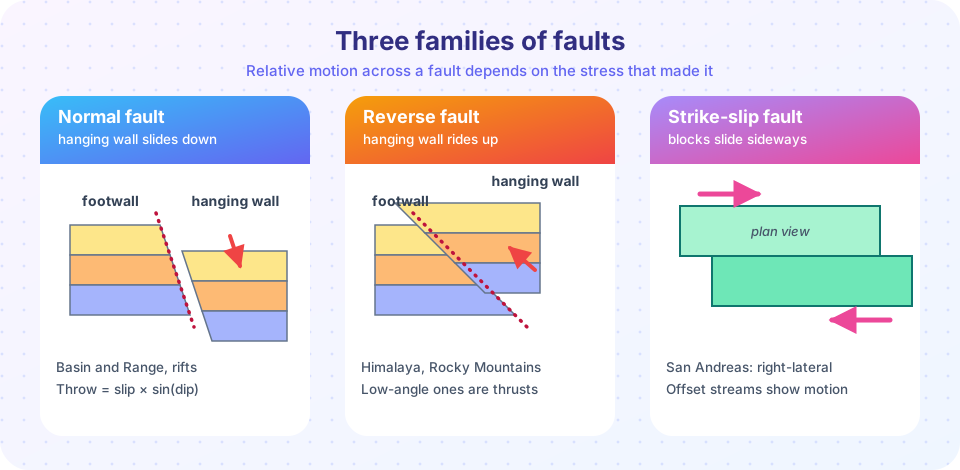
Faults are named by how the hanging wall moves relative to the footwall.
Normal faults
In a normal fault the hanging wall moves down. Normal faults lengthen the crust. They form under tension, and typical dips are 50° to 70°. Where many normal faults occur together they make a staircase of tilted blocks, as in the Basin and Range province of the western United States. A downdropped block between two normal faults is a graben; a raised block is a horst. The East African Rift is a giant system of grabens and half-grabens, and the Rhine valley between France and Germany is a graben too.
Reverse faults and thrusts
In a reverse fault the hanging wall moves up. Reverse faults shorten the crust. They form under compression. A reverse fault with a gentle dip, below roughly 30°, is a thrust fault. Thrusts can carry slabs of rock tens of kilometers over younger rock, so that old strata end up lying on young. The Himalaya and the Alps are built from stacks of thrust sheets, and the Main Himalayan Thrust is the huge surface that accommodates India's northward push.
Strike-slip faults
In a strike-slip fault the blocks slide horizontally, parallel to the fault's strike. The fault plane is usually vertical or nearly so. Stand on one side and look across: if the opposite side moved to your right it is right-lateral (dextral); if to your left, left-lateral (sinistral). The sense is the same no matter which side you stand on. The San Andreas Fault in California is right-lateral. A large strike-slip fault that forms a plate boundary is a transform fault.
Faults that combine dip-slip and strike-slip motion are oblique-slip faults. The Alpine Fault in New Zealand moves mostly right-lateral with a significant component of reverse motion.
Anderson's rule of thumb
In the previous lesson you saw that the orientation of the principal stresses fixes the fault type. Near the surface one principal stress is vertical, because the ground is free to move up and there is no shear on it. If the vertical stress is the largest (σ1), the result is a normal fault dipping about 60°. If it is the smallest (σ3), the result is a reverse fault dipping about 30°. If it is the intermediate one (σ2), the result is a vertical strike-slip fault.
Throw, heave and net slip
For a pure dip-slip fault with dip δ and net slip d:
throw = d × sin δ
heave = d × cos δ
A normal fault dipping 60° with 100 m of net slip has a throw of 100 × 0.866 = 86.6 m and a heave of 100 × 0.5 = 50 m. The heave is the amount the crust has been stretched horizontally. Add up the heaves of all the faults across a region and you have a measure of extension.
Fault motion also leaves evidence you can see:
- Slickensides are polished, grooved surfaces whose striations point along the direction of slip.
- Fault breccia and fault gouge are broken and ground-up rock along the plane. Gouge is the fine, clay-rich product.
- Mylonite is rock sheared in a ductile way at depth, a sign of fault activity below the brittle-ductile transition.
- A fault scarp is a step in the land surface where a recent fault broke through. Scarps along the Wasatch Fault in Utah and the Teton Fault in Wyoming mark young normal faults.
Relative age from faults
A fault is younger than every layer it cuts, and older than anything that crosses it unbroken. That cross-cutting logic is one of the central tools for relative dating, and you will use it again in Chapter 6.
Joints
A joint is a crack with no appreciable shear displacement. Joints usually occur in parallel groups called joint sets, and sets at different angles form a joint system. Spacing is related to layer thickness: thin beds tend to have closely spaced joints.
Joints form in several ways:
- Tectonic joints open under tension or compression during regional deformation.
- Cooling joints form as lava or intrusions shrink. The six-sided columnar joints of Giant's Causeway in Northern Ireland and Devils Tower in Wyoming are famous examples.
- Sheeting joints are curved cracks parallel to the surface that open as erosion removes the weight above, producing the rounded domes in Yosemite.
Joints matter because they are pathways. Groundwater, oil and magma move through them. They control how quarry blocks come out of a hillside, where rockfalls start and how weathering penetrates.
Common misconceptions
"Faults are single clean cracks." Large faults are zones, sometimes hundreds of meters wide, with many strands, breccia and gouge.
"Reverse and thrust faults are different things." A thrust is simply a reverse fault with a gentle dip.
"Earthquakes create faults." Most earthquakes happen on faults that already exist. Over many earthquakes the fault grows.
"The hanging wall is the upper side of any fracture." The terms apply only to inclined faults; a vertical fault has neither.
Try it
Press Run (or Ctrl + Enter) to see the result here.
Program input · what you'd type while the program runs
Type the answers before you press Run, one per line. Each time the program reads a line (with input()), it gets the next line from this box.
Press Run (or Ctrl + Enter) to see the console output here.
No output.
Check your understanding
Quick check · 6 questions
of 6 answered You scored / 6 · perfect!
-
1. The hanging wall of an inclined fault has moved down. What type of fault is it?
Hanging wall down is the definition of a normal fault, produced by tension. -
2. A fault dips 30° and the hanging wall has moved up. It is best called a:
A reverse fault with a gentle dip is a thrust. -
3. A normal fault dips 60° with a net slip of 50 m. What is the throw?
Throw = 50 × sin 60° = 43.3 m. -
4. Which feature shows a fracture with NO displacement?
A joint is a fracture without measurable shear displacement. -
5. Standing on one side of a fault, you see the far side has moved to your right. Standing on the other side, you would see:
Right-lateral motion looks the same from both sides. -
6. Which stress regime produces normal faults?
Tension pulls the crust apart and drops the hanging wall.
Summary
- Faults show displacement; joints do not.
- Normal faults (hanging wall down, tension), reverse and thrust faults (hanging wall up, compression) and strike-slip faults (sideways, shear) are the three families.
- Throw =
d sin δand heave =d cos δ. - Slickensides, gouge, breccia, mylonite and scarps are evidence of fault motion.
- Joints form by tectonic stress, cooling and unloading, and guide fluids through rock.
Next: Chapter 5 review
Track your progress
Create a free account to tick off lessons and pick up where you left off on any device.
of Geology lessons completed