


















Lesson 14 of 48 · Igneous and Metamorphic Processes
Volcanoes and eruptions
Understand why some volcanoes erupt gently and others explosively, learn the main volcano types, eruption products, the VEI scale and volcanic hazards.
A volcano is a place where magma reaches the surface. That sounds simple, but eruptions range from a gentle river of lava in Hawaii that tourists can walk beside, to the 1815 eruption of Tambora in Indonesia, which blasted so much ash and sulfur gas into the atmosphere that the following year, 1816, was known in Europe and North America as the "year without a summer".
What makes the difference? Two things you already know from the last lesson: the silica content of the magma, and the gas it carries. This lesson shows how these combine to give each volcano its shape, its eruption style and its hazards.
What you will learn
- Why magma erupts and why some eruptions are explosive
- The main volcano types and their typical settings
- Products of eruptions, from lava flows to ash
- The Volcanic Explosivity Index and the main hazards
Key terms
Viscosity: a liquid's resistance to flow (honey is more viscous than water). Volatiles: dissolved gases in magma, mainly water vapor, carbon dioxide and sulfur dioxide. Pyroclastic: made of fragments blown out by explosions ("fire-broken"). Caldera: a large basin left when a volcano collapses after emptying its magma chamber. VEI: the Volcanic Explosivity Index, a scale from 0 to 8.
Why magma erupts
Magma is lighter than the surrounding solid rock, so it rises, a process called buoyancy. It collects in a magma chamber a few kilometers to tens of kilometers below the surface and eventually forces its way up through cracks and a central conduit to the vent.
Deep underground, volatiles are dissolved in the magma like carbon dioxide in a sealed bottle of soda. As the magma rises, pressure falls and the gas starts to come out of solution as bubbles. How the eruption goes depends on what happens next:
- If the magma is runny (mafic, low silica), the bubbles rise and escape easily. The eruption is effusive: lava pours out in flows and fountains.
- If the magma is thick and sticky (felsic or intermediate, high silica), the bubbles are trapped and expand with enormous force. Pressure builds until the magma shatters into ash and fragments. The eruption is explosive. It is like shaking the soda bottle and then removing the cap.
So the recipe for a violent eruption is high viscosity plus lots of dissolved gas. This also tells you where to expect them: subduction zones, where wet, silica-rich magmas form.
Volcano types
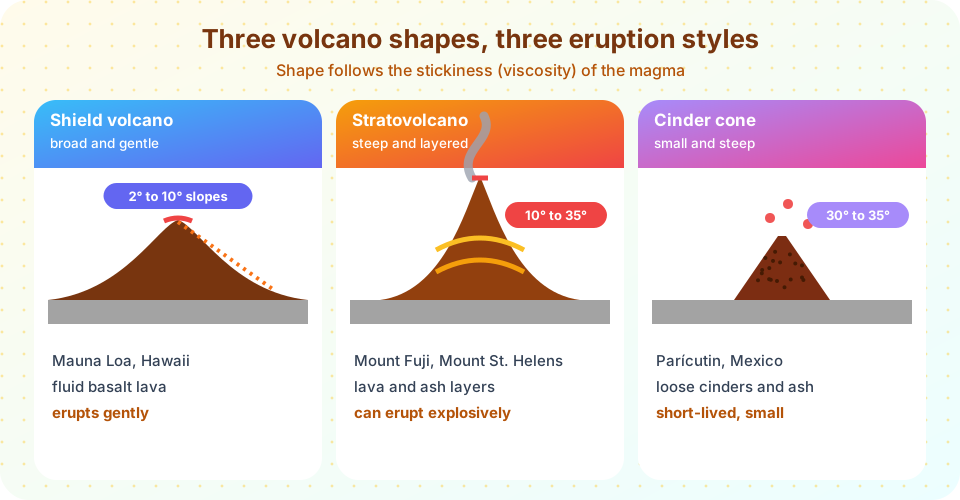
- Shield volcanoes are broad and gently sloping (typically 2 to 10 degrees), built of thousands of thin lava flows of fluid basalt. Mauna Loa in Hawaii is the largest active volcano on Earth by volume. Shield volcanoes are found at hotspots and some rifts.
- Stratovolcanoes (also called composite volcanoes) are steep, symmetrical cones built of alternating layers of lava, ash and breccia. They form at subduction zones from andesitic magma, and many are famous: Mount Fuji, Mount Rainier, Vesuvius, Mount St. Helens. They are the most dangerous because they erupt explosively.
- Cinder cones are small (usually under 300 meters), steep (about 30 to 35 degrees) piles of loose volcanic fragments called cinders, built in a single short eruption. Parícutin, in Mexico, grew out of a farmer's cornfield in 1943 and grew to about 400 meters during nine years of activity.
- Lava domes are bulges of very viscous lava that pile up over a vent. Collapse of a dome can trigger a deadly pyroclastic flow.
- Calderas are huge depressions formed when a magma chamber empties in a giant eruption and the roof collapses. Crater Lake in Oregon fills a caldera formed about 7,700 years ago.
Not all volcanoes are cones. Large fissure eruptions of basalt can build vast flood basalt provinces, such as the Deccan Traps in India, which erupted about 66 million years ago.
What comes out?
Lava flows. Fluid basalt lava forms two main types. Pahoehoe has a smooth, ropy surface; aa (pronounced "ah-ah") is rough and clinkery. Lava flows usually move slowly enough for people to walk away. Underwater lava forms rounded pillow lava.
Pyroclastic material (tephra). Fragments are classified by size: ash (smaller than 2 mm), lapilli (2 to 64 mm) and bombs or blocks (larger than 64 mm). Ash is made of tiny shards of volcanic glass and rock, sharp and abrasive, not soft like wood ash.
Gases. Mostly water vapor, with carbon dioxide, sulfur dioxide and others. Sulfur dioxide forms sulfate particles in the stratosphere that reflect sunlight and can cool the climate for a year or two, which happened after Tambora (1815) and Pinatubo (1991).
Measuring size: the VEI
The Volcanic Explosivity Index was proposed by Chris Newhall and Stephen Self in 1982. It runs from 0 (gentle, effusive) to 8 (a "super-eruption") and is roughly logarithmic: each step up means about ten times more material erupted. Some examples, with their approximate classes: Mount St. Helens 1980 (VEI 5), Vesuvius in 79 CE (VEI 5), Krakatau 1883 (VEI 6), Pinatubo 1991 (VEI 6), Tambora 1815 (VEI 7). VEI 8 events, such as the ancient eruptions of the Yellowstone caldera, happen only once every tens of thousands of years or more.
Hazards
Lava flows destroy property but rarely kill. The deadliest volcanic hazards are:
- Pyroclastic flows: fast-moving avalanches of hot gas and ash, hundreds of degrees Celsius and often moving faster than 100 km per hour. They destroyed the Roman towns of Pompeii and Herculaneum in 79 CE.
- Lahars: volcanic mudflows of ash and water that can travel tens of kilometers down river valleys. In 1985 a lahar from Nevado del Ruiz in Colombia buried the town of Armero.
- Ash fall: collapses roofs, contaminates water and endangers aircraft engines.
- Volcanic gases: such as carbon dioxide, which can pool in low places and suffocate.
- Tsunamis: triggered by island collapse or caldera eruptions, as at Krakatau.
Monitoring relies on the warning signs that magma gives before an eruption: swarms of small earthquakes, swelling of the volcano measured by GPS, tiltmeters and satellite radar, and changes in the gas released. These signs let scientists issue warnings, though predicting the exact time and size of an eruption remains difficult.
Common misconception: "All volcanoes are cone-shaped mountains that erupt lava." Shapes vary, and many eruptions are mostly ash and gas. Some dangerous volcanoes are collapsed calderas.
Common misconception: "A volcano that has been quiet for centuries is dead." Many active volcanoes sleep for hundreds or thousands of years between eruptions. The label "extinct" is risky.
Common misconception: "Lava is the main killer." Pyroclastic flows, lahars, ash and gas cause most deaths.
Try it
The first example plots the VEI scale on a logarithmic axis, with the minimum volume of material for each class and a few well-known eruptions placed at their approximate class.
Press Run (or Ctrl + Enter) to see the result here.
Program input · what you'd type while the program runs
Type the answers before you press Run, one per line. Each time the program reads a line (with input()), it gets the next line from this box.
The second example is a rule-of-thumb predictor. Set the silica content and the amount of dissolved water and read the likely eruption style. It is a simplification for learning, not a forecast tool.
Check your understanding
Quick check · 5 questions
of 5 answered You scored / 5 · perfect!
-
1. Which magma is most likely to erupt explosively?
Viscous magma traps expanding gas bubbles, so pressure builds until the magma shatters. -
2. Mauna Loa in Hawaii is a
Mauna Loa is a huge shield volcano built from fluid basalt flows. -
3. A tephra fragment 10 mm across is called
Lapilli are 2 to 64 mm; ash is under 2 mm, and bombs or blocks are over 64 mm. -
4. Each step up on the VEI scale means roughly
The VEI is approximately logarithmic: each class is about ten times larger in erupted volume. -
5. Which hazard destroyed Pompeii in 79 CE?
Hot pyroclastic surges and heavy ash fall buried Pompeii and Herculaneum.
Summary
- Magma erupts because it is buoyant and its dissolved gas expands as pressure falls.
- Runny, low-silica magma erupts effusively; thick, silica-rich, gas-rich magma erupts explosively.
- Shield volcanoes, stratovolcanoes, cinder cones, domes and calderas have distinct shapes and settings.
- The VEI scales eruptions from 0 to 8, about ten times more material per step.
- Pyroclastic flows, lahars, ash and gases are the main hazards; monitoring watches earthquakes, ground swelling and gas.
Next: Metamorphic rocks
Track your progress
Create a free account to tick off lessons and pick up where you left off on any device.
of Geology lessons completed