


















Lesson 2 of 48 · Getting Started
Why learn French, and how to study it well
Find out where French is spoken around the world, why it is worth learning, and which study habits (spaced repetition, speaking aloud, regular review) work best for beginners.
Before you learn a single verb, it helps to know why French is worth the effort and how to go about it so your time is not wasted. French is spoken on every continent, it is one of the working languages of the United Nations, and it opens doors to literature, film, cooking, science, fashion and travel. It is also a very friendly first foreign language for English speakers, because the two languages share so much history.
This lesson answers three questions. Where do people speak French, and which kind of French should you expect to meet? Why does English contain so many French words? And which study methods are backed by research on memory, so that you learn faster with less frustration?
What you will learn
- Where French is spoken and why its geography is wider than many people think.
- How French and English are related, and which French words you already know.
- Which regional variations you will meet (for example in Quebec, Belgium and Switzerland).
- Three study methods that work: spaced repetition, retrieval practice and speaking aloud.
Key terms
Francophone means French-speaking; a francophone is a French speaker. La Francophonie is the community of French-speaking countries and regions.
Cognate is a word with a shared origin in two languages, such as l'information and information.
False friend (faux ami) is a word that looks like an English word but means something else, such as librairie, which is a bookshop, not a library.
Retrieval practice is testing yourself instead of rereading.
Where French is spoken
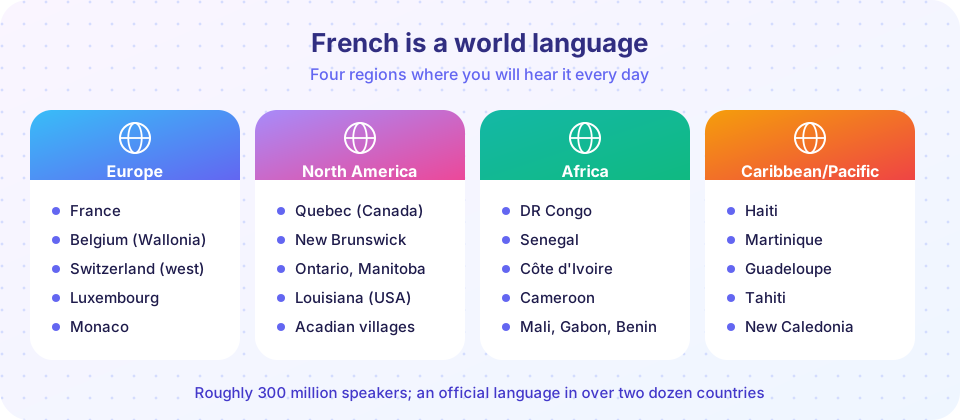
French began as a Romance language, a descendant of the Latin spoken in Roman Gaul. Over centuries it spread through exploration, trade, colonization and, later, migration and education. Today estimates put the number of speakers at roughly three hundred million, and French is an official language in more than two dozen countries and in organizations such as the United Nations, the European Union and the International Olympic Committee.
In Europe, French is the main language of France and also an official language in Belgium (in Wallonia and Brussels), Switzerland (mainly the western part, called Romandie), Luxembourg and Monaco. In North America, it is the first language of most people in the Canadian province of Quebec, and it is spoken in Acadian communities in New Brunswick and in parts of Ontario, Manitoba and Louisiana. In the Caribbean and Pacific, you find it in Haiti, in Martinique and Guadeloupe, in French Polynesia (Tahiti) and in New Caledonia.
The largest and fastest-growing region of French use is Africa. French is an official or administrative language in countries such as Senegal, Côte d'Ivoire, Cameroon, Mali, Gabon, Morocco (as a widely used second language), Tunisia and Algeria (widely used), and the Democratic Republic of the Congo, whose capital Kinshasa has one of the largest French-speaking populations of any city on Earth. In many of these places French is spoken alongside local languages, so people are often bilingual or multilingual.
This geography matters for your learning. The French in your lessons is standard French, the form taught in schools and used in news broadcasts, and it is understood everywhere. But you will hear differences. In Quebec you may hear char for "car" and magasiner for "to shop", where France says voiture and faire les courses or faire du shopping. In Belgium and Switzerland people say septante (70) and nonante (90), where France says soixante-dix and quatre-vingt-dix; some Swiss regions also say huitante for 80. Those variations are normal, not mistakes. Beginners can safely learn standard French and add regional words later.
Why English already contains French
In 1066 the Normans, who spoke a form of French, conquered England. For roughly three centuries French was the language of the royal court, law and government. Many words entered English in that period, and a large share of English vocabulary today has French or Latin-via-French roots. That is why you already recognize words like table, question, machine, possible and difficile (difficult).
Notice a pattern in the words that cross over: the English word often looks the same but is said differently, and the English "-tion" ending is usually "-tion" in French too. Nation, station, action, conversation, solution are all spelled the same, but the French vowel sounds are different and the stress falls on the last syllable. A good first habit is to notice cognates, but always check the sound.
Be careful with false friends. A few common ones:
| French word | Looks like | Actually means |
|---|---|---|
| la librairie | library | bookshop |
| actuellement | actually | at the moment, currently |
| un cours | course (of a meal) | a class or lesson |
| la monnaie | money | change, currency |
| sensible | sensible | sensitive |
| assister à | assist | attend, be present at |
How memory works, and what to do about it
Learning vocabulary is mostly a memory problem. Three findings from memory science are worth building your habits around.
Spacing. In 1885 the German psychologist Hermann Ebbinghaus tested his own memory with nonsense syllables and described a "forgetting curve": much of what you learn fades within a day or two unless you refresh it. Every well-timed review makes the memory last longer. So five sessions of ten minutes spread over a week beat one session of fifty minutes. The Leitner system, popularized by the German science journalist Sebastian Leitner in the 1970s, turns this into a box game: correct cards move to a box that is reviewed less often, wrong cards return to box one.
Retrieval. Trying to remember something strengthens the memory more than looking at it again. That is why flashcards, quizzes and gap-fill exercises work better than rereading a list. When a Try it exercise tempts you to peek, try to answer first, even if you guess.
Output and listening. Saying a sentence aloud forces you to produce the sounds, which exposes gaps that silent reading hides. Listening to French, even without understanding every word, trains your ear. Some researchers argue about exactly how much comprehensible input is needed, but nearly everyone agrees that you need a lot of both input and output.
Combine the three: keep a deck of cards, review them in short daily sessions, and say every example aloud.
Practical routine for beginners
Plan about twenty minutes a day. Use five for review of old items, ten for the new lesson and five for speaking or listening. Keep a notebook with three columns: the French, the English, and a note on anything odd (a gender, an accent, an irregular form). Write full phrases, not only single words: un café, s'il vous plaît teaches the article and a polite habit at once.
Add small doses of real French. Listen to a French radio station while cooking. Change your phone language for one app. Watch a film you already know in French with French subtitles. At this stage you will not understand most of it, and that is fine; your goal is to get used to the sound and rhythm.
Common misconceptions
"I'm too old to learn a language." Children pick up accents easily, but adults are better at grammar, planning and using study strategies. Adults regularly reach good levels in a second language.
"Immersion alone will do it." Being surrounded by French helps a lot, but most adults also need explicit explanations of rules, which is what a course provides.
"Standard French is the only real French." Regional French is just as real. Learn the standard form first, then enjoy the variety.
Try it
First, a simulation of what spaced repetition does. The model below is a simplification: each review doubles how long a memory lasts. It prints the review days for a card and then plots memory strength over time with and without reviews. This is an illustration of the idea, not measured data.
Press Run (or Ctrl + Enter) to see the result here.
Program input · what you'd type while the program runs
Type the answers before you press Run, one per line. Each time the program reads a line (with input()), it gets the next line from this box.
Next, test your geography. Match each French-speaking place to its country.
Finally, learn the false friends from this lesson as flashcards. Say each French word aloud before you flip.
Check your understanding
Quick check · 5 questions
of 5 answered You scored / 5 · perfect!
-
1. Which of these is a false friend?
La librairie looks like library but is a bookshop. The others are true cognates. -
2. Who described the forgetting curve in 1885?
Hermann Ebbinghaus tested his own memory and showed that forgetting is fastest soon after learning. -
3. Why does English contain so many French words?
The Norman conquest began a long period of heavy French influence on English vocabulary. -
4. In Belgium and Switzerland, what do many people say for 70?
Belgian and Swiss French use septante, while France uses soixante-dix. -
5. Which study habit has the strongest research support?
Spaced retrieval practice builds longer-lasting memories than rereading.
Summary
- French is spoken on every continent; Africa has the largest and fastest-growing French-speaking population.
- Standard French is understood everywhere; regional variants such as septante or Quebec's magasiner are normal.
- English and French share many cognates, but watch out for false friends like librairie.
- Use spaced repetition, retrieval practice and speaking aloud, in short daily sessions.
Track your progress
Create a free account to tick off lessons and pick up where you left off on any device.
of French for Beginners lessons completed