


















Lesson 12 of 48 · Nouns, Articles and Adjectives
Nouns: gender and plurals
Learn how French nouns get their gender, which endings predict masculine or feminine, how to form feminine job titles, and the plural rules for -s, -x and -aux.
French has no neuter, so every noun is either masculine or feminine. A chair is feminine, a desk is masculine, a problem is masculine, a hand is feminine. For many words you simply have to learn the gender, but a surprising number of them follow patterns, and you can guess correctly most of the time once you know the endings. In this lesson you will learn those patterns, see how people's jobs and relatives change between masculine and feminine, and learn how to make nouns plural.
Remember the golden rule: never learn a noun alone. Learn le livre, not livre. Your future self will thank you.
What you will learn
- How to recognize gender from the ending of a noun, and the main exceptions.
- How to form the feminine of people and job nouns.
- How to make plurals: -s, -x, -aux and the irregular ones.
- How to hear gender and number in speech.
Key terms
Masculine (m.) nouns take le, un; feminine (f.) nouns take la, une.
Suffix is the ending of a word.
Plural means more than one; most French plurals end in -s, which is silent.
Homograph with gender are words spelled the same but with a different gender and meaning, like le tour and la tour.
Natural gender: people and animals
For people, gender usually follows sex: un homme (a man), une femme (a woman), un garçon, une fille, un père, une mère, un frère, une sœur. Many relatives and jobs change by adding -e: un ami / une amie, un étudiant / une étudiante, un employé / une employée, un voisin / une voisine. When a consonant becomes pronounced, you hear the difference: étudiant /etydjɑ̃/ becomes étudiante /etydjɑ̃t/.
Other patterns:
| Masculine | Feminine | Pattern |
|---|---|---|
| un boulanger | une boulangère | -er to -ère |
| un infirmier | une infirmière | -ier to -ière |
| un chanteur | une chanteuse | -eur to -euse |
| un acteur | une actrice | -teur to -trice |
| un musicien | une musicienne | -ien to -ienne |
| un patron | une patronne | -on to -onne |
| un chat | une chatte | -t doubles |
| un/une élève, artiste, collègue, enfant, touriste | same | one form for both |
Words that end in -e in the masculine, like élève, artiste and collègue, do not change; only the article shows the gender. Some job titles historically had only a masculine form (un médecin, un professeur, un ingénieur), and usage has been changing: forms such as une professeure and une ingénieure are standard in Quebec and increasingly accepted in France, while many people still say une médecin or la professeur. If you need a job title, listen to what people around you say.
Gender clues in endings
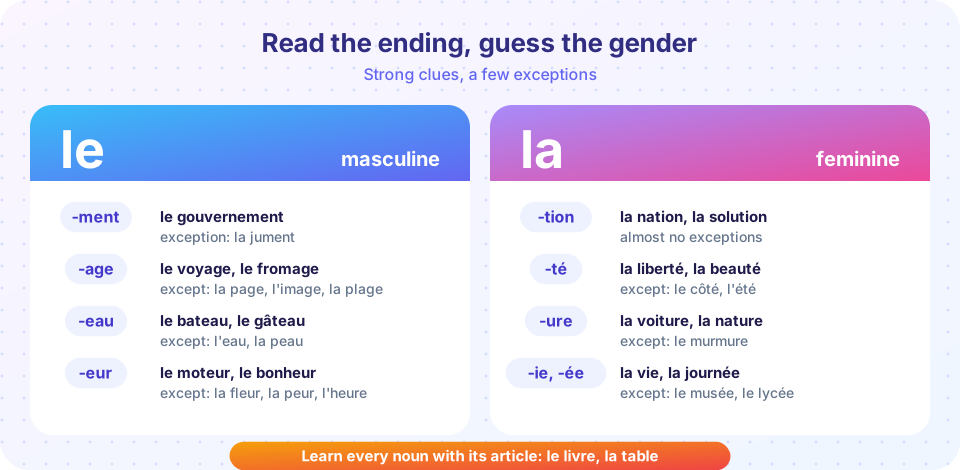
For things and ideas, look at the ending. These patterns are reliable most of the time (not always).
Usually masculine:
| Ending | Examples | Exceptions to know |
|---|---|---|
| -ment | le gouvernement, le bâtiment, le moment | la jument (mare) |
| -age | le voyage, le fromage, le garage | la page, la plage, l'image, la cage, la nage |
| -eur (things) | le moteur, le bonheur, le malheur | la fleur, la couleur, la chaleur, la peur, l'heure, la valeur, la douleur |
| -isme | le tourisme, le réalisme | none worth learning yet |
| -eau | le bateau, le château, le gâteau | l'eau, la peau |
| -oir | le miroir, le couloir | none |
Usually feminine:
| Ending | Examples | Exceptions to know |
|---|---|---|
| -tion, -sion | la nation, la télévision, la solution | none common |
| -té | la liberté, la beauté, la qualité | le côté, l'été (summer) |
| -ure | la voiture, la nature, la culture | le murmure |
| -ie | la vie, la boulangerie, la pharmacie | le génie |
| -ée | la journée, l'année, l'idée | le musée, le lycée |
| -ette, -esse, -ence, -ance | la baguette, la tristesse, la chance | le silence |
Some categories are always masculine: days of the week (le lundi), months and seasons (le printemps), languages (le français), colors as nouns (le rouge), most metals (le fer), and the points of the compass (le nord). Many countries ending in -e are feminine (la France, l'Italie), and most others masculine (le Canada, le Japon).
Because a noun's article is also its gender label, one wrong guess causes the article and the adjective to be wrong too, but not unintelligible: people will still understand le voiture. The most important thing is to try. When you are unsure, check a dictionary and write down the article.
Same spelling, different gender
A few common words change meaning with gender:
| Masculine | Feminine |
|---|---|
| le livre (book) | la livre (pound, the weight or currency) |
| le tour (turn, tour) | la tour (tower) |
| le poste (job, position) | la poste (post office) |
| le mode (way, method) | la mode (fashion) |
| le voile (veil) | la voile (sail) |
| le mémoire (thesis) | la mémoire (memory) |
Forming plurals
Most French plurals add -s, and that -s is silent, so le chat /lə ʃa/ and les chats /le ʃa/ sound the same apart from the article. Learn to hear the article: le/la/l' (singular) versus les (plural). Before a vowel, liaison helps: l'ami /lami/ versus les amis /lezami/.
| Rule | Singular | Plural |
|---|---|---|
| Add -s | un livre, une table, un étudiant | des livres, des tables, des étudiants |
| Already ends in -s, -x or -z: no change | un fils, un prix, un nez | des fils, des prix, des nez |
| -eau, -eu: add -x | un bateau, un jeu, un neveu | des bateaux, des jeux, des neveux |
| -al: -aux | un journal, un cheval, un animal | des journaux, des chevaux, des animaux |
| -ail: usually -s | un détail, un portail | des détails, des portails |
| -ou: usually -s | un trou, un clou | des trous, des clous |
There are exceptions: un pneu becomes des pneus, un bleu becomes des bleus, un bal becomes des bals, un festival becomes des festivals, un travail becomes des travaux, and seven words in -ou take -x: bijou, caillou, chou, genou, hibou, joujou, pou (des bijoux, des genoux). A few nouns change in other ways: un œil becomes des yeux, monsieur becomes messieurs, madame becomes mesdames, and un œuf /œf/ becomes des œufs /ø/ with a different vowel and a silent f, as does un os /ɔs/ to des os /o/. Learn those as individual items.
Some words are normally plural: les ciseaux (scissors), les vacances (holidays), les gens (people), les lunettes (glasses).
A worked example: guess, then check
Let us practice the guess-and-check method on four words you have not met. First, la patience. The ending -ence is feminine, and the dictionary agrees. Second, le développement. The ending -ment predicts masculine, and it is. Third, la plage. The ending -age predicts masculine, but plage is on the exception list, so it is feminine: la plage. A guess based on a pattern is a good start, but exceptions exist, and you should note them in your notebook with a star. Fourth, le soleil. There is no pattern here at all: soleil is masculine and lune is feminine (la lune), while in German the sun is feminine and the moon masculine. Gender is simply a property of the word in each language, and it will not match across languages.
When you learn a new noun, write down the article, the meaning, a short example sentence and a star if it breaks a pattern. After a few weeks you will have a personal list of exceptions, and that list is much more useful than any generic table.
Common misconceptions
"Gender is random, so I cannot learn it." A lot of it is predictable from endings and categories; the rest comes with repetition and with learning each noun alongside its article.
"The plural is always pronounced -s." The final -s is silent. Listen for the article or the liaison to hear that a noun is plural.
"Feminine always means adding -e." It often does, but there are many patterns (-euse, -trice, -ère, -onne), and some words do not change.
Try it
The first helper guesses the gender and the plural of a noun from its ending, using the rules and exceptions in this lesson. Try your own nouns by editing the list. It is a rule-of-thumb tool: the real answer is always the dictionary.
Press Run (or Ctrl + Enter) to see the result here.
Program input · what you'd type while the program runs
Type the answers before you press Run, one per line. Each time the program reads a line (with input()), it gets the next line from this box.
Next, a game: turn a masculine job title into its feminine form. Type the full feminine word.
Finally, a drill for the plural rules. Match each singular with its plural.
Check your understanding
Quick check · 5 questions
of 5 answered You scored / 5 · perfect!
-
1. Which ending usually signals a feminine noun?
-tion words are feminine: la nation, la solution. -
2. What is the plural of un journal?
Nouns in -al change to -aux: des journaux. -
3. Which is an exception to -age being masculine?
La page is feminine, like la plage and l'image. -
4. How do you hear the plural in les chats?
The plural -s is silent; the article les shows plural. -
5. What is the feminine of 'un acteur'?
Nouns in -teur often become -trice: actrice, directrice.
Summary
- Every noun is masculine or feminine; learn it with its article.
- Endings are clues: -ment, -age, -eau often masculine; -tion, -té, -ure, -ie, -ée often feminine; learn the exceptions.
- People and jobs: add -e, or use patterns like -euse, -trice, -ère, -ienne; some words do not change.
- Plurals: add -s (silent); -s/-x/-z stay; -eau and -eu take -x; -al becomes -aux.
Track your progress
Create a free account to tick off lessons and pick up where you left off on any device.
of French for Beginners lessons completed