Learn French numbers from 0 to 1,000,000, how to tell the time, say days, months and dates, and read prices and phone numbers, with drills.
Numbers are the part of French that surprises English speakers most. Up to sixty everything is neat. Then the language starts counting in twenties: 80 is "four twenties", and 97 is "four twenties seventeen". The good news is that the system is completely regular once you see the pattern, and you only need a few dozen words to count to a million.
Time and dates build directly on numbers. The French use the 24-hour clock in writing and often in speech, they put the day before the month, and they have a small set of fixed words for quarters and halves of an hour. This lesson gives you all of it, and a Python helper at the end that spells out any number or time you type.
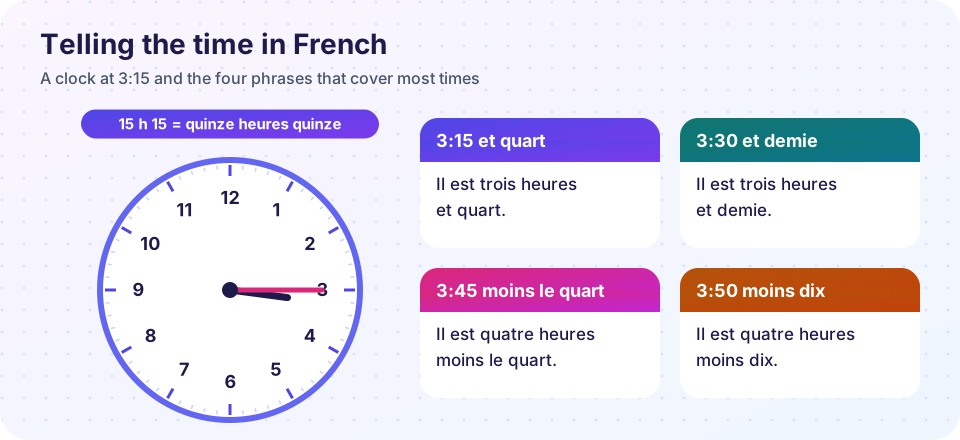
A clock face and the four phrases that cover almost every time you will ever say.
un nombre: a number. l'heure (f.): the hour, or "time" when you ask what time it is. la date: the date. et quart / et demie / moins le quart: quarter past, half past, quarter to. le 24-heures: the 24-hour clock used on timetables, tickets and in formal speech.
These you simply learn. Say each one aloud several times.
#
French
#
French
0
zéro
11
onze
1
un (une)
12
douze
2
deux
13
treize
3
trois
14
quatorze
4
quatre
15
quinze
5
cinq
16
seize
6
six
17
dix-sept
7
sept
18
dix-huit
8
huit
19
dix-neuf
9
neuf
20
vingt
10
dix
Two details. The number one has a feminine form: un livre (one book), une table (one table). And the final consonants of six, huit and dix are pronounced when the number stands alone (six sounds like "seess"), but silent before a consonant: six livres sounds like "see leevr", while six amis links the x as a z: "see zah-mee".
From twenty the pattern is "tens word + unit": vingt, trente, quarante, cinquante, soixante. You add the units with a hyphen: vingt-deux (22), trente-cinq (35), quarante-huit (48), cinquante-neuf (59), soixante-six (66).
The only exception is the number one. The links et un appear in 21, 31, 41, 51 and 61: vingt et un, trente et un, quarante et un, cinquante et un, soixante et un. There is no et in any other number: 22 is vingt-deux, and 32 is trente-deux. (A 1990 spelling reform allows hyphens everywhere, as in vingt-et-un, but the traditional form with spaces around et is still the one you will see most often.)
Standard French in France counts 70 to 99 by adding onto sixty and eighty:
Number
Literal meaning
French
70
sixty-ten
soixante-dix
71
sixty and eleven
soixante et onze
72
sixty-twelve
soixante-douze
79
sixty-nineteen
soixante-dix-neuf
80
four-twenties
quatre-vingts
81
four-twenty-one
quatre-vingt-un
90
four-twenty-ten
quatre-vingt-dix
91
four-twenty-eleven
quatre-vingt-onze
99
four-twenty-nineteen
quatre-vingt-dix-neuf
Look at three details. First, 71 takes et (soixante et onze), but 81 and 91 do not (quatre-vingt-un, quatre-vingt-onze). Second, quatre-vingts has an s only when it ends the number; it loses it before another number (quatre-vingt-deux). Third, in Belgium and Switzerland you will hear septante (70) and nonante (90) instead, and some Swiss regions say huitante for 80. They are completely correct and often easier to learn. Both systems are understood everywhere, but use the one you will meet most where you plan to travel.
100 is cent, and 200 is deux cents. The s appears only when cent is multiplied and ends the number: deux cents (200), but deux cent trois (203).
1,000 is mille, and it never takes an s: deux mille (2,000), trois mille cinq cents (3,500).
1,000,000 is un million, and it takes an s from two millions on: deux millions, and then de before a noun: deux millions d'euros.
Before mille, cent and vingt lose their s: deux cent mille (200,000), quatre-vingt mille (80,000).
Years are said as a normal number: 2025 is deux mille vingt-cinq, and 1998 is mille neuf cent quatre-vingt-dix-huit (people also say dix-neuf cent quatre-vingt-dix-huit). Write 1,000 as 1 000 with a space and a decimal as a comma: 3,14 is trois virgule quatorze, the reverse of English.
To ask the time: Quelle heure est-il ? (formal) or Il est quelle heure ? (casual). The answer starts with Il est and uses the plural heures for anything above one: Il est une heure, Il est deux heures.
Time
French
3:00
Il est trois heures.
3:15
Il est trois heures et quart.
3:30
Il est trois heures et demie.
3:45
Il est quatre heures moins le quart.
3:10
Il est trois heures dix.
3:50
Il est quatre heures moins dix.
12:00
Il est midi.
00:00
Il est minuit.
12:30
Il est midi et demi.
The logic is this. For the first half of the hour you say the hour and add minutes: trois heures cinq, trois heures vingt. Past the half you say the next hour minus the remaining minutes: quatre heures moins vingt for 3:40. Demie is feminine because heure is feminine, but midi and minuit are masculine, so you say midi et demi. In writing and on timetables, people use the 24-hour clock with an h: 14 h 15 is quatorze heures quinze, and 18 h 40 is dix-huit heures quarante. Nobody says "quarter" in the 24-hour style.
To say "at" a time use à: Le film commence à vingt heures (The film starts at 8 p.m.). Use du matin, de l'après-midi and du soir on the 12-hour clock: sept heures du matin, dix heures du soir.
The days: lundi, mardi, mercredi, jeudi, vendredi, samedi, dimanche. The months: janvier, février, mars, avril, mai, juin, juillet, août, septembre, octobre, novembre, décembre. In French, days and months are not capitalized, and the week starts on Monday on calendars.
Idea
French
What day is it?
Quel jour sommes-nous ? / On est quel jour ?
What is the date?
Quelle est la date ?
It is 5 March.
Nous sommes le 5 mars. / On est le cinq mars.
1 May
le premier mai (le 1er mai)
14 July
le quatorze juillet
on Monday (this coming one)
lundi
every Monday
le lundi
in January
en janvier / au mois de janvier
in spring / summer
au printemps / en été
in autumn / winter
en automne / en hiver
The date is le + number + month, with the day first: 3/9/2026 means 3 September. Only the first of the month uses the ordinal premier; every other day uses a plain number. Le before a weekday means "every": Le samedi, je dors tard means "On Saturdays, I sleep in".
Prices say euros and then the cents, with no separate word for the comma: 12,50 € is douze euros cinquante. Ask with Ça coûte combien ? or C'est combien ? To give your age use avoir, not être: J'ai vingt ans, never "je suis vingt ans".
French phone numbers have ten digits and are spoken in pairs: 06 12 34 56 78 is zéro six, douze, trente-quatre, cinquante-six, soixante-dix-huit. Mobile numbers in France start with 06 or 07. Learn your own number as a pair-by-pair chant.
Start with flashcards. Tap a card to flip it, and try the English-first direction too.
Number flashcards
<style>:root{--ink:#1e1b4b;--mut:#475569;--a:#4f46e5;--b:#db2777}*{box-sizing:border-box}body{margin:0;padding:14px;font-family:system-ui,-apple-system,'Segoe UI',sans-serif;background:linear-gradient(135deg,#faf5ff,#eff6ff);color:var(--ink)}.wrap{max-width:640px;margin:0 auto}button{font:inherit;cursor:pointer;border:0;border-radius:999px;padding:8px 16px;color:#fff;background:linear-gradient(135deg,#4f46e5,#7c3aed);box-shadow:0 4px 10px rgba(79,70,229,.25)}button.alt{background:#fff;color:var(--a);border:1px solid #c7d2fe;box-shadow:none}button:disabled{opacity:.45;cursor:default}.row{display:flex;gap:8px;flex-wrap:wrap;justify-content:center;margin:12px 0}.card{background:#fff;border-radius:18px;box-shadow:0 10px 24px rgba(67,56,202,.16);padding:26px 18px;text-align:center;min-height:130px;display:flex;flex-direction:column;justify-content:center;align-items:center;width:100%;color:var(--ink);cursor:pointer;border:0}.card .big{font-size:28px;font-weight:700}.card .sm{font-size:14px;color:var(--mut);margin-top:6px}.cnt{text-align:center;color:var(--mut);font-size:14px;margin-bottom:8px}.msg{text-align:center;min-height:22px;color:var(--mut);font-size:14px}.ok{color:#047857;font-weight:600}.bad{color:#be123c;font-weight:600}input[type=text]{font:inherit;border:2px solid #c7d2fe;border-radius:10px;padding:5px 8px;width:150px;background:#fff;color:var(--ink)}input.good{border-color:#10b981;background:#ecfdf5}input.wrong{border-color:#ef4444;background:#fef2f2}.item{background:#fff;border-radius:14px;padding:10px 14px;margin:8px 0;box-shadow:0 4px 12px rgba(67,56,202,.10);line-height:2}.item small{display:block;color:var(--mut);line-height:1.3}.keys{display:flex;flex-wrap:wrap;gap:6px;justify-content:center;margin:8px 0}.keys button{padding:4px 11px;background:#fff;color:var(--a);border:1px solid #c7d2fe;box-shadow:none;border-radius:8px}.cols{display:grid;grid-template-columns:1fr 1fr;gap:10px}.cols button{display:block;width:100%;border-radius:12px;background:#fff;color:var(--ink);border:2px solid #c7d2fe;box-shadow:none;padding:10px 8px;margin-bottom:8px;text-align:center}.cols button.sel{border-color:#4f46e5;background:#eef2ff}.cols button.done{border-color:#10b981;background:#ecfdf5;color:#047857;cursor:default}.cols button.no{border-color:#ef4444;background:#fef2f2}</style><divclass="wrap"><divclass="cnt"id="cnt"></div><buttonclass="card"id="card"aria-live="polite"><spanclass="big"id="big"></span><spanclass="sm"id="sm"></span></button><divclass="row"><buttonclass="alt"id="prev">Back</button><buttonid="flip">Flip</button><buttonclass="alt"id="next">Next</button></div><divclass="row"><buttonclass="alt"id="dir">French first</button><buttonclass="alt"id="shuf">Shuffle</button><buttonclass="alt"id="say">Listen</button></div><divclass="msg"id="msg"></div></div><script>constD=[["soixante-dix","70"],["soixante et onze","71"],["quatre-vingts","80"],["quatre-vingt-un","81"],["quatre-vingt-dix","90"],["quatre-vingt-quinze","95"],["cent","100"],["deux cents","200"],["mille","1,000"],["un million","1,000,000"],["midi","noon"],["minuit","midnight"]];let i=0,showFr=true,fr=true;const$=id=>document.getElementById(id);functiondraw(){const c=D[i];$('cnt').textContent='Card '+(i+1)+' of '+D.length;const q=fr?c[0]:c[1],a=fr?c[1]:c[0];$('big').textContent=showFr?q:a;$('sm').textContent=showFr?'Tap to flip':(fr?'English':'French');}functionflip(){showFr=!showFr;draw();}$('card').onclick=flip;$('flip').onclick=flip;$('next').onclick=()=>{i=(i+1)%D.length;showFr=true;draw();};$('prev').onclick=()=>{i=(i-1+D.length)%D.length;showFr=true;draw();};$('dir').onclick=()=>{fr=!fr;$('dir').textContent=fr?'French first':'English first';showFr=true;draw();};$('shuf').onclick=()=>{for(let k=D.length-1;k>0;k--){const j=Math.floor(Math.random()*(k+1));[D[k],D[j]]=[D[j],D[k]];}i=0;showFr=true;draw();};$('say').onclick=()=>{try{if(!('speechSynthesis'in window))throw0;const u=newSpeechSynthesisUtterance(D[i][0]);u.lang='fr-FR';speechSynthesis.cancel();speechSynthesis.speak(u);$('msg').textContent='';}catch(e){$('msg').textContent='Speech is not available in this preview. Say it aloud yourself.';}};draw();</script>
Now a Python helper that spells out any number from 0 to 999,999 in French and says the time. It follows the rules above, including the et un, quatre-vingts and cent rules. Change the numbers at the bottom and run it.
Python
Say any number or time in French
UNITS =["zéro","un","deux","trois","quatre","cinq","six","sept","huit","neuf","dix","onze","douze","treize","quatorze","quinze","seize"]
TENS ={2:"vingt",3:"trente",4:"quarante",5:"cinquante",6:"soixante"}defbelow_100(n):if n <=16:return UNITS[n]if n <20:return"dix-"+ UNITS[n -10]if n <70:
t, u =divmod(n,10)if u ==0:return TENS[t]if u ==1:return TENS[t]+" et un"return TENS[t]+"-"+ UNITS[u]if n <80:
r = n -60return"soixante et onze"if r ==11else"soixante-"+ below_100(r)
r = n -80return"quatre-vingts"if r ==0else"quatre-vingt-"+ below_100(r)defbelow_1000(n):
h, r =divmod(n,100)if h ==0:return below_100(r)
head ="cent"if h ==1else UNITS[h]+" cent"if r ==0:return head +("s"if h >1else"")return head +" "+ below_100(r)defnumber(n):if n <1000:return below_1000(n)
th, r =divmod(n,1000)if th ==1:
head ="mille"else:
s = below_1000(th)if s.endswith("cents")or s.endswith("vingts"):
s = s[:-1]
head = s +" mille"return head if r ==0else head +" "+ below_1000(r)defhours(h):if h in(0,24):return"minuit"if h ==12:return"midi"
base = number(h)if h in(1,21):
base +="e"return base +" heure"+("s"if h >1else"")defsay_time(h, m):if m ==0:
t = hours(h)elif m ==15:
t = hours(h)+" et quart"elif m ==30:
t = hours(h)+(" et demi"if h in(0,12,24)else" et demie")elif m ==45:
t = hours(h +1)+" moins le quart"elif m <30:
t = hours(h)+" "+ number(m)else:
t = hours(h +1)+" moins "+ number(60- m)return"Il est "+ t +"."for n in[0,16,21,71,77,80,81,91,99,200,280,1000,2025,80000]:print(n,"=", number(n))print()for h, m in[(1,0),(3,15),(3,30),(3,45),(11,50),(12,30),(14,10),(21,0)]:print(f"{h:02d}:{m:02d}", say_time(h, m))
Press Run (or Ctrl + Enter) to see the result here.
Program input · what you'd type while the program runs
Type the answers before you press Run, one per line. Each time the program reads a line (with input()), it gets the next line from this box.
And a gap-fill. Use the accent buttons when you need them.
Numbers, time and dates
<style>:root{--ink:#1e1b4b;--mut:#475569;--a:#4f46e5;--b:#db2777}*{box-sizing:border-box}body{margin:0;padding:14px;font-family:system-ui,-apple-system,'Segoe UI',sans-serif;background:linear-gradient(135deg,#faf5ff,#eff6ff);color:var(--ink)}.wrap{max-width:640px;margin:0 auto}button{font:inherit;cursor:pointer;border:0;border-radius:999px;padding:8px 16px;color:#fff;background:linear-gradient(135deg,#4f46e5,#7c3aed);box-shadow:0 4px 10px rgba(79,70,229,.25)}button.alt{background:#fff;color:var(--a);border:1px solid #c7d2fe;box-shadow:none}button:disabled{opacity:.45;cursor:default}.row{display:flex;gap:8px;flex-wrap:wrap;justify-content:center;margin:12px 0}.card{background:#fff;border-radius:18px;box-shadow:0 10px 24px rgba(67,56,202,.16);padding:26px 18px;text-align:center;min-height:130px;display:flex;flex-direction:column;justify-content:center;align-items:center;width:100%;color:var(--ink);cursor:pointer;border:0}.card .big{font-size:28px;font-weight:700}.card .sm{font-size:14px;color:var(--mut);margin-top:6px}.cnt{text-align:center;color:var(--mut);font-size:14px;margin-bottom:8px}.msg{text-align:center;min-height:22px;color:var(--mut);font-size:14px}.ok{color:#047857;font-weight:600}.bad{color:#be123c;font-weight:600}input[type=text]{font:inherit;border:2px solid #c7d2fe;border-radius:10px;padding:5px 8px;width:150px;background:#fff;color:var(--ink)}input.good{border-color:#10b981;background:#ecfdf5}input.wrong{border-color:#ef4444;background:#fef2f2}.item{background:#fff;border-radius:14px;padding:10px 14px;margin:8px 0;box-shadow:0 4px 12px rgba(67,56,202,.10);line-height:2}.item small{display:block;color:var(--mut);line-height:1.3}.keys{display:flex;flex-wrap:wrap;gap:6px;justify-content:center;margin:8px 0}.keys button{padding:4px 11px;background:#fff;color:var(--a);border:1px solid #c7d2fe;box-shadow:none;border-radius:8px}.cols{display:grid;grid-template-columns:1fr 1fr;gap:10px}.cols button{display:block;width:100%;border-radius:12px;background:#fff;color:var(--ink);border:2px solid #c7d2fe;box-shadow:none;padding:10px 8px;margin-bottom:8px;text-align:center}.cols button.sel{border-color:#4f46e5;background:#eef2ff}.cols button.done{border-color:#10b981;background:#ecfdf5;color:#047857;cursor:default}.cols button.no{border-color:#ef4444;background:#fef2f2}</style><divclass="wrap"><divclass="keys"id="keys"></div><divid="list"></div><divclass="row"><buttonid="chk">Check answers</button><buttonclass="alt"id="show">Show answers</button></div><divclass="msg"id="msg">Type each answer. Use the accent buttons if your keyboard has no accents.</div></div><script>constD=[{"s":"Le train part à ___ heures et quart. (3:15)","a":["trois"],"h":"Write the number in letters."},{"s":"Il est ___ et demi. (12:30 p.m.)","a":["midi"],"h":""},{"s":"Mon anniversaire, c'est le ___ mai. (1 May)","a":["premier"],"h":"Only the first of the month uses an ordinal."},{"s":"J'___ vingt ans. (I am 20)","a":["ai"],"h":"Age uses avoir."},{"s":"80 = quatre-___","a":["vingts"],"h":"With the final s."},{"s":"Il est quatre heures ___ le quart. (3:45)","a":["moins"],"h":""}];const$=id=>document.getElementById(id);let last=null;constnorm=s=>s.trim().toLowerCase().replace(/[\u2019\u2018]/g,"'").replace(/\s+/g,' ');D.forEach((d,k)=>{const p=d.s.split('___');const div=document.createElement('div');div.className='item';
div.append(p[0]);const inp=document.createElement('input');inp.type='text';inp.id='i'+k;inp.autocomplete='off';inp.spellcheck=false;inp.setAttribute('aria-label','Answer '+(k+1));inp.onfocus=()=>last=inp;div.append(inp);div.append(p[1]||'');if(d.h){const s=document.createElement('small');s.textContent=d.h;div.append(s);}$('list').append(div);});['é','è','ê','à','â','ç','î','ï','ô','ù','û','œ'].forEach(ch=>{const b=document.createElement('button');b.textContent=ch;b.setAttribute('aria-label','Insert '+ch);b.onmousedown=e=>e.preventDefault();b.onclick=()=>{const t=last||$('i0');t.focus();const s=t.selectionStart,e=t.selectionEnd;t.setRangeText(ch,s,e,'end');};$('keys').append(b);});$('chk').onclick=()=>{let n=0;D.forEach((d,k)=>{const t=$('i'+k);const ok=d.a.some(a=>norm(a)===norm(t.value));t.className=ok?'good':'wrong';if(ok)n++;});$('msg').innerHTML=n===D.length?'<span class="ok">All '+n+' correct. Bravo !</span>':'<span class="bad">'+n+' of '+D.length+' correct.</span> Check accents and endings.';};$('show').onclick=()=>{D.forEach((d,k)=>{$('i'+k).value=d.a[0];$('i'+k).className='good';});$('msg').textContent='Answers shown. Reload the preview to reset.';};</script>