


















Lesson 3 of 48 · Getting Started
The French alphabet and accents
Learn the 26 letters of the French alphabet and their names, what each accent mark does (é, è, ê, à, ç, ï, œ), and how to spell words aloud and type accents.
The good news first: French uses the same 26 letters as English. You can already read the shapes of the words. The surprise is that those letters have different names and that French adds small marks above and below some letters. Those marks, called accents or diacritics, are not decoration. They change how a letter sounds, they separate words that would otherwise look identical, and they leave clues about the history of the word.
By the end of this lesson you will be able to say the alphabet, spell your name aloud in French (a daily need on the phone, in hotels and at the post office), recognize each accent and know what it tells you, and type accents on your own keyboard.
What you will learn
- The names of the 26 letters and how to spell words aloud.
- What the acute, grave, circumflex, cedilla and diaeresis do.
- Why the ligatures œ and æ exist.
- How to type accented letters on common keyboards.
Key terms
Diacritic is a mark added to a letter to change its sound or meaning; "accent" is the everyday word for it.
Ligature is two letters joined into one symbol, such as œ in cœur (heart).
Homophone is a word that sounds like another but is spelled differently, such as ou (or) and où (where).
Silent letter is a letter written but not pronounced, such as the final t in petit.
The alphabet and the names of the letters
The letters appear in the same order as in English: a, b, c, d, e, f, g, h, i, j, k, l, m, n, o, p, q, r, s, t, u, v, w, x, y, z. In French, the alphabet is l'alphabet (masculine). Each letter has a name you use when you spell a word. The IPA symbols are in slashes; the respelling imitates the sound with English letters, and treat it as a rough guide (chapter 2 covers the sounds in detail).
| Letter | Name (IPA) | Respelling | Letter | Name (IPA) | Respelling |
|---|---|---|---|---|---|
| A | /a/ | ah | N | /ɛn/ | enn |
| B | /be/ | bay | O | /o/ | oh |
| C | /se/ | say | P | /pe/ | pay |
| D | /de/ | day | Q | /ky/ | kü |
| E | /ə/ | uh | R | /ɛʁ/ | air (French r) |
| F | /ɛf/ | eff | S | /ɛs/ | ess |
| G | /ʒe/ | zhay | T | /te/ | tay |
| H | /aʃ/ | ahsh | U | /y/ | ü |
| I | /i/ | ee | V | /ve/ | vay |
| J | /ʒi/ | zhee | W | /dubləve/ | doo-bluh-vay |
| K | /ka/ | kah | X | /iks/ | eeks |
| L | /ɛl/ | ell | Y | /igʁɛk/ | ee-grek |
| M | /ɛm/ | emm | Z | /zɛd/ | zed |
Three letters need a warning. The letter e is called "uh", not "ee"; i is "ee"; and j sounds like the s in English "measure" followed by "ee". The letters q and u contain the French u sound, which English does not have: say "ee" with your lips rounded as if whistling. Practice it now, because you will meet it in tu, rue, une and hundreds of other words.
The letters k and w are rare in native French words. You see them mostly in borrowed words such as le kiwi, le week-end and le whisky.
Spelling aloud
When someone asks Comment ça s'écrit ? ("How is that spelled?"), you answer with letter names. To say a double letter, use deux before it: "Anne" is a, deux n, e (a, enn, enn, uh). The apostrophe is une apostrophe, a hyphen is un tiret, and an accent is named by its type. For email addresses, French speakers say arobase for @ and point for the dot:
Mon adresse e-mail est marie point dupont arobase exemple point fr. "My email address is marie dot dupont at example dot fr."
To spell Hélène, you would say: H, é accent aigu, l, è accent grave, n, e. The long names of accents are part of this: accent aigu (acute), accent grave, accent circonflexe, tréma (diaeresis) and cédille.
The five accents and what they do
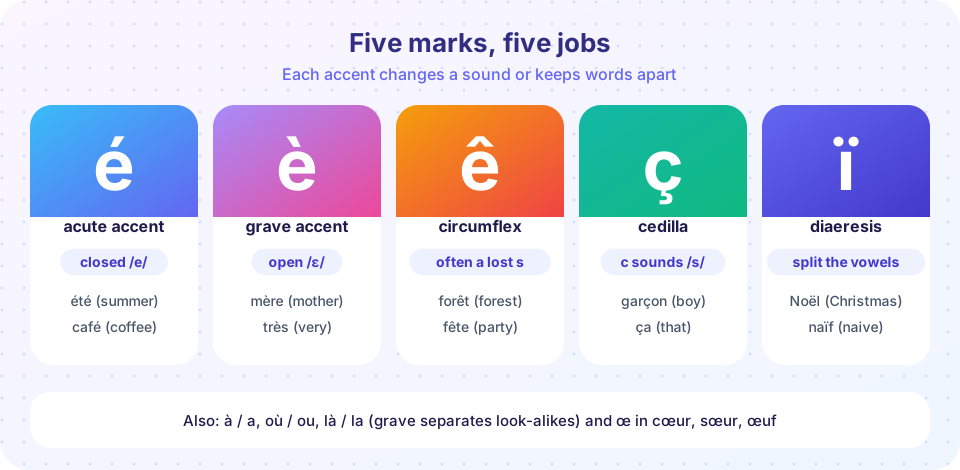
The acute accent (l'accent aigu) é. It appears only on e, and it makes the closed sound /e/, close to the vowel in English "say" but without gliding. Examples: été (summer), café, école (school), écouter (to listen).
The grave accent (l'accent grave) è, à, ù. On e, it gives the open sound /ɛ/, like the vowel in English "bed": mère (mother), père (father), très (very). On a and u, it does not change the sound; it separates look-alike words. Ou means "or" but où means "where"; a is "has" but à means "to, at"; la is "the" but là means "there".
The circumflex (l'accent circonflexe) â, ê, î, ô, û. Its sound effect is small: ê sounds like è. Its main job is historical. In many words a circumflex replaces an s that used to be pronounced and is still visible in the English cognate: forêt (forest), hôpital (hospital), île (isle), fête (feast, as in "festival"), pâte (paste). When you meet an unfamiliar word with a circumflex, try inserting an s after the vowel and see whether an English word appears. Sometimes it also separates homophones: sur (on) and sûr (sure), du (of the) and dû (due, owed).
The cedilla (la cédille) ç. It appears only under c, and only before a, o or u. Without the cedilla, c before those vowels sounds like /k/ (as in café, cour); with the cedilla it sounds like /s/. So garçon (boy) has an s sound, and ça (that) sounds like "sa". Before e and i, c is already /s/, so you never write çe or çi.
The diaeresis (le tréma) ë, ï, ü. Two dots tell you to pronounce a vowel separately instead of combining it with the one before: Noël (Christmas), naïf (naive), Haïti. The word maïs (corn) is not pronounced like mais (but) for the same reason.
Ligatures. The letters o and e join in œ in a few important words: cœur (heart), sœur (sister), œuf (egg), œil (eye), bœuf (beef), nœud (knot). The ligature is part of the correct spelling. The sound is a rounded /œ/ or /ø/ that you will practice in chapter 2. The ligature æ is rare (et cætera, ex æquo).
Capital letters and accents
French dictionaries and style guides prefer that capitals keep their accents: À bientôt, École, État. In practice, some signs omit them, but if you are writing correctly, include them. A missing accent can change the meaning in rare cases, for example PECHE could be pêche (peach, fishing) or péché (sin).
Typing accents
On a French AZERTY keyboard, é, è, à, ù, ç have their own keys. On other keyboards:
- Windows with the "United States-International" layout: press the quote or backtick key, then the vowel (for example ` then e gives è), and AltGr plus a letter for others.
- Mac: hold Option and press e, then the vowel for the acute; Option plus ` for the grave; Option plus i for the circumflex; Option plus u for the diaeresis; Option plus c gives ç.
- Phones: press and hold the letter (e, a, u, c) and slide to the accented form.
If you cannot type an accent, write the plain letter and keep going; learning to say the word correctly matters more than perfect typing, but practice writing accents by hand in your notebook.
Common misconceptions
"Accents are optional decoration." They are part of the spelling. Ou and où are different words, and é and è are different sounds.
"An accent tells you where to put the stress." In French, accents do not mark stress. Stress falls gently on the last syllable of a phrase. Accents show vowel quality or distinguish words.
"The letter e is pronounced 'ee'." The letter name is "uh". The letter that is called "ee" is i.
Try it
Practice the sound of each letter with these flashcards. Say the letter name aloud, then flip to see the respelling.
Now the accent finder. This Python program analyzes any French sentence and lists the accents it contains, with the name of each mark.
Press Run (or Ctrl + Enter) to see the result here.
Program input · what you'd type while the program runs
Type the answers before you press Run, one per line. Each time the program reads a line (with input()), it gets the next line from this box.
Finally, restore the missing accents. Type the correct word. If you leave an accent out, the checker will tell you that you are close.
Check your understanding
Quick check · 5 questions
of 5 answered You scored / 5 · perfect!
-
1. What does the cedilla in ç do?
Before a, o and u, c is normally /k/. The cedilla changes it to /s/, as in garçon. -
2. Which pair of words is separated only by a grave accent?
Ou means or, and où means where. The grave accent on u does not change the sound; it separates the words. -
3. How do you say the double n in 'Anne' when spelling?
French uses deux before a doubled letter when spelling: a, deux n, e. -
4. What does the circumflex often indicate in older words?
Forêt, hôpital and île all lost an s that English kept. -
5. How do French speakers say the symbol @ in an email address?
Arobase is @, point is the dot, and tiret is the hyphen.
Summary
- French uses the 26 English letters, but with different names; e is "uh", i is "ee", u is the rounded "ü".
- Spell with letter names; say deux before a double letter.
- Accents mean something: é is /e/, è and ê are /ɛ/, ç is /s/, ï and ë separate vowels, and à/où/là separate homophones.
- A circumflex often marks a lost s (forêt, hôpital).
- Learn to type or at least to write accents; they are part of the spelling.
Track your progress
Create a free account to tick off lessons and pick up where you left off on any device.
of French for Beginners lessons completed