


















Lesson 28 of 48 · Daily Life and Questions
Chapter 5 Review: Daily Life and Questions
Review numbers, time, dates, question forms and negation from Chapter 5 with a one-page picture, recap table, practice and a ten-question quiz.
You have covered a lot of ground in this chapter. You can count past a hundred, tell the time two ways, ask questions at three levels of formality and say no in half a dozen ways. This review pulls everything into one page, shows you where learners usually trip, and gives you a longer quiz to test yourself. Do the quiz without looking back first. Then use the recap to repair the gaps.
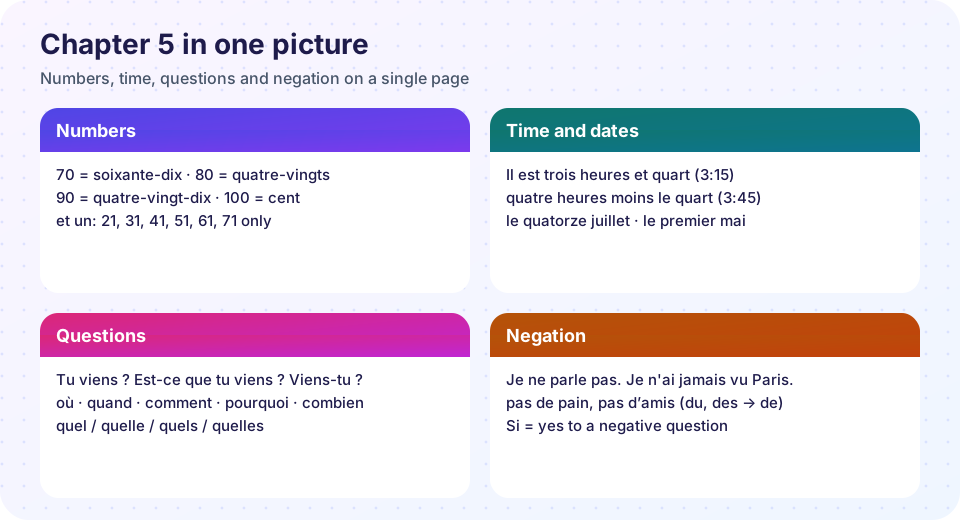
What you will learn
- Check which Chapter 5 skills are solid and which need another pass
- Mix numbers, time, questions and negation in one practice session
- Spot the five most common mistakes of the chapter
Recap table
| Skill | Rule to remember | Example |
|---|---|---|
| Numbers 70-99 | 60 + 10..19, and 80 = four twenties | soixante-dix-sept, quatre-vingt-onze |
| et un | only in 21, 31, 41, 51, 61, 71 | trente et un, but quatre-vingt-un |
| Hundreds | cent/quatre-vingts keep s only at the end | deux cents, deux cent trois |
| Time | Il est ... heures, et quart, et demie, moins le quart | Il est quatre heures moins le quart. |
| Dates | day first, le premier for the 1st | le quatorze juillet |
| Age | avoir | J'ai quinze ans. |
| Questions | intonation, est-ce que, inversion with -t- | Parle-t-il ? |
| Quel | agrees with the noun | quelle heure, quels livres |
| Negation | ne + verb + second word | Je n'ai jamais vu Paris. |
| After negation | du, de la, des, un, une become de | Je n'ai pas de frère. |
| Yes to a negative question | si | Tu ne viens pas ? — Si ! |
The five classic mistakes
- Saying je suis vingt ans instead of j'ai vingt ans.
- Writing the date month first or capitalizing the day and month.
- Forgetting -t- in Parle-t-il ? or using inversion with je.
- Using pas with rien/personne, as in je ne vois pas rien.
- Keeping du or des after ne ... pas: je ne mange pas du pain.
A good test. Read your own sentences aloud and ask three questions: Is every number spelled out the French way? Is there a ne wherever there is a pas? Did the article change to de? If the answer is yes three times, you are on track.
Worked examples
Read each sentence, name the tool it uses, and then check the explanation.
- À quelle heure part le train pour Lyon ? (What time does the train to Lyon leave?) This is an information question. The question words à quelle heure come first, and because the subject is a noun (le train), the verb simply moves in front of it. You do not need a pronoun for this short, common pattern.
- Je n'ai plus d'argent. (I have no money left.) The sandwich ne ... plus wraps the verb, and d'argent shows the article rule: de l'argent became d'argent after the negation. If you had written Je n'ai plus de l'argent, you would have kept an article that the negation removes.
- Il est quatre heures moins vingt, et le magasin ferme à dix-huit heures. (It is twenty to four, and the shop closes at 6 p.m.) Here two clock styles appear in one sentence: the spoken 12-hour style with moins, and the 24-hour style used for opening times. Notice that dix-huit is built as ten plus eight, not as a separate word.
When you can explain a sentence like this to yourself in English, you understand it well enough to reuse its pattern with new words.
Try it
Mix everything in this gap-fill. Take your time and watch the accents.
And a card set for the vocabulary of the chapter.
Check your understanding
Quick check · 10 questions
of 10 answered You scored / 10 · perfect!
-
1. How do you say 91?
91 is four-twenty-eleven: quatre-vingt-onze, without an s on vingt because another number follows. -
2. What time is 'Il est midi et demi'?
Midi is noon, and et demi means half past. Demi is masculine here because midi is masculine. -
3. Which is the correct date format for 3 September?
French dates read day then month: le trois septembre. -
4. Which question is the formal one?
Inversion (verb + hyphen + pronoun) is the formal pattern. -
5. What goes between 'a' and 'elle' in 'A-___-elle faim ?'
A -t- separates two vowel sounds in inversion with il, elle and on. -
6. Which form of quel fits 'Quelles ___ ?'
Quelles is feminine plural, and langues is feminine plural. -
7. How do you say 'I have no sister'?
After a negation une becomes de. -
8. What does 'Elle ne travaille plus ici' mean?
Ne ... plus means no longer or not any more. -
9. Which sentence is correct?
Personne already carries the negative meaning, so pas is not added. -
10. You hear 'C'est pas grave'. What has been dropped, and is it fine in speech?
Spoken French often drops ne. In writing and formal speech keep it: ce n'est pas grave.
Summary
- Numbers: 70-99 build on 60 and 80; cent and vingts take s only at the end.
- Time and dates: et quart, et demie, moins le quart; day before month; le premier.
- Questions: three registers, question words, quel agrees, si answers a negative question.
- Negation: ne ... pas and relatives; de replaces the article; ne is dropped in speech but not in writing.
- Next up, the past: in Chapter 6 you will tell stories about yesterday.
Track your progress
Create a free account to tick off lessons and pick up where you left off on any device.
of French for Beginners lessons completed