


















Lesson 42 of 48 · Conversation and Culture
Register, Politeness and the Francophone World
Learn when to use tu or vous, French greetings and the bise, text abbreviations, false friends, and how French differs in France, Belgium, Switzerland, Québec and Africa.
Good French is not only correct French. It is also the right register: the level of formality that fits the person, the place and the moment. Choosing between tu and vous, saying Bonjour instead of Salut, and knowing how to end an email are all part of speaking French well. A grammatically perfect sentence in the wrong register can sound cold, cheeky or even rude.
In this lesson you will learn how to choose, the greeting customs you will meet in France, a few message abbreviations, and a map of the Francophone world, so you know that the French you learn here is a shared language, not the property of one country.
What you will learn
- Choose between tu and vous and know how to move from one to the other
- Greet and say goodbye in formal and casual situations
- Write a short formal and informal message
- Decode common French text abbreviations
- Avoid several false friends
- Describe the main regional differences in the French-speaking world
Key terms
tutoyer / vouvoyer: to use tu / vous with someone. la bise: a greeting kiss on the cheek. le registre: the level of formality (familier, courant, soutenu). un faux ami: a false friend. la francophonie: the community of French-speaking countries and peoples.
Tu or vous?
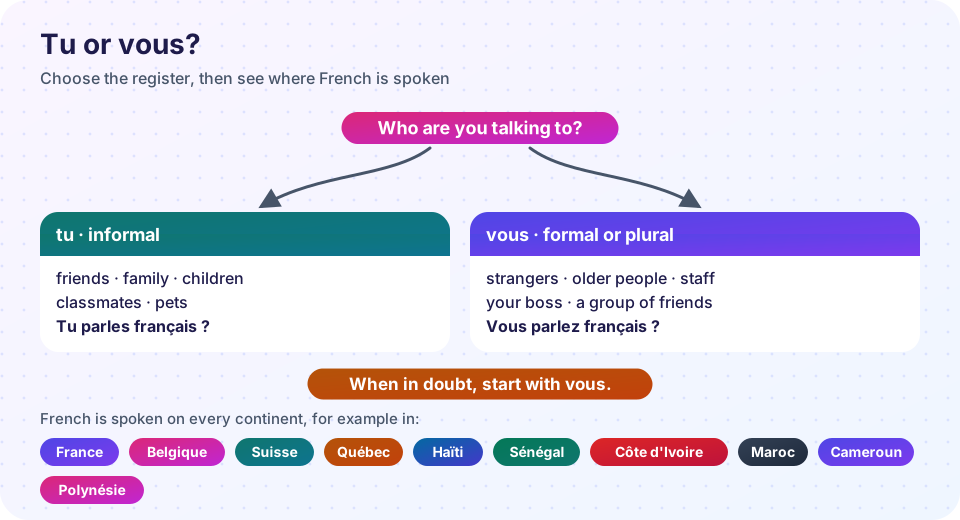
French has two words for "you" in the singular:
- tu is informal. Use it with friends, family, children, classmates, pets and people your own age in casual settings.
- vous is formal, and it is also the plural "you" for any group. Use it with strangers, older people, shop and office staff, your boss (in most workplaces) and anyone you want to show respect to.
| Situation | Choice | Example |
|---|---|---|
| A friend | tu | Tu viens ce soir ? |
| A child | tu | Tu as faim ? |
| A stranger asking for the time | vous | Vous avez l'heure, s'il vous plaît ? |
| A shop assistant | vous | Vous avez ce pull en bleu ? |
| Your teacher | vous | Vous pouvez répéter, s'il vous plaît ? |
| Several friends | vous | Vous venez ce soir ? |
When in doubt, start with vous. Being too formal rarely offends; being too casual can. French people often switch to tu by mutual agreement: someone may say On peut se tutoyer ? (Can we use tu?) or Tu peux me tutoyer. In some settings (among students, in many workplaces, in sports clubs, and often in certain regions) tu arrives quickly. Follow the other person's lead.
Titles follow the same pattern: Monsieur and Madame are the polite forms of address for adults you do not know. Mademoiselle is now old-fashioned and rarely used.
Greetings and goodbyes
| French | Meaning | When |
|---|---|---|
| Bonjour | hello, good day | until the evening, formal or neutral |
| Bonsoir | good evening | from the evening |
| Salut | hi / bye | friends only |
| Coucou | hi (very casual) | family, close friends, messages |
| Au revoir | goodbye | neutral |
| À bientôt / À demain | see you soon / tomorrow | neutral |
| À plus | see you later | casual |
| Bonne journée / Bonne soirée | have a good day / evening | at parting |
| Bonne nuit | good night | before bed |
| Enchanté(e) | nice to meet you | introductions |
In France, la bise (a kiss on each cheek, usually two, though the number varies by region and by group) is how friends and family greet each other. A handshake is the norm in formal settings and between people who meet for the first time at work. You do not kiss strangers, and you may be asked Je te fais la bise ? or simply see what the other person does. Watch and follow.
Writing: formal and informal
A formal email to a company or someone you do not know:
Bonjour Madame Martin,
Je vous écris pour demander des informations sur votre cours de français.
Pouvez-vous m'envoyer le programme, s'il vous plaît ?
Cordialement, Léa Dubois
(In English: "Hello Mrs. Martin, I'm writing to ask for information about your French course. Can you send me the program, please? Kind regards, Léa Dubois".)
An informal message to a friend:
Salut Paul ! Tu es libre samedi ? On va au cinéma ? Dis-moi ! Bises, Léa
("Hi Paul! Are you free on Saturday? Shall we go to the cinema? Let me know! Kisses, Léa".) Notice Cordialement and Bien cordialement for neutral-formal endings, and Bises, À bientôt or À plus for friends. Very formal letters use longer fixed closings, which you will learn later.
Text-message abbreviations
| Abbreviation | Meaning |
|---|---|
| slt | salut |
| cc | coucou |
| bjr / bsr | bonjour / bonsoir |
| stp / svp | s'il te plaît / s'il vous plaît |
| mdr | mort de rire (LOL) |
| jsp | je ne sais pas |
| tkt | t'inquiète (don't worry) |
| bcp | beaucoup |
| dsl | désolé |
| pk | pourquoi |
| a+ | à plus tard |
Use them only with friends and in casual messages; never in formal emails or at work unless it is normal there.
False friends
| French word | Looks like | Actually means |
|---|---|---|
| actuellement | actually | currently |
| une librairie | library | bookshop (library = une bibliothèque) |
| assister à | assist | attend |
| sensible | sensible | sensitive |
| la monnaie | money | change (coins) |
| demander | demand | ask |
| attendre | attend | wait |
| une journée | journey | a whole day |
The Francophone world
French is spoken on every inhabited continent. A rough sketch of where:
- Europe: France, Belgium (alongside Dutch and German), Switzerland (alongside German, Italian and Romansh), Luxembourg, Monaco.
- North America and the Caribbean: Canada (Québec is French-speaking; New Brunswick is officially bilingual, and French is an official language of Canada), Haiti, Martinique and Guadeloupe (French overseas departments).
- Africa: French is an official or widely used language in Senegal, Côte d'Ivoire, Cameroon, the Democratic Republic of the Congo, Madagascar, Mali, Burkina Faso and many other countries; it is widely spoken in Morocco, Algeria and Tunisia.
- Indian Ocean and Pacific: Réunion, Mauritius, the Seychelles, French Polynesia (Tahiti), New Caledonia.
Roughly 300 million people speak French in some form, and it is an official language in more than two dozen countries and in many international organizations. Many Francophones speak it as a second language alongside local languages such as Wolof, Arabic or Creole.
Regional differences that are worth knowing
| Topic | France | Elsewhere |
|---|---|---|
| 70 / 90 | soixante-dix / quatre-vingt-dix | septante / nonante (Belgium, Switzerland) |
| 80 | quatre-vingts | huitante in some Swiss cantons |
| Meals | petit-déjeuner, déjeuner, dîner | Belgium, Switzerland, Québec: déjeuner (breakfast), dîner (lunch), souper (dinner) |
| e-mail / mail | courriel (Québec) | |
| Corner shop | une supérette / une épicerie | un dépanneur ("dép") in Québec |
| Weekend | le week-end | la fin de semaine (Québec) |
| You're welcome | de rien, je vous en prie | bienvenue is also used in Québec |
The accents differ too (a Québécois accent is not a Parisian one), and everyone understands each other. As a learner, copy the French of the teacher or region that matters to you, and enjoy the differences.
Common misconceptions
"French is spoken only in France." The majority of French speakers live outside France, with Africa growing fast.
"Tu is rude." Tu is not rude; it is simply the wrong choice with a stranger or a boss. Switch when invited.
"Everyone kisses everyone." The bise is for friends and family; strangers shake hands or just say Bonjour.
"Actuellement means actually." It means "currently"; "actually" is en fait.
"Dîner always means dinner." Not in Belgium, Switzerland or Québec, where dîner is lunch and souper is dinner.
Try it
Decode these text messages. The script replaces every known abbreviation with its full form. Change the message and add your own.
Press Run (or Ctrl + Enter) to see the result here.
Program input · what you'd type while the program runs
Type the answers before you press Run, one per line. Each time the program reads a line (with input()), it gets the next line from this box.
Check your understanding
Quick check · 5 questions
of 5 answered You scored / 5 · perfect!
-
1. Which pronoun do you use with a shop assistant you do not know?
Vous is the polite form for strangers and service staff. -
2. What does 'On peut se tutoyer ?' ask?
Tutoyer means to use tu. The question asks permission to switch to the informal address. -
3. What does 'actuellement' mean?
Actuellement means currently. It is a false friend of actually. -
4. In Québec, what is 'le souper'?
In Québec, Belgium and Switzerland: déjeuner = breakfast, dîner = lunch, souper = dinner. -
5. Which closing fits a formal email?
Cordialement is the standard neutral-formal closing. Bises and À plus are for friends.
Summary
- Tu is for friends, family and children; vous for strangers, elders, staff and groups. When in doubt, use vous.
- Greet with Bonjour / Bonsoir, say Au revoir / Bonne journée, and use la bise only with friends and family.
- Formal emails end with Cordialement; friendly messages with Bises or À bientôt; abbreviations like slt, stp, bcp belong to casual texting.
- French is global: septante / nonante, souper / dîner and courriel vary by region.
Next: Chapter 8 review
Track your progress
Create a free account to tick off lessons and pick up where you left off on any device.
of French for Beginners lessons completed